
How to Identify Blue-headed Parrot Feathers
How to identify the deep blue head feathers, green body, and red undertail coverts of this South and Central American parrot.
Read the full Blue-headed Parrot encyclopedia entry →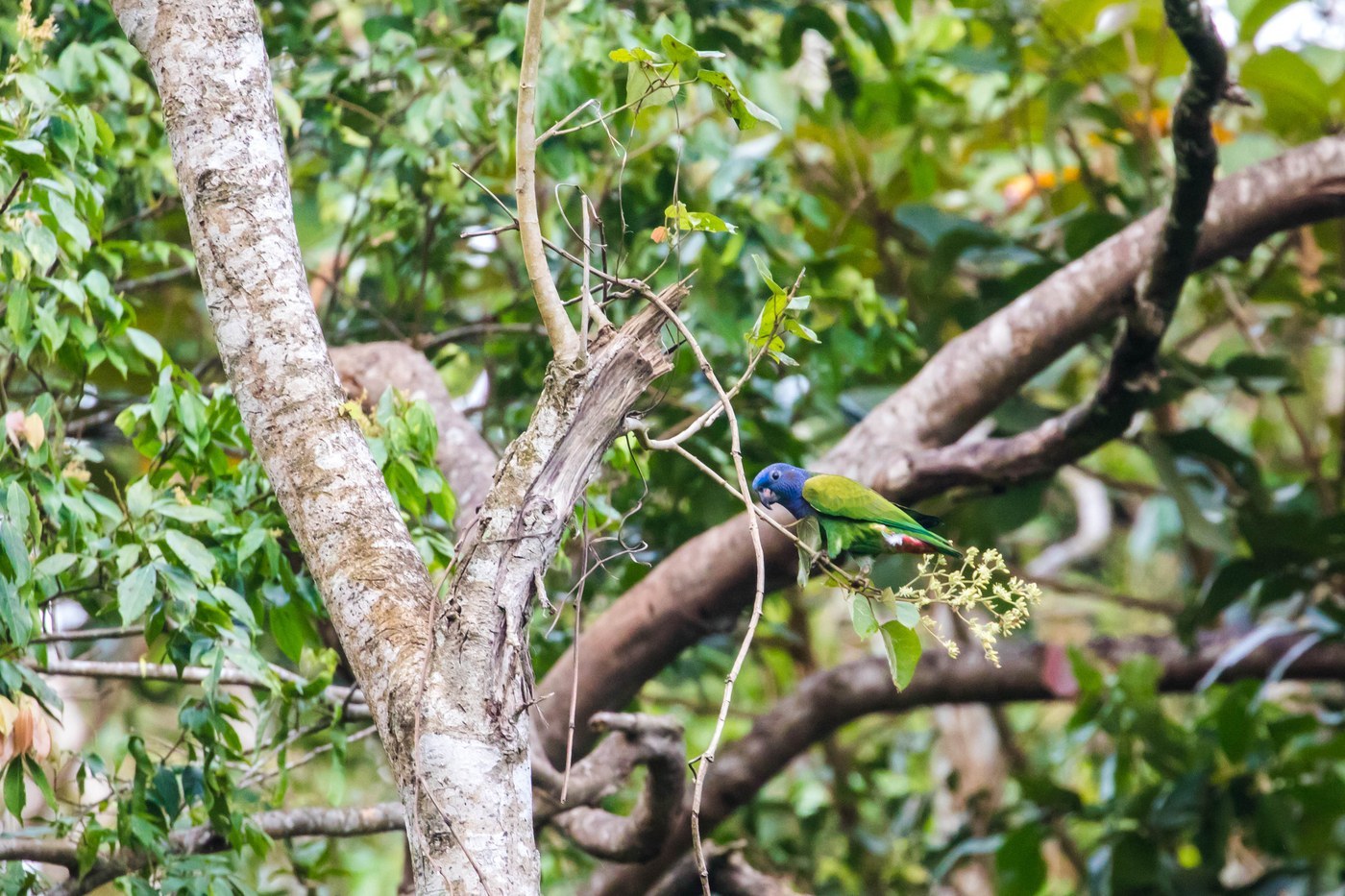
What Blue-headed Parrot's Feathers Look Like
Blue-headed Parrot carries one of the most clean-cut color patterns among Neotropical parrots. Head feathers, from forehead through crown, cheeks, and nape, are a solid, rich cobalt-to-violet blue, with no green intrusion — a full "hood" rather than a partial patch, which is the species' single best identifying feature. Body, back, and wing feathers are bright green, contrasting sharply with the blue head at the neck boundary. The other diagnostic marking is on the undertail coverts, which are red, visible as a bold red patch when tail feathers from the underside are examined — a distinctive combination found in few sympatric parrots. Flight feathers are green with a bluish tinge to the outer webs of the primaries. Tail feathers are green above, often show a bluish tip, and reveal the red covert patch at the base from below. Feather texture is typical stiff, glossy parrot plumage, with flight feathers around 12-15 cm.
Step-by-Step: Is This Feather From a Blue-headed Parrot?
- Check for a complete blue hood, not just a patch or band — the whole head/face should be blue if it's from this species.
- Look at undertail coverts for red feathers — this red patch paired with an all-blue head is highly diagnostic.
- Confirm bright green body plumage contrasting cleanly with the blue head at the neck.
- Measure feather size: mid-sized parrot feathers, smaller than an Amazon or macaw, larger than a parrotlet.
- Rule out partial blue patches — if blue is confined to just the crown or forehead, consider a different species such as Blue-crowned Conure instead.
Similar Species & How to Tell Them Apart
Blue-crowned Conure has blue restricted to the crown/nape only, with a green face — quite different from the full blue hood of Blue-headed Parrot. White-crowned Parrot shows white on the forehead and blue restricted mostly to the face/cheeks, not a complete hood, plus it's a smaller-bodied bird overall. Red-fan Parrot has a very different, streaky reddish-green head pattern with an erectile neck fan, nothing like the smooth solid blue hood here. The full blue-hooded head combined with red undertail coverts is essentially unique to Blue-headed Parrot among its regional relatives.
Where & When You'll Find Them
Blue-headed Parrot ranges widely through lowland tropical forest, forest edge, and riverine woodland from Costa Rica south through much of Amazonian South America, often traveling in noisy flocks and roosting communally in tall trees. Feathers are frequently found near fruiting trees, clay licks, and communal roost sites, since flocks gather in large numbers at these spots. As with most parrots, molt is continuous and gradual, so feathers can be found across all seasons, though feather turnover is often heightened during and shortly after the breeding season.
Frequently asked questions
What is the defining feather feature of this species?
A complete cobalt-to-violet blue hood covering the whole head — forehead, crown, cheeks, and nape — not just a partial patch.
What other color patch should I look for?
Red undertail covert feathers, visible from below the tail, which pair distinctively with the all-blue head.
How is this different from Blue-crowned Conure?
Blue-crowned Conure has blue limited to the crown and nape with a green face, while Blue-headed Parrot's blue covers the entire head.
What about White-crowned Parrot?
White-crowned Parrot shows white on the forehead and blue mainly on the face/cheeks rather than a full solid blue hood, and is smaller overall.
Where are feathers most likely found?
Near fruiting trees, clay licks, and communal roost sites in lowland tropical forest from Costa Rica through Amazonian South America.