
How to Identify Blue-winged Kookaburra Feathers
How to identify the brown head, streaked underparts, and vivid blue wing feathers of this large Australian and New Guinean kingfisher relative.
Read the full Blue-winged Kookaburra encyclopedia entry →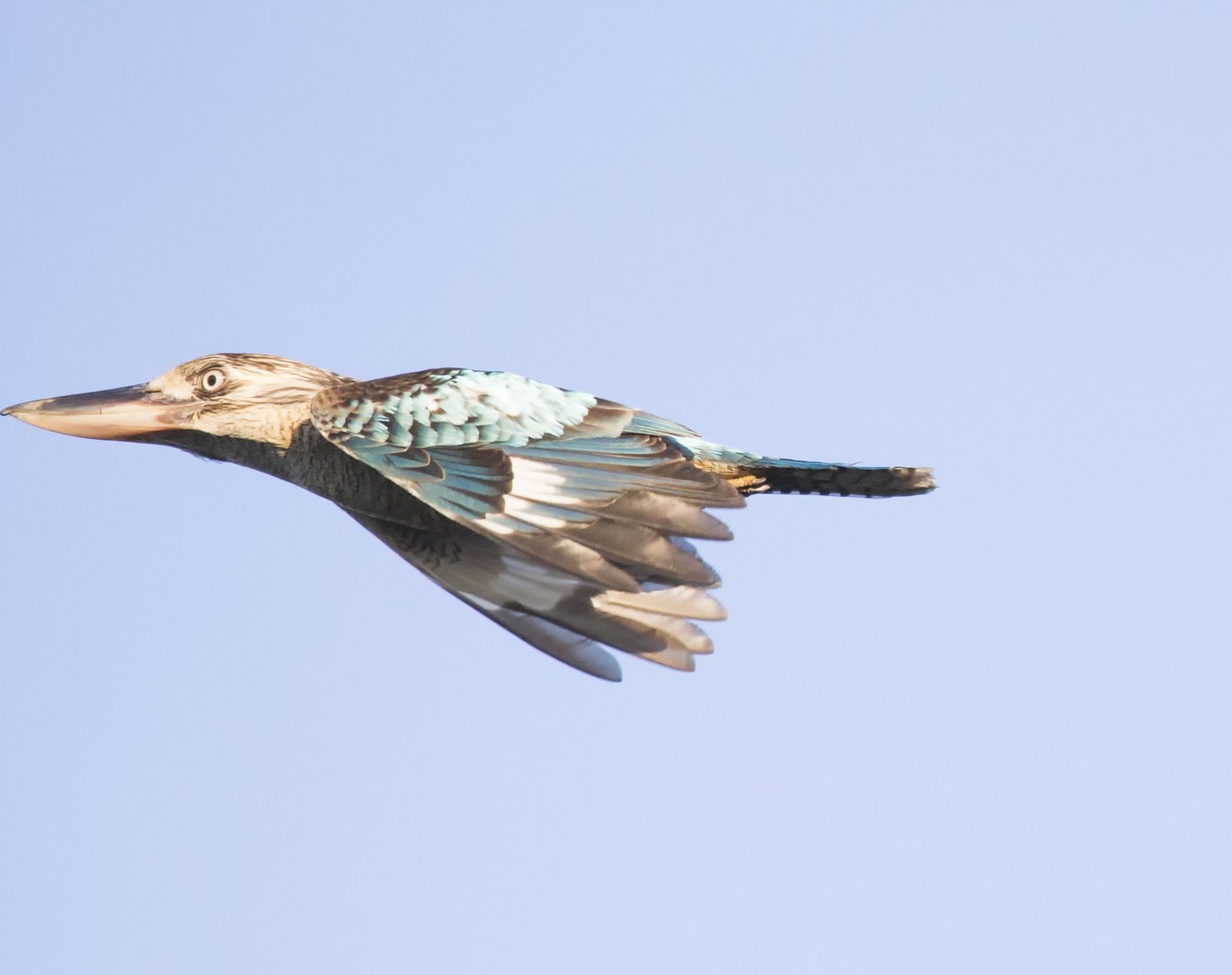
What Blue-winged Kookaburra's Feathers Look Like
Blue-winged Kookaburra is a large, heavy-billed kingfisher relative, and its feathers reflect both bulk and a striking color contrast. Head and crown feathers are plain brown, without the strong dark cap or bold facial stripe pattern of the more familiar Laughing Kookaburra. Underparts (breast, belly) feathers are whitish to buff with fine dark streaking, giving a softly streaked rather than plain appearance. The standout feathers are on the wing: primary and secondary coverts and flight feathers are a vivid, deep blue, sharply contrasting with the plain brown body — this saturated blue wing panel is the species' defining feature and gives the bird its name. The back is brown, and the tail is barred rufous and blackish-brown, moderately long and broad. A key sex-linked clue: males typically have a more vivid, deep blue rump and wing patch, while females often show a duller, more restricted blue area, sometimes with a rufous-tinged rump instead — useful if you can compare multiple feathers from the same bird.
Step-by-Step: Is This Feather From a Blue-winged Kookaburra?
- Look for a vivid blue wing feather contrasting with plain brown body feathers — this is the single most useful clue for the species.
- Check underparts for fine dark streaking on a whitish-buff background, rather than a plain white or heavily barred belly.
- Confirm head feathers are plain brown, lacking a bold dark cap or facial mask pattern.
- Measure size and bill-adjacent feather thickness: this is a large, heavy-bodied kingfisher relative, so feathers are substantial, not delicate.
- Note tail pattern: rufous-and-blackish barring on a moderately long, broad tail feather supports this species.
Similar Species & How to Tell Them Apart
Laughing Kookaburra, the more widely known relative, has a bold dark brown eye-stripe/cap and much less blue in the wing (often confined to a smaller patch), plus a whiter, less streaked breast. Spangled Kookaburra, found in New Guinea, is similar but the two largely replace each other geographically and Spangled shows finer white spangling on the crown. The combination of streaked (not plain white) underparts, a plain brown head without a bold dark cap, and an extensive vivid blue wing panel favors Blue-winged Kookaburra over Laughing Kookaburra specifically.
Where & When You'll Find Them
Blue-winged Kookaburra inhabits open woodland, savanna, and forest edge across northern Australia and lowland New Guinea, often near water and in more open, drier habitat than some of its forest-dwelling relatives. Feathers are commonly found near favored perches used for hunting (kookaburras watch from exposed branches for insects, reptiles, and small vertebrates) and around nest holes in tree hollows or termite mounds. Molt generally follows the breeding season, so feathers are more likely to be found in the months after nesting, though the species' habit of using consistent perch sites means feathers can accumulate there across multiple seasons.
Frequently asked questions
What is the most distinctive feather feature of this species?
A vivid, deep blue wing panel across the primary and secondary coverts, sharply contrasting with the plain brown body — the source of the bird's name.
How is this different from a Laughing Kookaburra feather?
Laughing Kookaburra has a bold dark eye-stripe/cap, less extensive blue in the wing, and a whiter, less streaked breast, whereas Blue-winged Kookaburra has a plain brown head and streaked underparts.
Does the blue wing patch differ between males and females?
Yes, males typically show a more vivid, extensive blue wing and rump, while females often have a duller or more restricted blue area, sometimes with rufous tinging on the rump.
What does the underparts pattern look like?
Whitish to buff with fine dark streaking, rather than plain white or heavily barred.
Where should I look for shed feathers?
Near favored hunting perches and nest holes in tree hollows or termite mounds in open woodland and savanna across northern Australia and lowland New Guinea.