
How to Identify Common Kingfisher Feathers
A guide to recognizing the brilliant iridescent blue-green back feathers and chestnut-orange underparts of this small riverine kingfisher.
Read the full Common Kingfisher encyclopedia entry →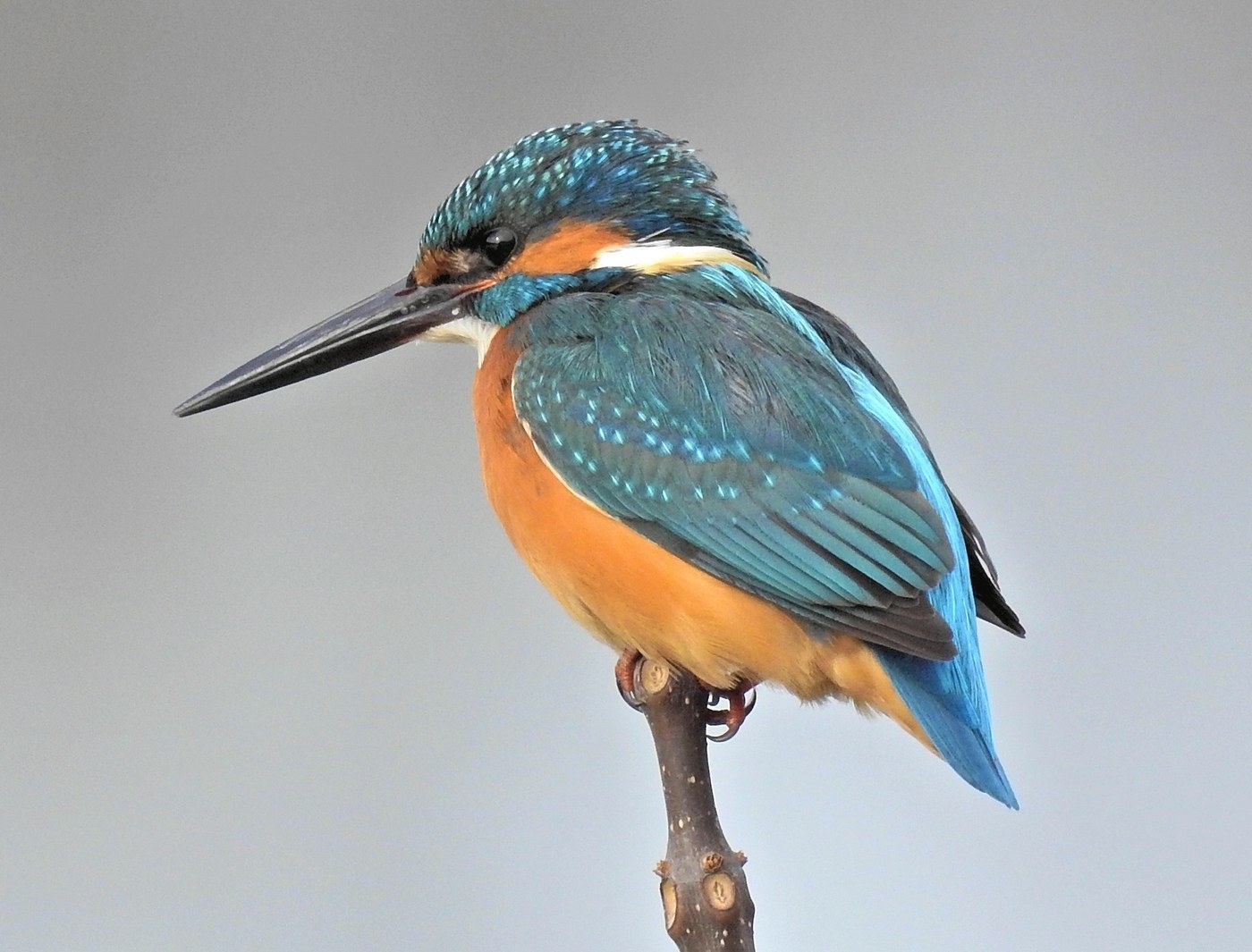
What Common Kingfisher's Feathers Look Like
The Common Kingfisher is a small, jewel-like bird of rivers, streams, and ponds across Europe, Asia, and North Africa, and its feathers are among the most visually striking of any common songbird-sized species. Back and crown feathers show a brilliant iridescent blue to blue-green sheen, which can shift toward turquoise, cobalt, or even greenish depending on the light angle — this color is structural, produced by microscopic layers in the feather barbs rather than pigment, so the same feather can look startlingly different in shade versus direct sun. Underparts, by contrast, are a warm, solid chestnut-orange, with no iridescence, giving a strong two-tone contrast between upperparts and underparts on any body feather that includes both zones.
A small white or pale orange patch is present on the neck side, and the throat is white, so a feather from this specific area will look plain rather than iridescent. Flight feathers are shorter and more rounded than in many songbirds, dark blue-black above, reflecting this species' whirring, direct flight low over water. Given the bird's tiny size, all feathers are quite small — flight feathers rarely exceed 5–6 cm — and have a dense, glossy, almost enamel-like texture unlike the softer feathers of similarly sized perching birds.
Step-by-Step: Is This Feather From a Common Kingfisher?
- Tilt it in bright light. A genuine, vivid blue-to-turquoise iridescent shift, rather than flat blue pigment, is the strongest single clue for this species.
- Check for chestnut-orange underparts. A small feather that is a solid, warm orange-chestnut with no iridescence likely comes from the underparts, and paired with a blue back feather makes identification very likely.
- Measure it. Feathers are tiny, generally under 6 cm even for flight feathers, reflecting this species' small size (roughly sparrow-sized body, disproportionately large bill).
- Look for white/pale patches. A small plain white or pale orange feather may be from the throat or neck-side patch.
- Feel the texture. A dense, glossy, almost stiff feel — closer to enamel than typical soft songbird down — fits kingfisher plumage.
- Consider the setting. A feather found along a riverbank, stream, pond edge, or canal, especially near a perch or nesting burrow in a earthen bank, strongly supports Common Kingfisher.
Similar Species & How to Tell Them Apart
Other small Old World kingfishers, such as the Blue-eared Kingfisher in parts of Asia, are extremely similar in color and can be very difficult to separate by feather alone; Blue-eared Kingfisher tends to show a slightly darker, more purplish-blue back rather than the Common Kingfisher's brighter turquoise-blue, and ear patches differ (a head feature, not usually preserved on a loose feather). Larger kingfishers like the Pied Kingfisher, which shares much of the range, are entirely black-and-white with no blue or orange at all, easily ruled out. White-throated Kingfisher, also often found nearby, is much larger with a brown head, white throat/breast, and turquoise confined mainly to the back and wings rather than the more uniformly iridescent upperparts of Common Kingfisher.
Where & When You'll Find Them
Common Kingfishers are found along slow-moving rivers, streams, ponds, and canals across a huge range spanning Europe, North Africa, and much of Asia, perching low over water to hunt small fish and aquatic invertebrates. Most populations are resident or make only short local movements in response to freezing water, though northern populations may move south in hard winters. Feathers are most likely to be found near favored fishing perches along banks and near nesting burrows dug into earthen riverbanks, with molt occurring mainly in late summer after the breeding season, making this the most productive time to find dropped feathers near waterways.
Frequently asked questions
Why does the same feather look different shades of blue depending on the light?
Common Kingfisher's back color is structural iridescence created by microscopic feather layers, not pigment, so the exact shade of blue-turquoise shifts noticeably depending on the angle and intensity of light hitting it.
What's the best pairing of clues to confirm this species?
A vividly iridescent blue-green feather paired with a plain warm chestnut-orange feather from the same area is a strong combination, since few similarly small riverine birds show both tones this vividly.
How small should I expect the feathers to be?
Very small — flight feathers rarely exceed 5–6 cm, reflecting this species' small overall body size despite its relatively large bill.
Could this be a Blue-eared Kingfisher feather instead?
Possibly, if you're in parts of Asia where ranges overlap; Blue-eared Kingfisher tends to show a slightly darker, more purplish-blue back, though feather-only separation can be difficult.
When are Common Kingfisher feathers most likely to be found?
Late summer near riverbanks, streams, and nesting burrows, corresponding with the post-breeding molt period, though feathers can turn up near favored fishing perches at other times too.
Common Kingfisher identified by the community
Recent Common Kingfisher feathers identified with Feather Identifier.


