
How to Identify Common Peafowl Spalding Feathers
A guide to identifying the intermediate iridescent feathers of Spalding hybrid peafowl, distinguishing them from pure Indian Blue and Green Peafowl plumage.
Read the full Common Peafowl Spalding encyclopedia entry →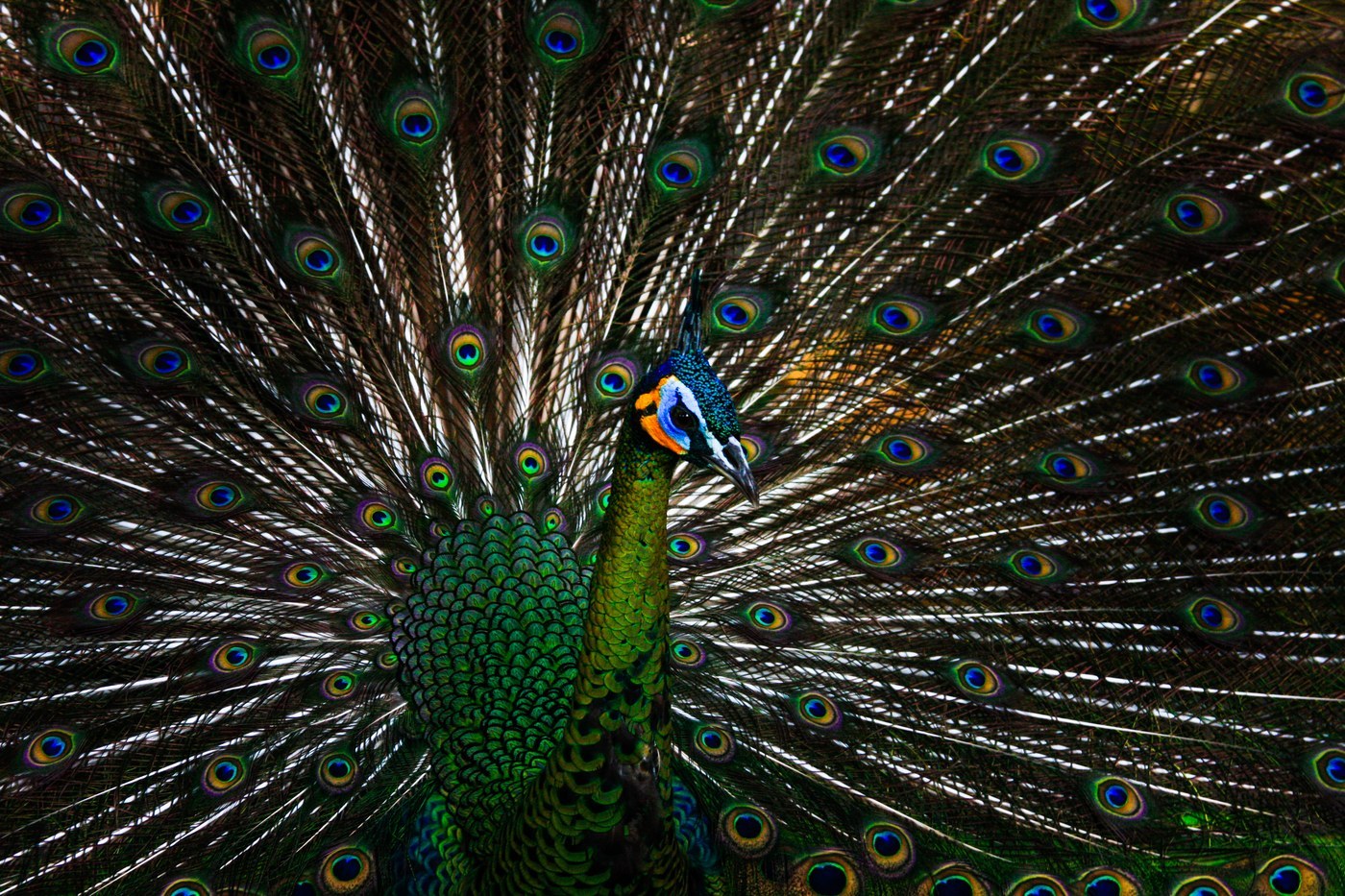
What Common Peafowl Spalding Feathers Look Like
"Spalding" peafowl are hybrids between the Indian Blue Peafowl and the Green Peafowl, and their feathers show a genuinely intermediate mix of traits rather than matching either parent species cleanly. The neck and breast contour feathers typically carry more green-bronze iridescence than a pure Indian Blue (whose neck is a more uniform solid cobalt-blue), while still not showing the fully scaled, metallic bronze-green body pattern of a pure Green Peafowl — Spalding neck feathers often look like a blended wash of blue and green sheen depending on the angle of light, rather than one pure color.
The male's famous train feathers (the elongated upper tail coverts, not the true tail) show ocelli — the iridescent eye-spot markings — that in Spalding birds are frequently more elongated or pointed at the tip than the rounder ocelli typical of pure Indian Blue Peafowl, echoing the Green Peafowl influence, while the overall train length and density often falls between the two parent species. Body/back feathers show a mix of scaled patterning: more defined scaling than a pure Indian Blue but less uniformly metallic than a pure Green Peafowl. Females (peahens) of Spalding lineage are typically mottled brown-grey but can show a subtle green cast to the neck feathers not seen in pure Indian Blue hens.
Step-by-Step: Is This Feather From a Spalding Peafowl?
- Check neck feather color. A blended blue-green iridescent sheen (rather than pure solid cobalt-blue or fully scaled bronze-green) suggests hybrid ancestry.
- Examine train feather ocelli shape. Ocelli that are more pointed/elongated than perfectly round, combined with body feathers that aren't fully scaled, fit a Spalding intermediate.
- Assess overall iridescence intensity. A greener cast than expected for Indian Blue but less saturated metallic bronze than Green Peafowl supports a hybrid.
- Check crest feathers. Look at head crest feather shape and density as an additional intermediate clue, since pure Green Peafowl has a more upright, fan-like crest than Indian Blue's tuft.
- Consider the source. Feathers found around ornamental aviaries, estates, or farms where mixed peafowl are kept are the most likely context for Spalding birds, since they are a captive-bred hybrid, not a wild population.
Similar Species & How to Tell Them Apart
Indian Blue Peafowl has a uniform, saturated solid cobalt-blue neck and breast with no green wash, and train feather ocelli that are more evenly round rather than pointed. Green Peafowl shows a fully scaled, metallic bronze-green pattern across the entire body (not just the neck), a taller and more upright crest, and notably longer legs relative to body size, with train ocelli that are more elongated and pointed than Indian Blue's. White Peafowl (a leucistic form, sometimes also crossed into Spalding lines) shows plain white feathers lacking iridescent color pattern altogether, making it easy to rule out if any color or ocelli pattern is present.
Where & When You'll Find Them
Spalding peafowl exist almost exclusively as an ornamental, captive-bred variety, kept in aviaries, on estates, and at parks and farms worldwide rather than occurring as a wild population — so context (an enclosure, garden, or farm setting) is often your best first clue. Like other peafowl, males molt their spectacular train feathers annually after the breeding display season, typically in late summer, dropping them near roosting and display sites, which is the most productive time and place to find intact train feathers with visible ocelli.
Frequently asked questions
What makes a peafowl feather a "Spalding" rather than a pure Indian Blue?
Spalding peafowl are hybrids of Indian Blue and Green Peafowl, so their feathers show a blended look — more green iridescence in the neck and more pointed train ocelli than a pure Indian Blue, without reaching the fully scaled bronze-green body of a pure Green Peafowl.
Are Spalding peafowl found in the wild?
No, Spalding peafowl are an ornamental hybrid maintained through captive breeding, so feathers are typically found around aviaries, estates, farms, or parks rather than wild habitat.
How can I tell a Spalding train feather from a pure Green Peafowl train feather?
Green Peafowl train feathers show fully scaled, metallic bronze-green patterning and more strongly pointed ocelli, while Spalding feathers are intermediate, with less uniform scaling across the body.
When do peacocks shed their long train feathers?
Male peafowl, including Spalding hybrids, molt their ornamental train feathers annually in late summer after the breeding display season ends.
Do Spalding peahens look different from Indian Blue peahens?
Both are mottled brown-grey overall, but Spalding peahens can show a subtle green cast in the neck feathers that pure Indian Blue peahens typically lack.