
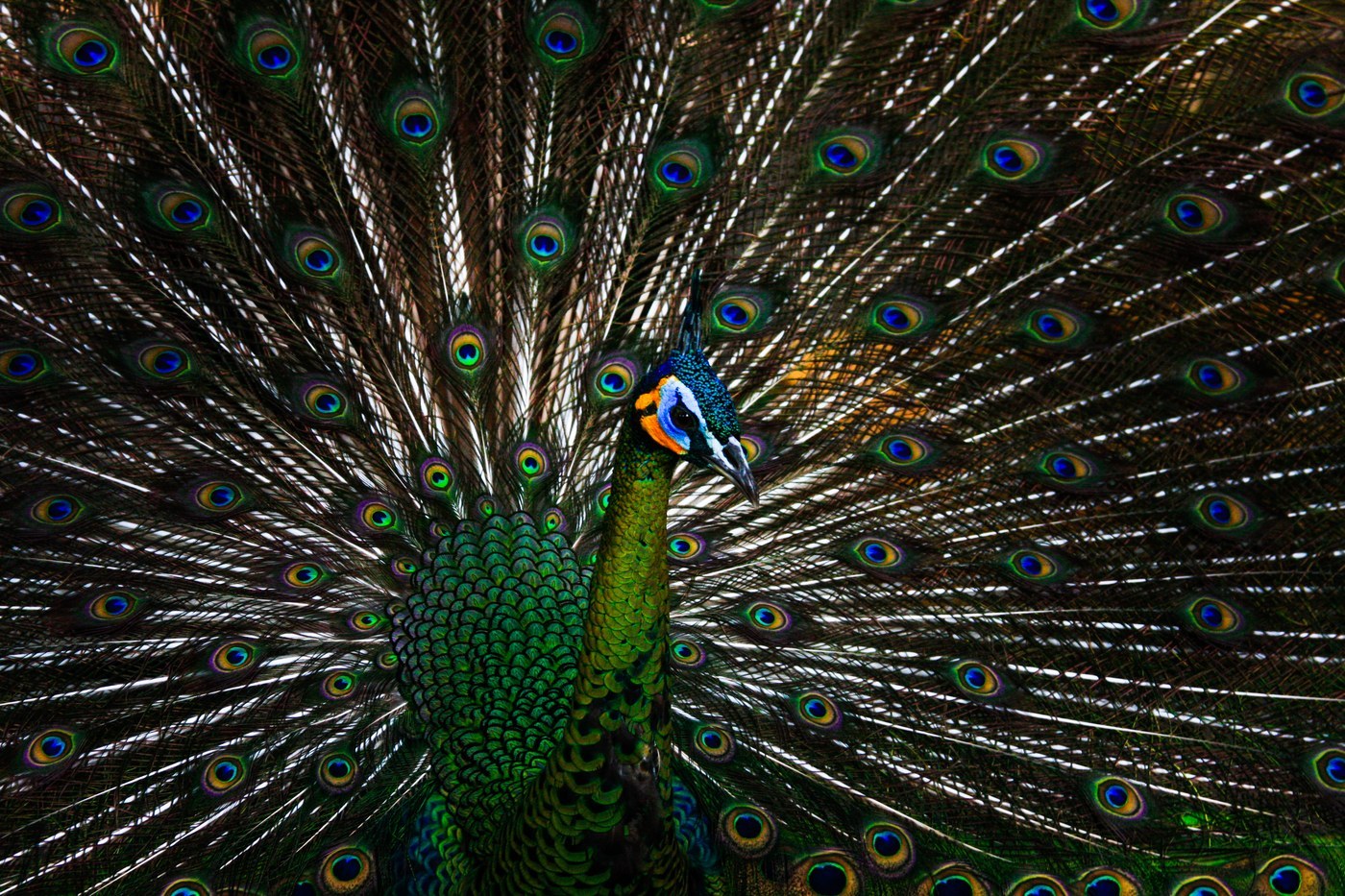
Common Peafowl Spalding
Pavo muticus
An aviculture strain blending Green and Indian Peafowl ancestry, showing iridescent scaled neck feathers, a tall crest, and a long ornamental train that draws on the coloring of both parent lines.
- Feather type
- Contour, scaled neck, and elongated train feathers
- Colours
- Iridescent green and blue with bronze and gold scaling
- Bird size
- Large gamebird, ~180-300 cm total length including train
Found a feather like this?
Identify any feather from a photo, free.
Overview
Overview
Often called a Spalding-type peafowl by breeders, this variety results from crossing Green Peafowl and Indian Peafowl lines, combining traits of both parent species. The Green Peafowl itself is native to open grassland and forest-edge habitat across Southeast Asia, while hybrid strains are maintained mainly in captivity for their striking, blended plumage.
Birds of this type typically show the scaled, iridescent neck feathering associated with Green Peafowl ancestry alongside a build and crest shape influenced by Indian Peafowl lines, resulting in a distinctive combination of coloring and posture.
Identifying the Feather
Feather Identification
- Neck feathers: scaled, iridescent green-bronze feathers overlapping like fish scales, a hallmark of Green Peafowl ancestry
- Crest: tends toward an upright, fan-shaped tuft, differing from the simple wire-tipped crest of pure Indian Peafowl
- Body feathers: iridescent green and blue sheen across the back and wings, with bronze-gold highlights
- Train feathers: long, upright-growing, adorned with eyespot ocelli along their length, fanned into a wide arc during display
- Wing coverts: often show a mix of barred and iridescent patterning reflecting both parent lines
- The scaled iridescent neck combined with a taller, more upright train growth pattern helps distinguish this hybrid type from a pure Indian Peafowl, whose neck feathers are smoother and more uniformly blue
Plumage & Molt
Plumage Details
Males show a blended plumage of iridescent green-bronze scaled neck feathering, a blue-green body sheen, and a long ocellated train that stands more upright than in pure Indian Peafowl before fanning outward in display. Females are duller, with reduced iridescence and a shorter tail, showing traits from both parent lines depending on the individual bird's ancestry.
Juveniles are cryptically colored and gradually develop adult coloring and train length over several years, with males reaching full train development only after multiple molt cycles. The annual molt renews train and body feathers, which can vary somewhat in exact color balance between individual birds due to mixed ancestry.
Habitat & Range
Habitat & Range
This hybrid type is maintained mainly in aviaries, parks, and private collections. The Green Peafowl side of its ancestry originates from open grassland, forest edge, and riverine habitat across Southeast Asia, a range now considerably reduced and fragmented due to habitat loss, while Indian Peafowl ancestry traces to the South Asian subcontinent. Captive birds are non-migratory and kept in enclosed or semi-free-range settings.
Behavior & Field Notes
Behavior & Field Notes
Birds of this type display similarly to other peafowl, with males fanning the train and performing wing-shaking courtship displays to attract females. Diet in captivity typically includes grain, greens, and small invertebrates, mirroring the omnivorous foraging habits of wild peafowl.
Nests are shallow ground scrapes lined with vegetation. The voice includes loud, far-carrying calls, often intermediate in tone between the calls of the two parent species. In the field or aviary setting, the scaled iridescent neck feathering is the most reliable clue to this bird's mixed ancestry.
Frequently asked questions
What does 'Spalding' refer to in this peafowl's naming?
It refers to a hybrid lineage between Green Peafowl and Indian Peafowl developed and perpetuated in aviculture, known for its blended plumage traits.
How can you identify the neck feathers of this type?
Look for scaled, iridescent green-bronze feathering overlapping like fish scales, a trait inherited from Green Peafowl ancestry.
Does the crest look different from a pure Indian Peafowl?
Yes, it often appears more upright and fan-shaped rather than the simple wire-tipped crest typical of pure Indian Peafowl.
Where does this type live?
It is maintained primarily in captivity, in aviaries, parks, and private collections rather than a specific wild range.
Common Peafowl Spalding guides
In-depth guides for identifying and understanding Common Peafowl Spalding.
Other feathers you may enjoy

Ring-necked Pheasant
Body (contour), tail, and wing feathers

Bornean Peacock-pheasant
Contour and tail feathers with iridescent ocelli

Crested Argus
Extremely elongated, ocellated (eyespot-patterned) tail feathers among the longest of any bird; tall, erectile crest

Grey Partridge
Body and flank feathers

Willow Ptarmigan
Larger, stockier body feathers with warmer rufous tones in summer; tail feathers black year-round

Wild Turkey
Broad, iridescent body feathers and large flight and tail feathers

Bulwer's Pheasant
Contour feathers and elongated white tail feathers
Red-legged Partridge
Flank, body, and flight feathers

White-tailed Ptarmigan
Small body feathers with a tail that stays pure white year-round, unlike other ptarmigan

Edwards's Pheasant
Contour and tail feathers

Sooty Grouse
Dense, plain contour feathers with a pale-tipped, fanned tail

Snow Partridge
Finely vermiculated barred contour feathers