
How to Identify Common Rosefinch Feathers
A guide to identifying the plain olive-brown feathers of most Common Rosefinches (and the rare bright pink-red adult male), with comparisons to female House Finch and redpoll.
Read the full Common Rosefinch encyclopedia entry →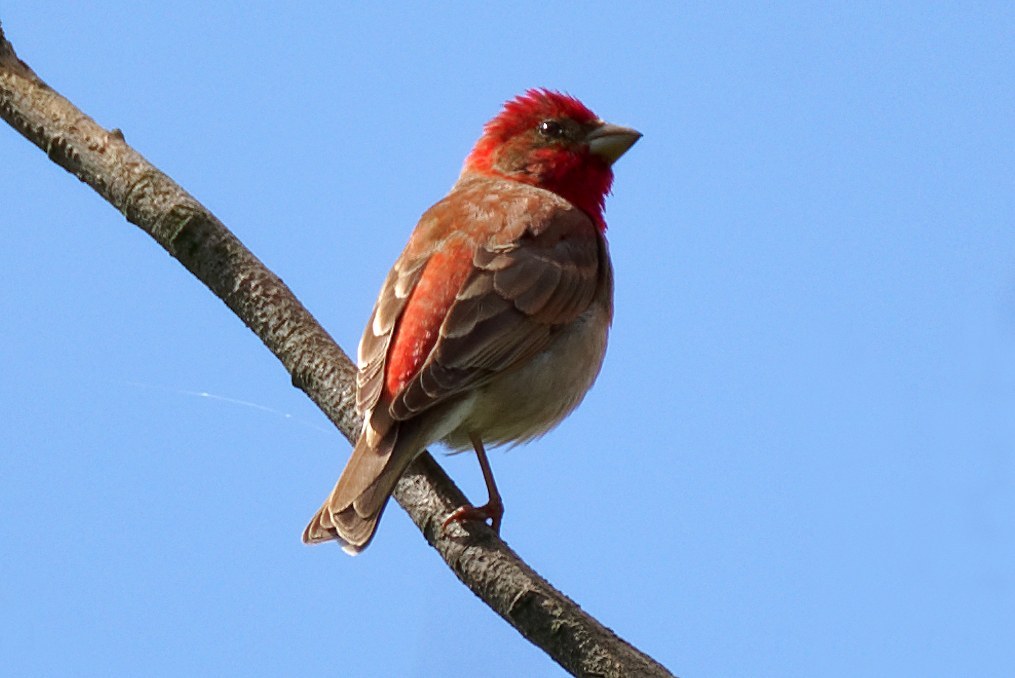
What Common Rosefinch Feathers Look Like
The Common Rosefinch is a stocky finch with a deceptively simple identification challenge: the species takes about two years to acquire full adult male coloring, so the great majority of individuals you'll encounter — females and young males alike — show a plain, unstreaked-to-lightly-streaked olive-brown plumage rather than the vivid color the name suggests. On these more common female-type birds, body feathers are olive-brown above and buffy below with soft streaking, and the bill-associated feathering looks stubby and deep, matching the species' thick, rounded conical bill.
Fully adult males show a strikingly different plumage: crown, throat, and breast feathers are a bright carmine-pink to rose-red, with brown, unmarked wings, making an adult male feather instantly distinctive if you're lucky enough to find one. Both sexes and ages show two pale, buffy wingbars on the covert feathers, a useful supporting clue even on dull female-type birds. The undertail covert feathers are unstreaked, plain buff or whitish, which is a key detail separating this species from some similar finches.
Step-by-Step: Is This Feather From a Common Rosefinch?
- Check for bright pink-red first. A carmine or rose-red crown, throat, or breast feather with unmarked brown wings is a straightforward adult male Common Rosefinch indicator.
- If dull, check the undertail. Plain, unstreaked buff or whitish undertail covert feathers support rosefinch and help rule out streak-vented look-alikes.
- Look for two wingbars. Pale buffy wingbars on the covert feathers are present across ages and sexes.
- Assess bill-related feathering. A deep, stubby, rounded feather profile near where the bill meets the face fits this species' thick conical bill.
- Rule out a red cap or black chin. Neither feature belongs to Rosefinch; their presence points to Common Redpoll instead.
- Consider the habitat. Feathers found in scrub, wet meadows, or riverside thickets, especially in areas of the species' expanding western range, fit Common Rosefinch.
Similar Species & How to Tell Them Apart
Most Common Rosefinches encountered will be in the dull female-type plumage, which is most easily confused with female House Finch or Purple Finch: the key difference is the undertail covert feathers, which are plain and unstreaked in Common Rosefinch but streaked in House Finch and Purple Finch. Common Redpoll is a different genus entirely but can superficially resemble a dull rosefinch at a glance — however, redpoll shows a distinct red cap on the forecrown and a black chin patch, both entirely absent in rosefinch, whose face is comparatively plain. Adult male Rosefinch is distinctive enough that confusion is unlikely, though very worn or faded feathers could conceivably be mistaken for other reddish finches without checking the wing (unmarked brown, no black-and-white pattern).
Where & When You'll Find Them
Common Rosefinches breed in scrub, wet meadows, riverside thickets, and forest edges across a range that spans Europe (where it has been gradually expanding westward) through much of temperate Asia. They are long-distance migrants, wintering mainly in India and Southeast Asia. The post-breeding molt occurs before autumn departure, so feathers — predominantly the duller female-type plumage given how few individuals reach full adult male coloring — are most likely to be found near breeding scrub and wetland edges in late summer, just ahead of migration.
Frequently asked questions
Why did I expect a bright pink feather but found a plain brown one instead?
Most Common Rosefinches you'll encounter are females or young males, since the species takes about two years to acquire full adult male coloring — plain olive-brown is actually the more common plumage, not an exception.
What's the best clue to separate a dull Common Rosefinch feather from a female House Finch feather?
Check the undertail covert feathers. Common Rosefinch has plain, unstreaked undertail coverts, while House Finch and Purple Finch show streaking there.
How do I know a plain brown feather isn't from a Common Redpoll instead?
Look for a red cap on the forecrown and a black chin patch — both are Common Redpoll traits that Common Rosefinch entirely lacks, which stays comparatively plain-faced.
Is an adult male Common Rosefinch feather hard to identify?
No, it's the most distinctive plumage in the species — a bright carmine-pink to rose-red crown, throat, or breast feather paired with unmarked brown wings is fairly unmistakable.
When are Common Rosefinch feathers most likely to be found?
Late summer, during the post-breeding molt that occurs before the species' long migration to wintering grounds in India and Southeast Asia.