
How to Identify Costa's Hummingbird Feathers
How to identify the tiny violet-gorget feathers of the male Costa's Hummingbird and the plain green-and-white feathers of females, with tips for separating them from Anna's and Black-chinned Hummingbirds.
Read the full Costa's Hummingbird encyclopedia entry →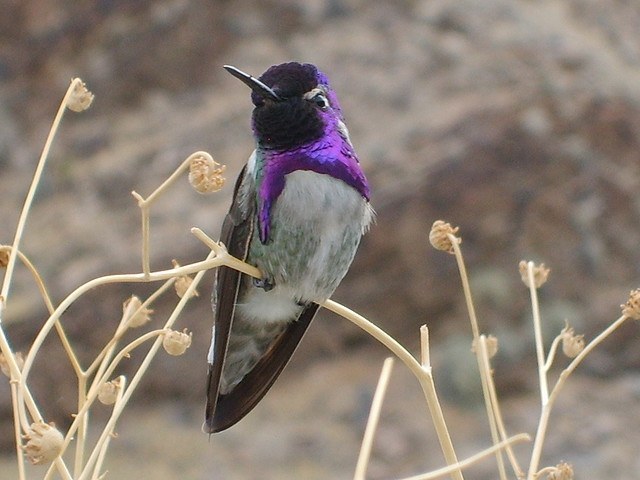
What Costa's Hummingbird Feathers Look Like
Costa's Hummingbird is one of the smallest hummingbirds in North America, so any feather you find will be tiny — often just a few millimeters long. The male's signature feature is his brilliant violet-purple gorget, which covers the throat and extends into elongated, pointed feather flares that sweep out to the sides like a mustache. These gorget feathers are flattened and structurally colored, meaning the same feather can look glowing violet in direct light and nearly black in shade or from a different angle — a classic hummingbird iridescence effect.
The crown is also violet-purple in adult males, blending into a green back and mostly white underparts with greenish flanks. Females and immatures lack any gorget color entirely — their throats are plain whitish, sometimes with faint dusky speckling, and their upperparts are a plain iridescent green. Tail feathers are short; in females they show small white tips, while males have shorter, less patterned dark bronze-green central feathers.
Step-by-Step: Is This Feather From a Costa's Hummingbird?
- Check size first — anything longer than about 3-4 cm is too large; hummingbird feathers, especially this species, are extremely small.
- Tilt a throat feather in the light — if it flashes violet-purple and looks black when not catching light, that supports a male Costa's Hummingbird.
- Look for elongated, pointed side flares on gorget feathers, a shape distinctive to this species' extended mustache-like gorget.
- Confirm green upperparts with a plain (not violet) crown on a body feather to help sex or rule out the male.
- Check tail feathers for small white tips, more typical of females.
- Factor habitat — arid desert scrub in the southwestern U.S. or Mexico supports this ID over other hummingbirds.
Similar Species & How to Tell Them Apart
Anna's Hummingbird males have a gorget that is rose-red to magenta, not violet-purple, and the color also covers the crown in a rounder, less flared shape without the pointed side extensions seen in Costa's. Black-chinned Hummingbird males show a black chin with only a narrow band of violet at the very base of the throat, rather than an extensive violet gorget covering the whole throat and flaring outward — so a feather that is entirely black with just a thin violet edge points to Black-chinned rather than Costa's. Female hummingbirds of these species are much harder to separate by feather alone, since all show similar green-and-white patterns, making habitat and range the more useful clue in that case.
Where & When You'll Find Them
Costa's Hummingbirds live in arid desert scrub, chaparral, and dry washes across the southwestern United States (California, Arizona, Nevada) and northwestern Mexico, with some populations making short seasonal movements tied to flowering cycles rather than long-distance migration. Feathers are most likely to be found near desert flowering shrubs, ocotillo, or agave during the breeding season in late winter and spring, when males display extensively and territorial encounters can dislodge feathers, as well as near nest sites through early summer.
Frequently asked questions
How small are Costa's Hummingbird feathers?
Extremely small — often just a few millimeters, since Costa's is among the tiniest hummingbirds in North America. Any feather several centimeters long is too large to be this species.
How do I tell a Costa's Hummingbird gorget feather from an Anna's Hummingbird gorget feather?
Costa's gorget is violet-purple with elongated pointed side flares, while Anna's is rose-red to magenta and rounder without the mustache-like extensions.
Why does a hummingbird throat feather change color when I move it?
Gorget feathers are structurally colored rather than pigmented, so they only flash their bright color when light hits them at the right angle, appearing dark or black otherwise.
Can I tell male and female Costa's Hummingbird feathers apart easily?
Males are easy to spot from their violet gorget and crown feathers; females lack any throat color and look like plain green-and-white hummingbird feathers, which are harder to pin to species with certainty.