
How to Identify Eastern Rosella Feathers
A guide to the vividly multicolored red, yellow, blue, and black feathers of the Eastern Rosella, a strikingly patterned Australian parrot.
Read the full Eastern Rosella encyclopedia entry →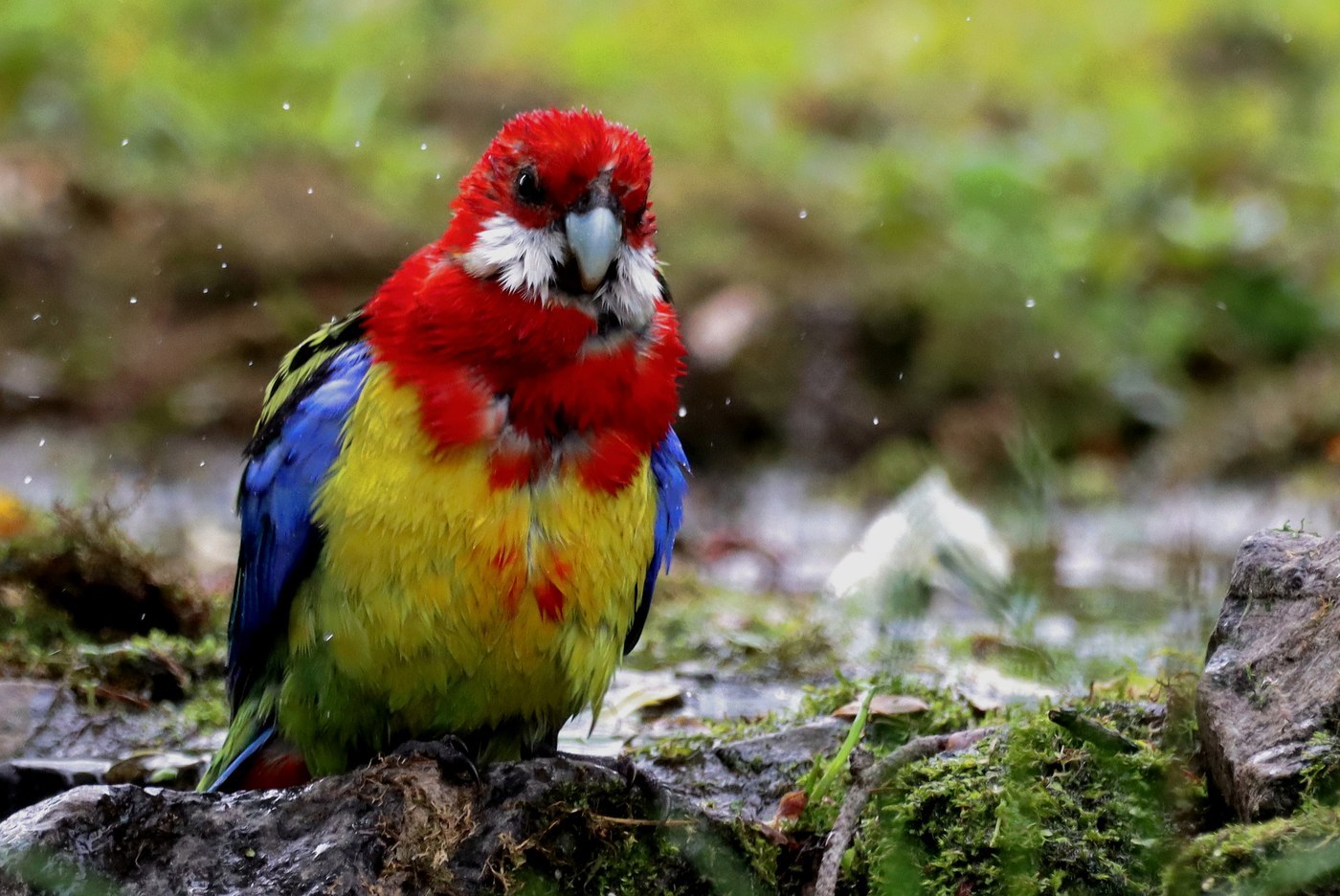
What Eastern Rosella's Feathers Look Like
Eastern Rosella feathers are among the most colorful and easily zoned of any common parrot, with different body regions showing sharply distinct colors. Head, throat, and upper breast feathers are a vivid scarlet red, while a bold white-to-pale-blue cheek patch sits just below and behind the eye, standing out clearly against the red. Back and scapular feathers show a striking scalloped pattern: each feather is black-centered with bright yellow-green edging, creating a scaled, almost tiled look across the back distinct from the solid colors elsewhere on the body. The lower breast and belly transition to bright yellow, and the rump is a clean pale green. Wing feathers show patches of deep blue on the coverts and flight feathers, adding yet another color zone. The tail is long, graduated, and blue-green with darker blue central feathers — typical of the broad-tailed parrot group Rosellas belong to. Overall feather size fits a medium parrot, and the sheer number of distinct color zones on a single bird makes even a single feather often identifiable to general region of origin.
Step-by-Step: Is This Feather From an Eastern Rosella?
- Sort by color zone first. Scarlet red, black-and-yellow scalloped, clean yellow, pale green, deep blue, or white/pale-blue cheek — each points to a specific body region on this species.
- Look for the black-centered, yellow-green-edged scalloped pattern specifically on back/scapular feathers — this tiled look is fairly distinctive among parrots.
- Check for a white or pale blue cheek-patch feather, a strong regional marker unique to the rosella group.
- Confirm the tail is long and graduated with blue-green coloring rather than short and squared.
- Rule out solid, single-color body feathers without zonation, since true Rosella feathers rarely show a blended or muddy color.
- Weigh the Australian context, since this species is native only to southeastern Australia (with introduced populations e lsewhere like New Zealand).
Similar Species & How to Tell Them Apart
The Crimson Rosella, a close relative with overlapping range in parts of southeastern Australia, is more uniformly deep crimson-red over the head, breast, and back rather than showing the sharp red-vs-yellow-green scalloped back pattern of Eastern Rosella — its back feathers are black-centered but edged in deep red or purple-blue rather than yellow-green. Pale-headed Rosella, found further north, has a pale yellowish-white head rather than red, immediately ruling it out if a feather shows scarlet head coloring. Rainbow Lorikeet, while also vividly multicolored, shows a much more blended, gradient-like transition between colors (blue head fading into green) rather than the sharply zoned, almost blocky color pattern of a Rosella. The sharply divided color zones — especially the yellow-green scalloped back next to solid scarlet head feathers — are the most useful clue for pinning down Eastern Rosella specifically.
Where & When You'll Find Them
Eastern Rosellas are native to southeastern Australia, including Victoria, New South Wales, and Tasmania, favoring open woodland, farmland with scattered trees, parks, and gardens, and they've also been introduced to parts of New Zealand where feral populations are established. As non-migratory parrots, feathers can be found year-round, though most parrots molt gradually and continuously rather than in one sharp seasonal event, with perhaps a modest increase in feather turnover during and after the breeding season in spring and summer. Check under large eucalypts, around parkland picnic areas, and near bird feeders or nest hollows in areas where this common and conspicuous parrot is resident.
Frequently asked questions
What makes an Eastern Rosella feather easy to identify?
Its feathers are sharply zoned by color — scarlet red head, black-and-yellow-green scalloped back, yellow belly, and blue wing patches — making even a single feather often traceable to a specific body region.
How is this different from a Crimson Rosella feather?
Crimson Rosella is more uniformly deep crimson-red over the head, breast, and back, with back feathers edged in red or purple-blue rather than the yellow-green scalloping of Eastern Rosella.
Does the Eastern Rosella have a distinctive cheek patch?
Yes — a bold white-to-pale-blue cheek patch sits just below and behind the eye, contrasting against the scarlet red head feathers.
Is the Eastern Rosella found outside Australia?
It's native to southeastern Australia but has also been introduced to parts of New Zealand, where feral populations are established.
When are Eastern Rosella feathers most common?
Year-round, since they're non-migratory and molt gradually, with a modest increase during and after the spring/summer breeding season.