
How to Identify Golden Tanager Feathers
A guide to recognizing Golden Tanager feathers by their vivid golden-yellow body, black-spotted back, and black ear patch.
Read the full Golden Tanager encyclopedia entry →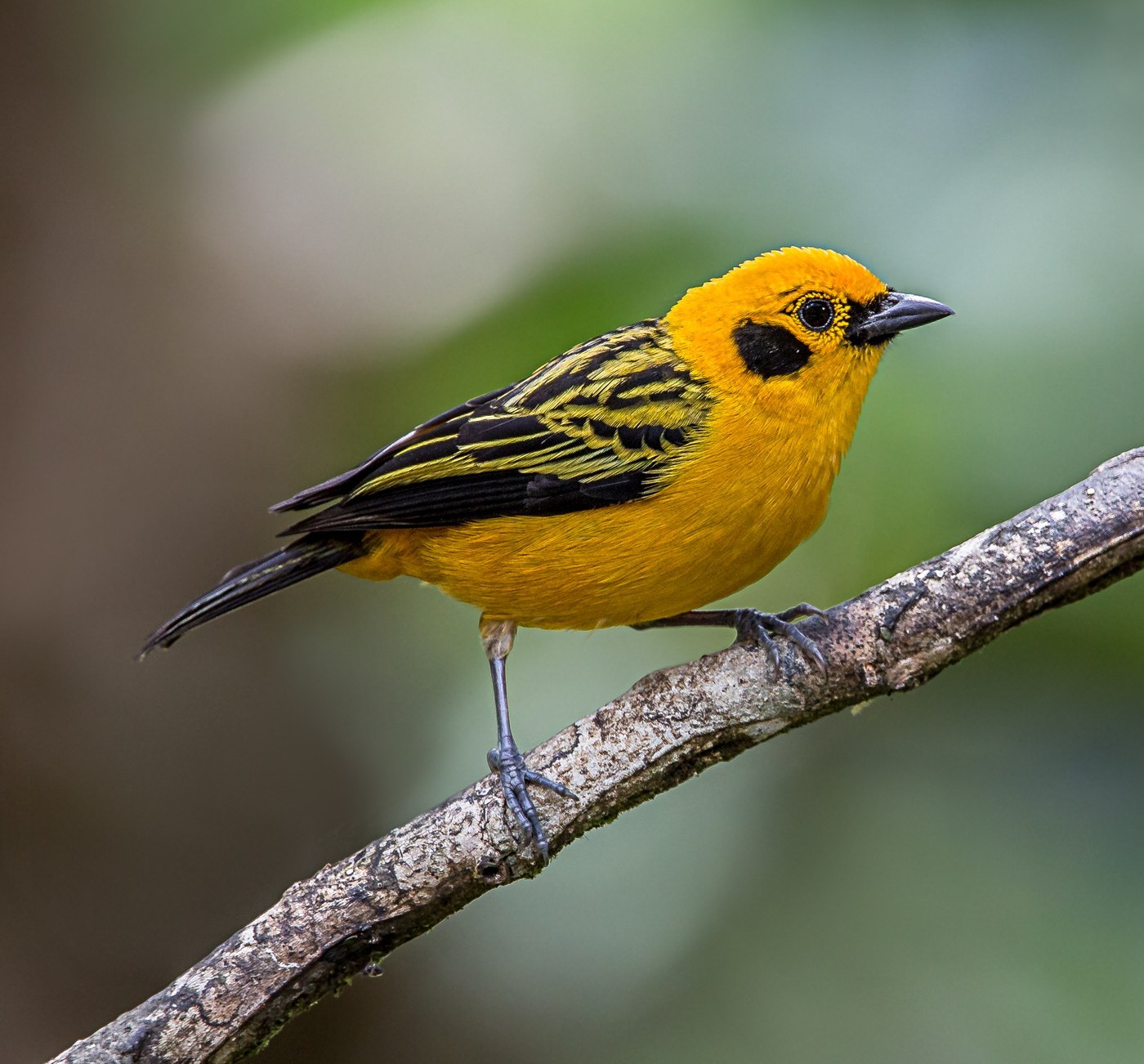
What Golden Tanager's Feathers Look Like
The Golden Tanager lives up to its name with body feathers in a rich, saturated golden-yellow covering the head, throat, chest, and belly, largely unbroken by other bright colors. The back and mantle carry black spotting or streaking over the golden base, giving shed back feathers a distinctive dappled look rather than a clean solid yellow. A black ear patch (mask) covers the area behind and below the eye, a feature that shows up clearly even on a small facial feather. Flight feathers are blackish, edged with yellow-green fringing that creates a pale panel along the folded wing. The overall feather set — golden-yellow body, black-spotted back, black ear patch, and yellow-green wing edging — is a distinctive combination among Andean tanagers. The rump and uppertail covert feathers stay a cleaner, unspotted gold, offering a useful contrast to the heavily marked mantle, and the tail itself is blackish with narrow yellow-green edging along each feather, matching the wing pattern rather than the solid gold of the body.
Step-by-Step: Is This Feather From a Golden Tanager?
- Check the base body color. A saturated, unmarked golden-yellow feather from the chest or belly is a strong starting point.
- Look for black spotting on back feathers. Golden-yellow feathers with black spots or streaks, rather than a clean solid color, match this species' mantle pattern.
- Find a black ear patch feather if possible. A small black feather from the face/ear area, paired with yellow body feathers, supports the identification.
- Examine wing feathers. Blackish flight feathers edged in yellow-green, rather than plain black or gray, fit this species.
- Rule out blue. If any feather shows blue tones on the head or throat, reconsider — Golden Tanager's plumage stays within the yellow-black-green range without blue.
Similar Species & How to Tell Them Apart
- Saffron-crowned Tanager: Has a green (not black-spotted) back and a blue throat patch, differing clearly from Golden Tanager's spotted back and lack of blue.
- Flame-faced Tanager: Shows a bright orange face patch rather than the more uniformly golden head of Golden Tanager.
- Golden-hooded Tanager: Has a turquoise-blue crown and a golden forehead band rather than an entirely golden-yellow head, making head color the quickest way to separate the two.
Where & When You'll Find Them
Golden Tanagers inhabit humid Andean cloud forest and forest edge from Colombia and Venezuela south through Bolivia, typically foraging in the forest interior and edge in small mixed flocks. Feathers are most likely to be found beneath fruiting trees and along forest edge trails at middle elevations. As a non-migratory tropical resident, molt is not tied to a strict season, so feathers can appear at any time of year, though turnover often loosely follows the local breeding period.
Frequently asked questions
What's the most distinctive single feather feature?
A golden-yellow back feather with black spotting is quite distinctive and helps separate this species from plain-backed golden tanagers in the same region.
How do I rule out Golden-hooded Tanager?
Check the crown — Golden-hooded Tanager shows a turquoise-blue crown with a golden forehead band, while Golden Tanager's whole head is a uniform golden-yellow.
Is there any blue on this species at all?
No, Golden Tanager's plumage stays within golden-yellow, black, and yellow-green tones without any blue, unlike several related tanagers in its range.
Where should I look for feathers in cloud forest?
Beneath fruiting trees and along forest edges at middle elevation, where this species commonly forages in mixed-species flocks.