
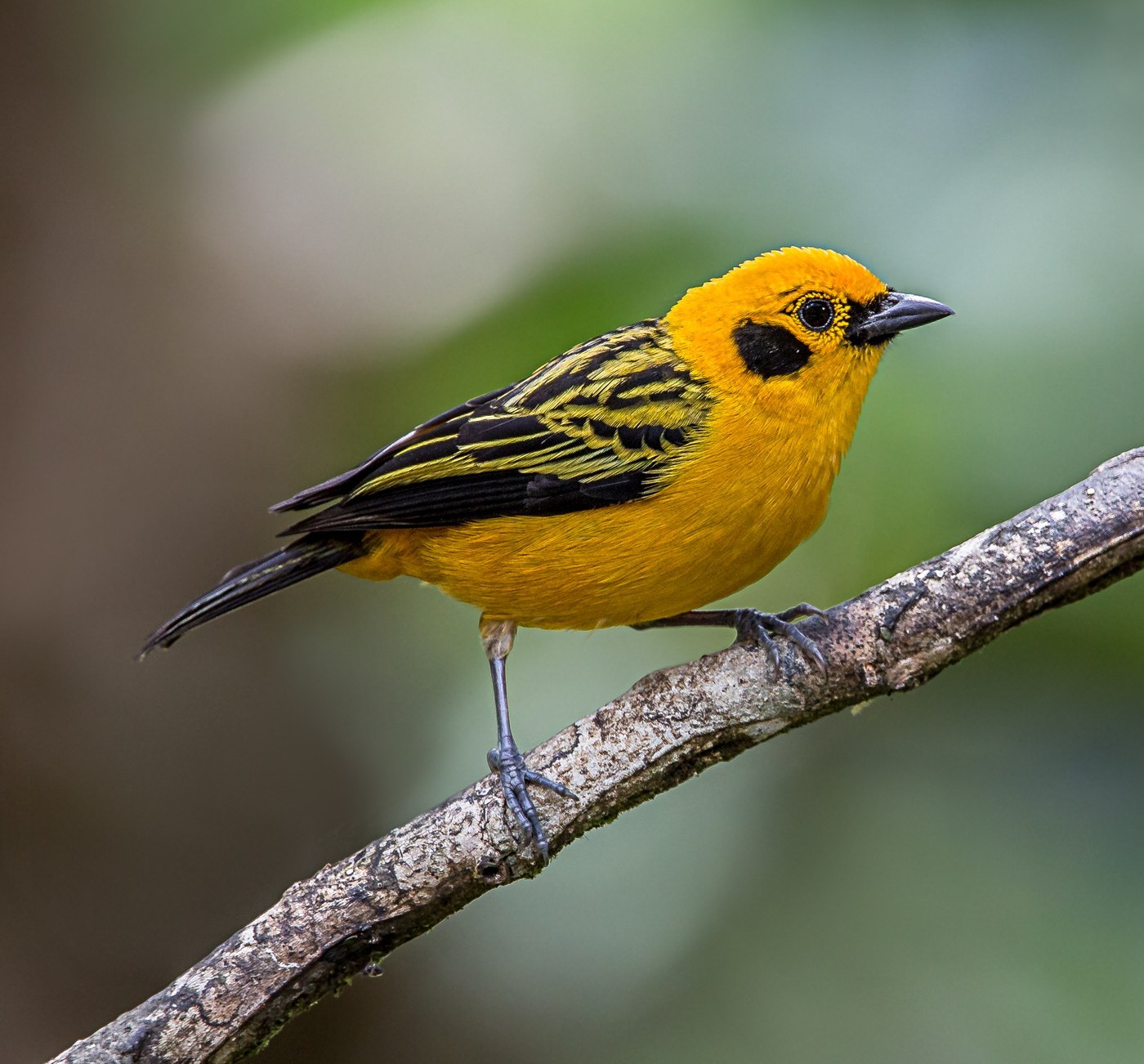
Golden Tanager
Tangara arthus
A vividly golden-yellow tanager of Andean cloud forests, marked by a bold black ear patch and dark streaking on the back and wings. Sexes look alike, and it often travels in mixed-species flocks through forest edge and secondary growth.
- Feather type
- Dense, silky contour feathers typical of Tangara tanagers
- Colours
- Bright golden-yellow overall with a black ear patch and black-marked back and wings
- Bird size
- Sparrow-sized, ~13-14 cm
Found a feather like this?
Identify any feather from a photo, free.
Overview
Overview
The Golden Tanager is a small, richly colored songbird of the Andes, found from Venezuela and Colombia south to Bolivia. Its plumage is a saturated golden-yellow across most of the body, set off by a bold black patch through the eye and ear coverts and black markings on the back and wings. Unlike many Tangara tanagers, the sexes look nearly identical. It is a regular member of mixed-species foraging flocks moving through humid montane forest edge and secondary growth.
Identifying the Feather
Feather Identification
- Body: Golden-yellow contour feathers cover the head, throat, breast, and belly, with intensity varying slightly by subspecies from lemon-yellow to more orange-tinged.
- Face: A solid black patch runs through the eye and ear coverts, contrasting sharply with the yellow face.
- Back: Feathers have dark centers, creating a streaked or lightly scaled appearance on the mantle.
- Wings and tail: Flight feathers are blackish, edged with yellow-green fringes that form pale wing markings; tail feathers are similarly dark-centered with pale edges.
- Versus similar tanagers: Other Tangara species in the same range show additional facial markings, blue or green patches, or different underpart colors; the Golden Tanager's unmarked golden underparts paired with a single black ear patch are diagnostic.
Plumage & Molt
Plumage Notes
Sexes are similar, which is unusual among Tangara tanagers, many of which show marked plumage differences between males and females. Juveniles are duller and more olive-yellow, gradually acquiring the bright adult coloration. A single complete molt follows breeding. Some geographic variation exists in the intensity of yellow versus orange tones across the species' range.
Habitat & Range
Habitat & Range
The Golden Tanager occurs along the Andes from Venezuela and Colombia south to Bolivia, generally in humid subtropical and lower temperate forest zones. It favors forest edge, clearings, and secondary growth rather than deep forest interior. The species is resident, though it may make short elevational movements in response to fruiting cycles.
Behavior & Field Notes
Behavior & Field Notes
Golden Tanagers forage in pairs or small groups for fruit and insects gleaned from foliage, frequently joining mixed tanager flocks moving through the forest canopy and edge. Nests are small open cups built in shrubs or low trees. Vocalizations include thin, high-pitched chips and soft twittering notes given while foraging.
Frequently asked questions
What makes the Golden Tanager easy to identify?
Its overall golden-yellow plumage combined with a bold black patch through the eye and ear coverts is distinctive among Andean tanagers.
Do male and female Golden Tanagers look different?
No, the sexes are similar in this species, unlike many other Tangara tanagers that show strong plumage differences.
Where is the Golden Tanager found?
It lives along the Andes from Venezuela and Colombia south to Bolivia, mainly in humid montane forest edge and secondary growth.
What does the Golden Tanager eat?
It feeds mainly on fruit and insects gleaned from foliage while foraging in flocks.
Golden Tanager guides
In-depth guides for identifying and understanding Golden Tanager.
Other feathers you may enjoy

Yellow-breasted Bunting
Contour and flight feathers, chestnut-and-yellow breeding pattern

Sedge Wren
Tiny streaked crown and back feathers

Yellow-winged Cacique
Glossy black body feathers, yellow wing patch, shaggy crest

Yellow Warbler
Small contour and flight feathers

Yellow-throated Warbler
Small contour and flight feathers

Yellow-throated Vireo
Bright yellow throat and spectacle feathers; olive-green back feathers; two white wing-bar feathers

Yellow-rumped Warbler
Small contour and flight feathers

Yellow-hooded Blackbird
Contrasting hood and body feathers

Yellow-headed Blackbird
Glossy black body plumage with a bright yellow head and breast

Yellow-eyed Junco
Contour and flight feathers

Yellow-fronted Canary
Small, smooth body plumage

Yellow-breasted Greenfinch
Compact, smooth body plumage