
How to Identify Golden-winged Warbler Feathers
A guide to identifying Golden-winged Warbler feathers using the male's black throat and eye mask, yellow crown patch, and bold yellow wing panel.
Read the full Golden-winged Warbler encyclopedia entry →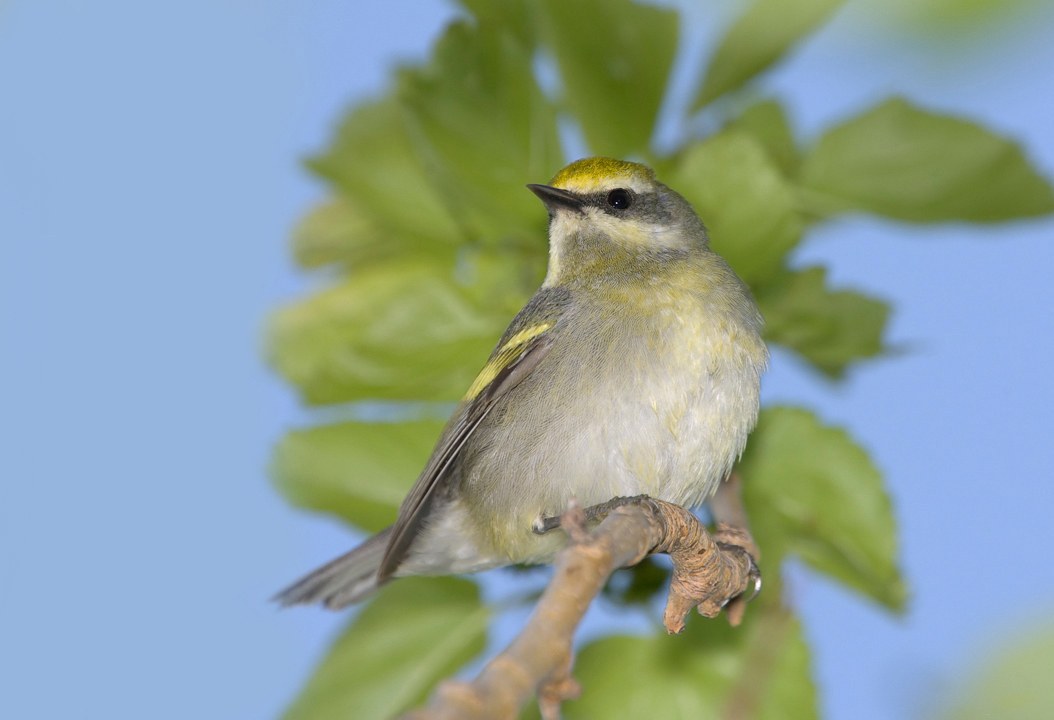
What Golden-winged Warbler's Feathers Look Like
The male Golden-winged Warbler shows a crisp, high-contrast pattern: gray back and flank feathers, a black throat patch, and a black mask through the eye, set against an otherwise pale gray-and-white face. On the crown sits a bright yellow patch, and the wing shows a bold yellow wing panel formed by yellow-tipped coverts — the feature that gives the species its name, and one of the more strikingly colored wing patches among North American warblers. Underparts below the black throat are clean white. Females show a paler, softer version of the same pattern: an olive-gray mask and throat area instead of solid black, with a duller yellow crown and wing patch. This species is well known for hybridizing with the closely related Blue-winged Warbler, producing intermediate-looking offspring (often called Brewster's or Lawrence's warblers) that can show a mix of yellow body color and reduced or partial black facial markings.
Step-by-Step: Is This Feather From a Golden-winged Warbler?
- Look for a yellow wing panel feather. A wing covert feather that is solid or largely yellow, rather than showing thin white wingbars, is a strong clue for this species.
- Check for black throat and mask feathers. Solid black feathers from the throat and face, on an otherwise gray-and-white bird, support a male identification.
- Note the yellow crown patch. A small bright yellow feather from the crown, distinct from the wing patch, adds further support.
- Consider duller gray-olive feathers. These may represent a female, whose throat and mask are grayer rather than solid black, with a less vivid yellow crown and wing patch.
- Watch for intermediate patterns. A feather set that mixes yellow body tones with reduced black markings could indicate a hybrid with Blue-winged Warbler rather than a pure individual of either species.
Similar Species & How to Tell Them Apart
- Blue-winged Warbler: Shows an overall yellow body with plain white wingbars (not a bold solid yellow patch) and only a thin black eyeline rather than a full black mask and throat.
- Brewster's Warbler (hybrid): Typically pale yellow-white overall with reduced facial markings, reflecting a blend between Golden-winged and Blue-winged Warbler traits.
- Black-throated Gray Warbler: Also shows a black throat, but has a gray (not yellow) crown and lacks the bold yellow wing panel of Golden-winged Warbler.
Where & When You'll Find Them
Golden-winged Warblers breed in shrubby, early-successional habitat — old fields, forest edge, and regenerating clearings — mainly in the Appalachian region and the upper Midwest and Great Lakes area, and winter in the forests of Central America and northern South America. Feathers are most likely to be found in dense shrub thickets and along brushy field edges during the breeding season. Molt occurs largely in late summer before migration, making that the most likely time to find breeding-range feathers, while winter-range feathers would be expected farther south in Central or northern South America.
Frequently asked questions
What's the clearest sign this isn't a Blue-winged Warbler?
A solid yellow wing patch (rather than thin white wingbars) combined with a solid black throat and mask points to Golden-winged Warbler rather than the more uniformly yellow-bodied Blue-winged Warbler.
Could a pale, oddly-marked feather be a hybrid?
Yes, Golden-winged and Blue-winged Warblers hybridize fairly often, and offspring can show a blend of yellow body tones with reduced or partial black facial markings.
How do female feathers differ from male feathers?
Females show a grayer, softer version of the mask and throat rather than solid black, along with a duller yellow crown and wing patch.
When should I expect to find breeding-range feathers?
Mainly from late spring through late summer, with molt concentrated in late summer just before birds migrate south for the winter.