
How to Identify Gray-cheeked Thrush Feathers
A guide to the cool olive-brown, uniformly toned feathers of Gray-cheeked Thrush and how to separate them from very similar migrant thrushes.
Read the full Gray-cheeked Thrush encyclopedia entry →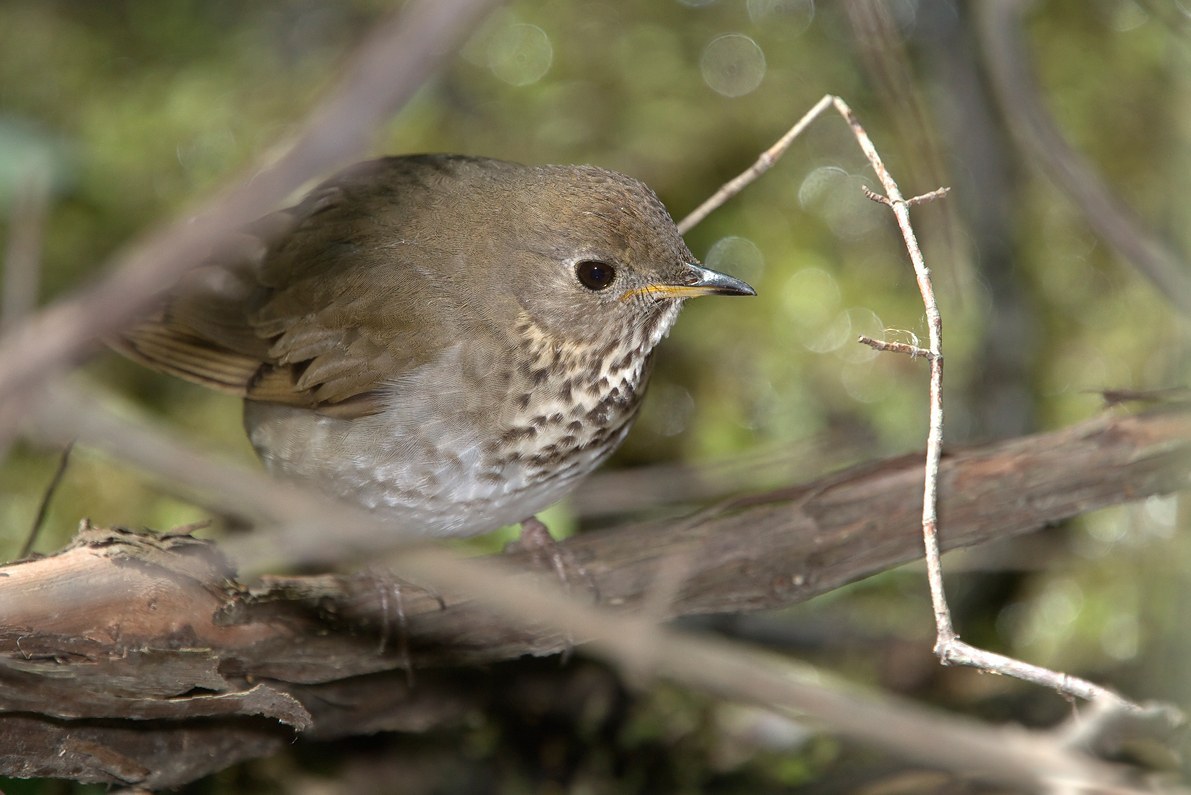
What Gray-cheeked Thrush's Feathers Look Like
Gray-cheeked Thrush is part of a notoriously tricky group of brown, spot-breasted thrushes, but its feathers carry a distinct "cold" tone that separates it from relatives. Upperpart contour feathers — back, crown, and especially the tail — are a uniform cold olive-brown to grayish-brown, without any warm rufous cast. Critically, the tail feathers match the back in color; there is no contrasting reddish tail as seen in some relatives. Breast feathers are pale buffy-white with bold, dark, wedge-shaped spots that extend down onto the sides of the breast and upper flanks more than in some similar thrushes. The face/cheek feathers are plain grayish, lacking a strong buffy eye-ring or spectacle — this is where the name comes from. Flight feathers are uniformly dusky olive-brown with pale edging, unremarkable but consistent with the same cool tone throughout.
Step-by-Step: Is This Feather From a Gray-cheeked Thrush?
- Check color temperature. Lay the feather next to a warm rufous-brown feather; Gray-cheeked's tone reads distinctly cooler/grayer, not reddish.
- Compare tail to back color. If a tail feather is the same olive-gray-brown as a back feather (no contrast), that supports this species over Hermit or Veery.
- Look at the spotting. Breast feathers with bold, dark wedge spots reaching well onto the flanks fit better than faint or sparse spotting.
- Consider the face. A feather from the face/cheek area that appears plain gray, without a buffy wash, favors this species over Swainson's Thrush.
- Note timing and location. A spotted thrush feather found during spring or fall migration, away from a known breeding range, is consistent with this long-distance migrant passing through.
Similar Species & How to Tell Them Apart
- Swainson's Thrush — has a warmer olive-brown back, a distinct buffy eye-ring and cheek wash, and buffier underparts; Gray-cheeked lacks the buffy face.
- Bicknell's Thrush — extremely similar and often inseparable from feathers alone; Bicknell's tends to show a slightly warmer, more rufous-tinged tail, but overlap is significant.
- Veery — much warmer, rufous-brown overall with faint, indistinct breast spotting, unlike Gray-cheeked's bold spots.
- Hermit Thrush — shows a contrastingly rufous tail against an olive-brown back, the opposite of Gray-cheeked's uniform coloring.
Where & When You'll Find Them
Gray-cheeked Thrush breeds in stunted boreal forest and shrubby tundra edge from Alaska across northern Canada to Newfoundland, then undertakes one of the longest migrations of any American thrush, wintering in northern South America. Because it breeds in remote, sparsely visited habitat, most feather finds happen during migration stopovers in spring (May) and fall (September–October), when birds pause in wooded parks, coastal thickets, and forest understory across the eastern and central U.S. to refuel. Molt is limited during migration, with a more complete molt occurring on or near the wintering grounds, so feathers found in North America are typically worn migratory plumage rather than fresh post-molt feathers.
Frequently asked questions
How can I tell a Gray-cheeked Thrush feather from a Swainson's Thrush feather?
Look at overall tone and the face: Gray-cheeked is cooler and grayer with a plain gray cheek, while Swainson's is warmer olive-brown with a buffy eye-ring and cheek wash.
Is it possible to distinguish Gray-cheeked from Bicknell's Thrush by feather alone?
It's very difficult — the two are extremely similar, with Bicknell's showing a slightly warmer, more rufous tail, but confident separation usually requires more than a single feather.
Why don't Gray-cheeked Thrush feathers show a contrasting rufous tail like Hermit Thrush?
Gray-cheeked Thrush lacks the rufous tail pigmentation found in Hermit Thrush, so its tail feathers match the same cool olive-brown tone as its back.
When during the year am I most likely to find one of these feathers?
Spring and fall migration are the best windows, since the species breeds in remote northern habitat and winters in South America, passing through the rest of North America only briefly.
Do Gray-cheeked Thrush feathers show heavy spotting everywhere on the body?
Spotting is concentrated on the breast and extends somewhat onto the flanks, but the back, wings, and tail are plain and unspotted.