
How to Identify Greater Flamingo Feathers
A guide to recognizing the pale pink body feathers and black flight feathers of the largest and palest flamingo species.
Read the full Greater Flamingo encyclopedia entry →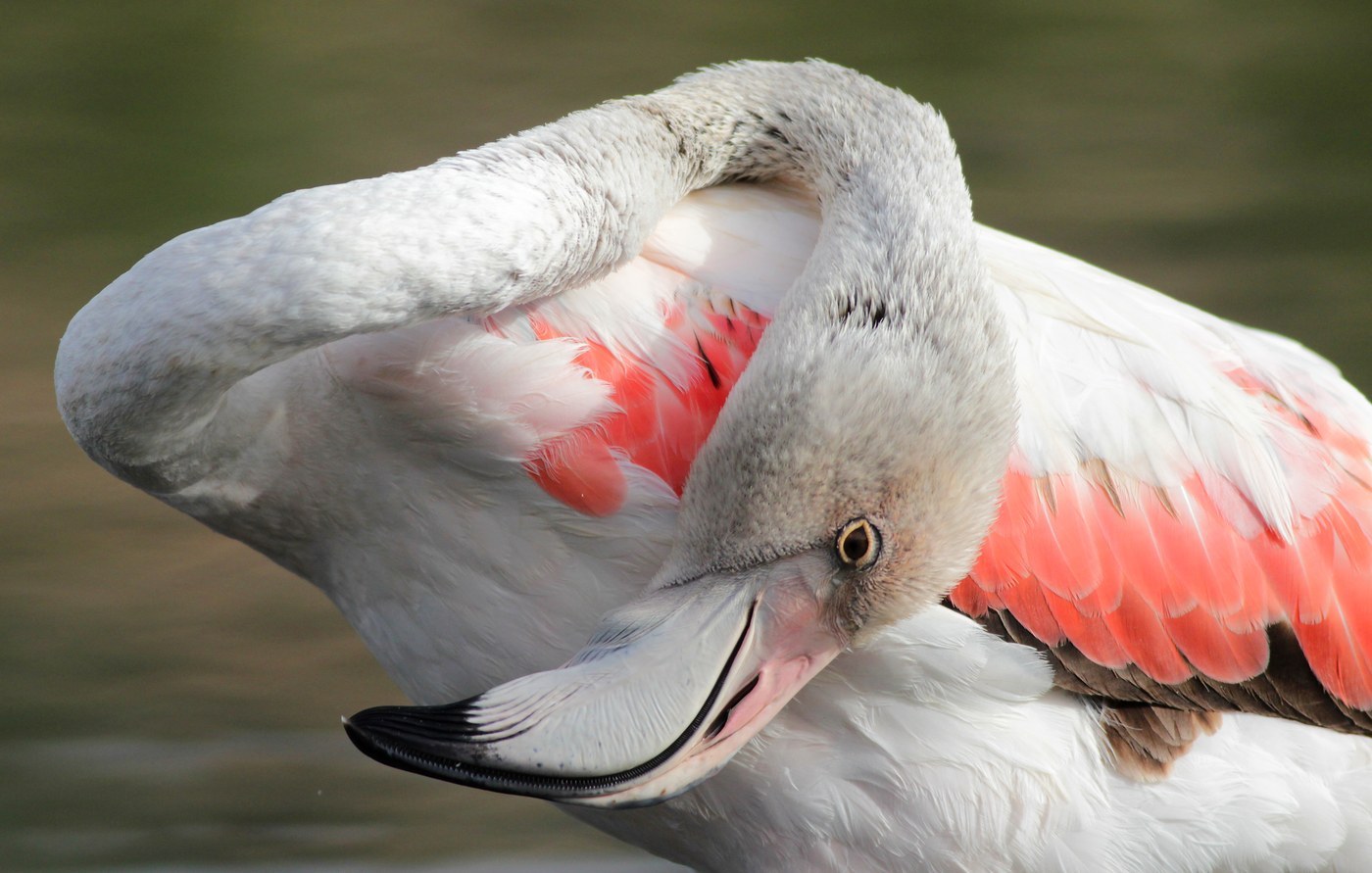
What Greater Flamingo's Feathers Look Like
The Greater Flamingo is the largest and among the palest of the world's flamingo species, found across parts of Africa, southern Europe, and Asia, and its feathers reflect a diet-driven pigmentation that varies noticeably between individuals. Body and contour feathers are typically a very pale pink to almost whitish-pink, considerably softer and less saturated than the vivid orange-pink of Caribbean flamingos, though wing covert feathers — the "shoulder" of the folded wing — often show a more vivid pink to red tone than the paler body. This two-tone effect, pale body with a brighter covert patch, is a genuine identification clue on its own.
The most dramatic contrast comes from the flight feathers: primaries and secondaries are solid black, creating a striking two-tone wing pattern that is hidden at rest but fully visible in flight or on a shed flight feather found alone. These flight feathers are long and only moderately broad, reflecting a bird that flies with slow, deep wingbeats on a fairly long neck-and-legs-outstretched silhouette. Overall feather texture is soft and somewhat downy on the body, denser and stiffer on the flight feathers, with a pale pinkish rachis on many contour feathers.
Step-by-Step: Is This Feather From a Greater Flamingo?
- Check overall pink saturation. A pale, soft pink to whitish-pink body feather, rather than a deep orange-red, fits Greater Flamingo better than the more saturated Caribbean/American Flamingo.
- Look at covert feathers separately. A brighter pink-to-red feather, if from the wing shoulder area, is consistent with this species' more vivid covert patch contrasting against a paler body.
- Find the black flight feathers. A long, solid black primary or secondary feather is a strong diagnostic when found alongside pale pink body feathers.
- Measure it. Flight feathers can reach 35–45 cm, reflecting this species' status as the largest flamingo.
- Feel the texture. A soft, somewhat downy body feather with a pale shaft supports a flamingo identification generally.
- Consider the setting. A pale pink feather found near alkaline lakes, coastal lagoons, or salt pans across Africa, southern Europe, or South/Central Asia fits this species' typical range.
Similar Species & How to Tell Them Apart
The American (Caribbean) Flamingo shows a much more saturated reddish-orange to scarlet body color throughout, considerably brighter than the pale Greater Flamingo, and occupies the Americas rather than the Old World range of Greater Flamingo. The Lesser Flamingo, sharing part of the African range, is notably smaller with deeper, more uniform pink body plumage and a darker reddish bill, producing smaller feathers overall. The Chilean Flamingo shows paler grey legs with pink joints and a somewhat more muted overall body tone, distinguishable mainly by the leg-color soft-tissue feature rather than by feather color alone.
Where & When You'll Find Them
Greater Flamingos breed colonially on alkaline lakes, coastal lagoons, and salt pans across parts of Africa, southern Europe (notably the Camargue and southern Spain), the Middle East, and South and Central Asia, often moving seasonally in response to water levels. Flamingos undergo a synchronized flightless period during their flight-feather molt, when large numbers of feathers are shed together near breeding and molting lakes. Feathers are most likely to be found near these traditional colony and molting sites in summer, when molt is concentrated, as well as scattered around foraging wetlands throughout the year.
Frequently asked questions
What's the fastest way to confirm a Greater Flamingo feather?
Look for a pale, softly pink body feather alongside a solid black flight feather — the combination of pale pink body plumage and black primaries/secondaries is the species' hallmark pattern.
Why is the color so much paler than photos of bright pink flamingos?
Greater Flamingo is naturally one of the palest flamingo species; the vivid saturated pink most people associate with flamingos is more typical of the American/Caribbean Flamingo.
How do I tell this from an American Flamingo feather?
American Flamingo shows a much more saturated reddish-orange to scarlet body color throughout, while Greater Flamingo is notably paler pink to whitish-pink.
Why do some feathers look brighter pink than others?
Wing covert ('shoulder') feathers often show a more vivid pink-red tone than the paler body feathers, creating a natural two-tone effect within the same bird.
When are Greater Flamingo feathers most likely to be found?
Summer near breeding and molting colonies on alkaline lakes and lagoons, when the species undergoes a synchronized flightless flight-feather molt.