
Green Peafowl
Pavo muticus
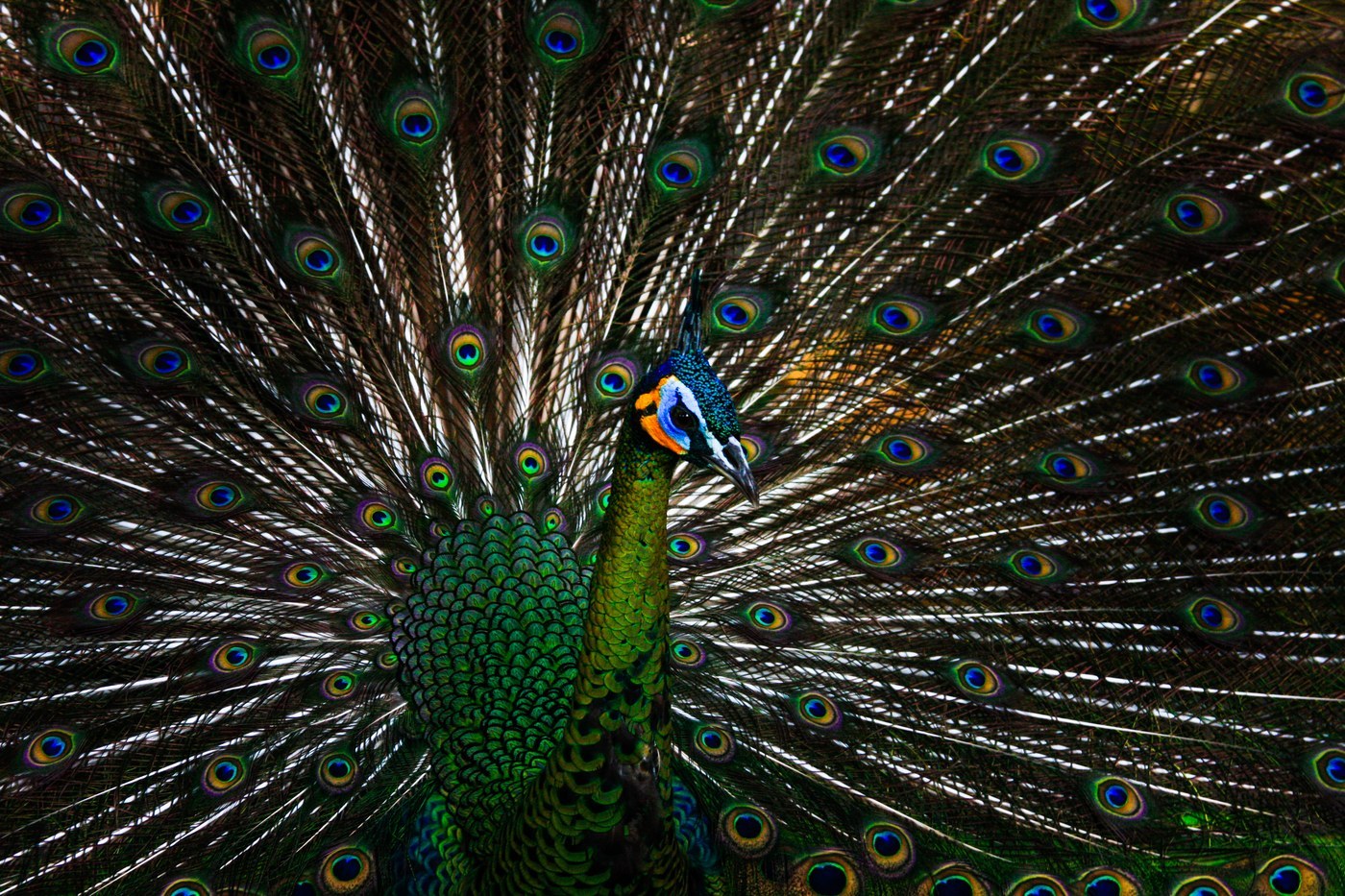
A peafowl of Southeast Asia showing less difference between the sexes than its Indian relative, with both males and females displaying scaled iridescent green body plumage.
- Feather type
- Scaled iridescent green body feathers with an ocellated train similar to the Indian Peafowl
- Colours
- Iridescent green and bronze scaled overall, with blue-green tones
- Bird size
- Very large, with train extending total length to roughly 200-300 cm (male)
Found a feather like this?
Identify any feather from a photo, free.
Overview
Overview
The Green Peafowl is native to open forest and forest-edge habitat, often near rivers, across parts of Southeast Asia. Unlike the Indian Peafowl, the sexes are more similar in overall coloration, both showing a scaled iridescent green body, though males still develop the elaborate ocellated train.
Identifying the Feather
Feather Identification
- Body feathers (both sexes): scaled and iridescent green with bronze highlights, giving a more uniformly colorful appearance than the Indian Peafowl's blue-dominated male plumage
- Train feathers (male): elongated uppertail coverts with large eyespots similar in structure to the Indian Peafowl, though set against a green rather than blue body background
- Crest: a narrow, upright tuft of feathers, more pointed than the fan-shaped crest of the Indian Peafowl
- Female feathers: closer in appearance to the male than in Indian Peafowl, retaining much of the scaled green coloration but with a shorter tail and no train
- Posture note: the species stands taller and more upright than Indian Peafowl, an impression reinforced by longer neck and leg feathering
Plumage & Molt
Plumage Notes
Both sexes show scaled iridescent green body plumage with bronze highlights, a reduced degree of sexual dimorphism compared to the Indian Peafowl, though males still grow an elaborate ocellated train of uppertail coverts. Juveniles resemble adults but with duller coloration and a shorter tail. Males regrow the train annually through a single post-breeding molt.
Habitat & Range
Habitat & Range
Green Peafowl inhabit open forest, forest edge, and grassland often near rivers across scattered parts of Southeast Asia, generally more closely tied to forest cover than the more open-country Indian Peafowl. The species is largely non-migratory and sedentary within suitable habitat.
Behavior & Field Notes
Behavior & Field Notes
Males perform a train-fanning display similar to the Indian Peafowl, accompanied by loud calls. Diet includes seeds, shoots, fruit, and invertebrates foraged from open ground near forest cover. Nests are shallow ground scrapes concealed in vegetation. The species tends to be more wary of humans than the Indian Peafowl and is generally found in less disturbed habitat.
Frequently asked questions
How do Green Peafowl feathers differ from Indian Peafowl feathers?
Green Peafowl body feathers are scaled iridescent green in both sexes, whereas Indian Peafowl males are dominated by blue neck and breast feathers with a much duller brown female.
Is the train feather structure different between the two species?
The train feathers are structurally similar in both peafowl species, differing mainly in the background body color against which the ocelli are set.
Do females have a train?
No, only males develop the elongated ocellated train in either peafowl species.
What does the crest look like?
The Green Peafowl crest is a narrow, upright, pointed tuft, differing from the broader fan-shaped crest of the Indian Peafowl.
Green Peafowl guides
In-depth guides for identifying and understanding Green Peafowl.
Other feathers you may enjoy

Ring-necked Pheasant
Body (contour), tail, and wing feathers

Bornean Peacock-pheasant
Contour and tail feathers with iridescent ocelli

Crested Argus
Extremely elongated, ocellated (eyespot-patterned) tail feathers among the longest of any bird; tall, erectile crest

Grey Partridge
Body and flank feathers

Willow Ptarmigan
Larger, stockier body feathers with warmer rufous tones in summer; tail feathers black year-round

Wild Turkey
Broad, iridescent body feathers and large flight and tail feathers

Bulwer's Pheasant
Contour feathers and elongated white tail feathers
Red-legged Partridge
Flank, body, and flight feathers

White-tailed Ptarmigan
Small body feathers with a tail that stays pure white year-round, unlike other ptarmigan

Edwards's Pheasant
Contour and tail feathers

Sooty Grouse
Dense, plain contour feathers with a pale-tipped, fanned tail

Snow Partridge
Finely vermiculated barred contour feathers