
How to Identify Hooded Warbler Feathers
Spot the black hood framing a yellow face, olive back, and white outer tail spots that identify this small North American wood warbler.
Read the full Hooded Warbler encyclopedia entry →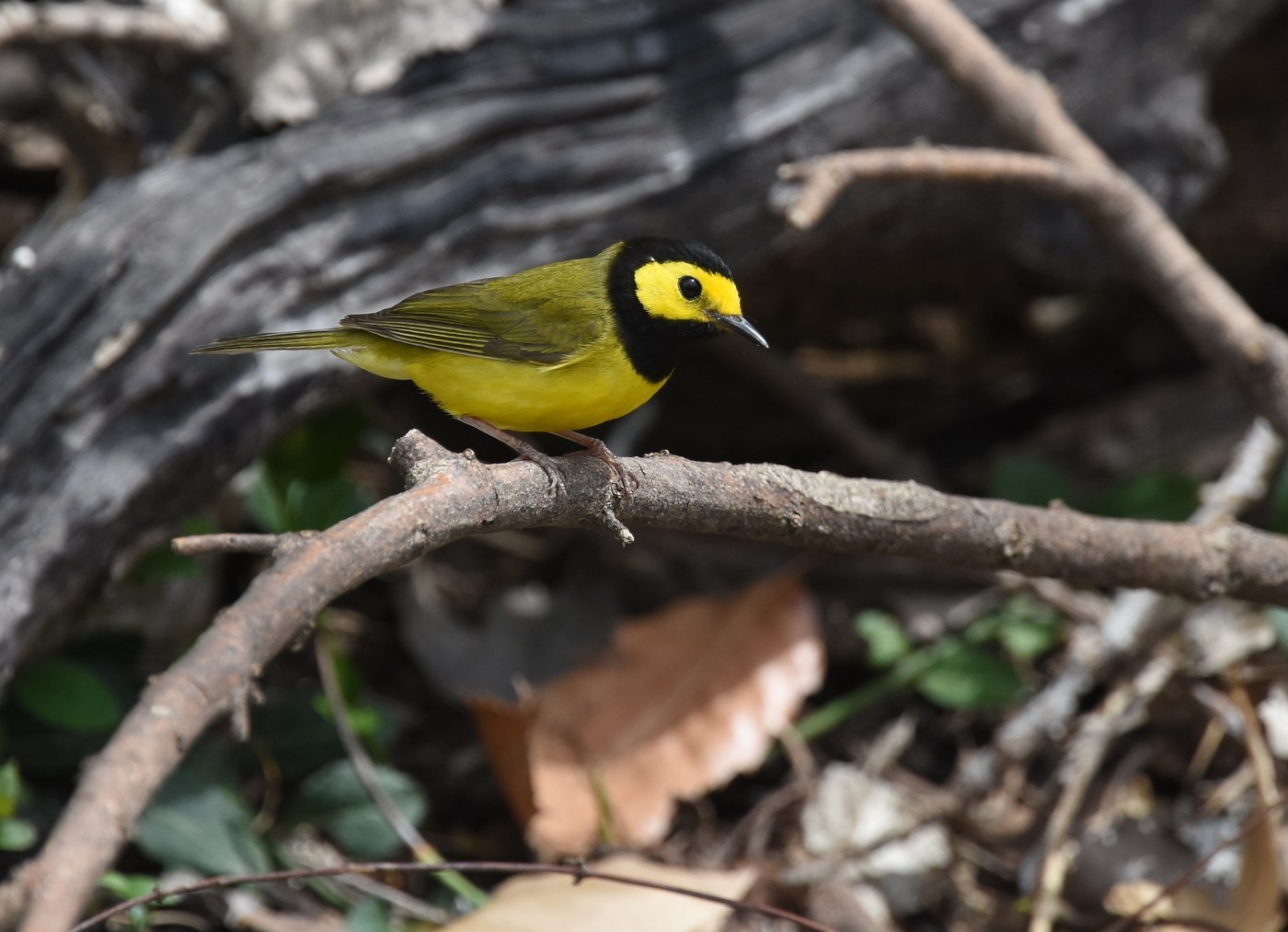
What Hooded Warbler Feathers Look Like
The Hooded Warbler is a small, brightly marked wood warbler of eastern North American forest understory. Adult males show a black hood — crown and throat both solid black — that wraps around and frames a vivid yellow face, leaving a bright yellow oval on the cheeks and forehead in sharp contrast to the surrounding black. Back and wing feathers are plain olive-green, unstreaked and unbarred, with no wing bars — a notably clean, simple wing pattern compared to many other warblers. Underparts are bright yellow, unmarked.
The best single feather clue is in the tail: the outer tail feathers are extensively white, especially on the inner web near the tip, showing as bold white patches that flash when the tail is fanned (a habit this species performs frequently while foraging). A loose outer tail feather with a large white patch against an otherwise olive-gray feather is highly distinctive. Females and immatures show a much reduced or entirely absent black hood — some females have only a trace of black on the crown or throat, or none at all — but retain the same yellow face, plain olive back, and diagnostic white outer tail patches.
Step-by-Step: Is This Feather From a Hooded Warbler?
- Check for a black-and-yellow face feather combination — solid black crown/throat framing yellow is diagnostic for adult males.
- Look at outer tail feathers for large white patches — present in both sexes and one of the most reliable clues even without other feathers.
- Confirm the back is unstreaked olive-green with no wing bars, ruling out warblers with bold wing patterns.
- Measure size. Feathers are small, consistent with a warbler roughly 12-13 cm in body length; flight feathers run only 4-6 cm.
- Consider that female/immature feathers may lack black entirely — rely on the white tail patches and plain olive back in that case.
Similar Species & How to Tell Them Apart
Wilson's Warbler, which shares a black cap in males, has the black restricted to a small round crown patch rather than a full hood including the throat, and lacks white tail patches entirely — its tail is plain olive. Kentucky Warbler shows black on the face (as a mask/sideburn) rather than a full hood, with a yellow eyebrow, and also lacks white in the tail. Canada Warbler has a gray back and a black "necklace" of streaks across a yellow breast, quite different from Hooded Warbler's plain olive back and solid black hood. The white outer tail feathers, largely absent or much reduced in these look-alikes, are the most decisive single clue for Hooded Warbler.
Where & When You'll Find Them
Hooded Warblers breed in the understory of mature deciduous forests across the eastern and southeastern United States, favoring shaded thickets with dense shrub cover, and winter in Mexico, Central America, and the Caribbean. As long-distance migrants, feathers are most likely to be found on breeding territory from late spring through summer, with additional feathers possible during migration stopovers in the Gulf Coast region and Central America in spring (April-May) and fall (August-September).
Frequently asked questions
What is the single best feather clue for Hooded Warbler?
A large white patch on an outer tail feather combined with a plain, unstreaked olive-green back — present in both sexes even when the black hood is reduced or absent.
Do all Hooded Warblers have a black hood?
No, many females and immatures show little or no black on the head, though they still have the yellow face and white tail patches.
How is this different from Wilson's Warbler?
Wilson's Warbler has a small round black cap rather than a full hood reaching the throat, and it lacks white outer tail feathers entirely.
Are there wing bars on this species?
No, the wings are plain olive-green with no wing bars, a simpler pattern than many other warblers.
When during the year are feathers most likely to be found?
Late spring through summer on breeding territory in eastern deciduous forests, with additional chances during spring and fall migration stopovers.