
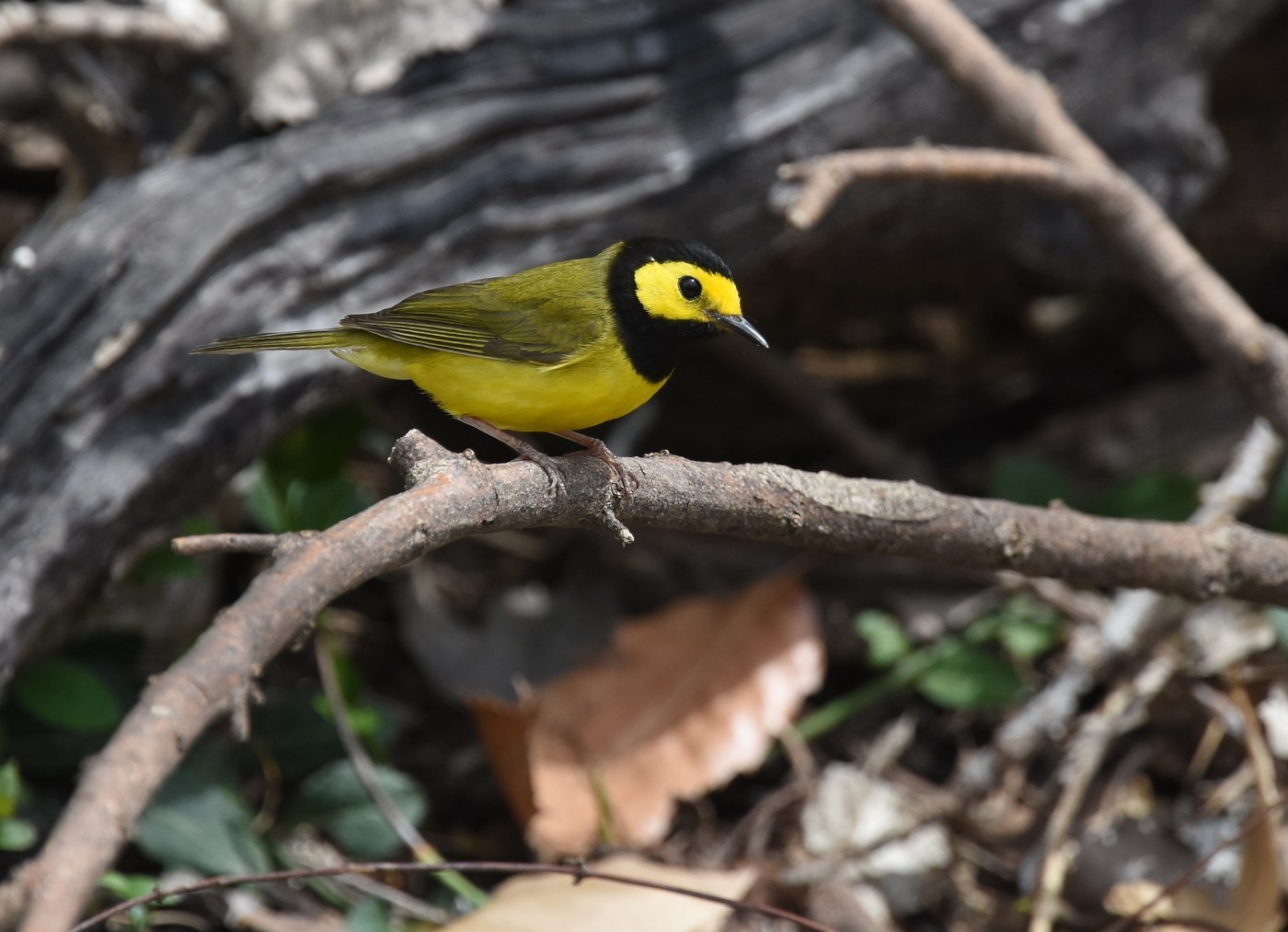
Hooded Warbler
Setophaga citrina
A vivid yellow-faced warbler whose adult males wear a complete black hood over the crown, nape, and throat, framing the bright yellow face like a cowl.
- Feather type
- Small, soft contour feathers; bold black hood in males
- Colours
- Bright yellow face, olive-green back, black hood, white tail spots
- Bird size
- Sparrow-sized, ~13 cm
Found a feather like this?
Identify any feather from a photo, free.
Overview
Overview
The Hooded Warbler is a strikingly patterned warbler of mature deciduous forest understory across the eastern and southeastern United States. Adult males are particularly distinctive, with a solid black hood covering the crown, nape, and throat that sharply frames a bright yellow face, while females show a more variable, often much reduced version of this pattern.
This species tends to stay low in dense shrub layers within otherwise tall forest, frequently flicking its tail to reveal white outer tail feathers, a useful behavioral and plumage clue when foraging.
Identifying the Feather
Feather Identification
- Hood: Adult male feathers form a solid black hood covering the crown, nape, and throat, sharply contrasting with the bright yellow face and forehead; this pattern is unique among regularly occurring warblers.
- Tail: Outer tail feathers show large white patches, conspicuous when the tail is spread or flicked, a helpful feature at any age or sex.
- Underparts: Breast, belly, and undertail feathers are bright yellow, unmarked by streaking.
- Upperparts: Back, wing, and tail feathers (aside from the white outer tail spots) are plain olive-green, without wing bars.
- Female/immature hood: Females and immatures show a highly variable amount of black on the crown and throat, ranging from nearly hooded like a male to almost entirely yellow-faced with just a trace of dark feathering.
Plumage & Molt
Plumage Details
Adult males display the most complete and solidly black hood, fully encircling the bright yellow face. Adult females are highly variable: some show a partial black hood approaching the male's pattern, while others show little to no black, appearing mostly yellow on the head with perhaps a faint dusky tinge on the crown or throat. Immature males typically show more black than immature females but generally less than adult males.
A complete molt occurs on the breeding grounds in late summer, and hood extent in females and immatures can become somewhat more developed with successive molts in subsequent years, though extensive individual variation exists at every age.
Habitat & Range
Habitat & Range
Hooded Warblers breed in mature deciduous forest with a dense shrub and sapling understory, often in bottomland or ravine forest, across much of the southeastern and eastern United States, extending into the lower Midwest and mid-Atlantic states.
This species is a long-distance migrant, wintering primarily in the lowlands of Mexico, Central America, and parts of the Caribbean, typically in forest and forest-edge habitats with a similarly dense understory structure to its breeding range.
Behavior & Field Notes
Behavior & Field Notes
Hooded Warblers forage low in dense shrub layers, gleaning insects from foliage and making frequent short sallying flights to catch flying prey, often flicking open the tail to flush insects and reveal the white outer tail feathers. This tail-flicking behavior is a distinctive and useful field habit.
The nest is a compact cup placed low in dense shrubs or saplings within the forest understory. The male's song is a loud, clear, whistled series often rendered as "ta-wit ta-wit ta-wit-tee-o," delivered from within the shrub layer or a mid-level perch. On the wintering grounds, this species shows notable habitat segregation by sex in some studies, with males and females sometimes favoring different forest structure types.
Frequently asked questions
What is the defining feather feature of a male Hooded Warbler?
A solid black hood covering the crown, nape, and throat that sharply frames the bright yellow face, unique among common warbler species.
Do all female Hooded Warblers lack the black hood?
No, females are highly variable; some show a partial hood approaching the male's pattern, while others show almost no black on the head.
Why does this species flick its tail while foraging?
Tail-flicking, which reveals white outer tail feathers, is thought to help flush hidden insects from foliage, and it is also a useful identification behavior.
What forest structure does the Hooded Warbler need for breeding?
Mature deciduous forest with a dense shrub and sapling understory, often in bottomland or ravine habitats.
Hooded Warbler guides
In-depth guides for identifying and understanding Hooded Warbler.
Other feathers you may enjoy

Yellow-breasted Bunting
Contour and flight feathers, chestnut-and-yellow breeding pattern

Sedge Wren
Tiny streaked crown and back feathers

Yellow-winged Cacique
Glossy black body feathers, yellow wing patch, shaggy crest

Yellow Warbler
Small contour and flight feathers

Yellow-throated Warbler
Small contour and flight feathers

Yellow-throated Vireo
Bright yellow throat and spectacle feathers; olive-green back feathers; two white wing-bar feathers

Yellow-rumped Warbler
Small contour and flight feathers

Yellow-hooded Blackbird
Contrasting hood and body feathers

Yellow-headed Blackbird
Glossy black body plumage with a bright yellow head and breast

Yellow-eyed Junco
Contour and flight feathers

Yellow-fronted Canary
Small, smooth body plumage

Yellow-breasted Greenfinch
Compact, smooth body plumage