
How to Identify House Martin Feathers
Identify the glossy blue-black back, bright white rump patch, and clean white underparts that set this swallow-family bird apart in flight.
Read the full House Martin encyclopedia entry →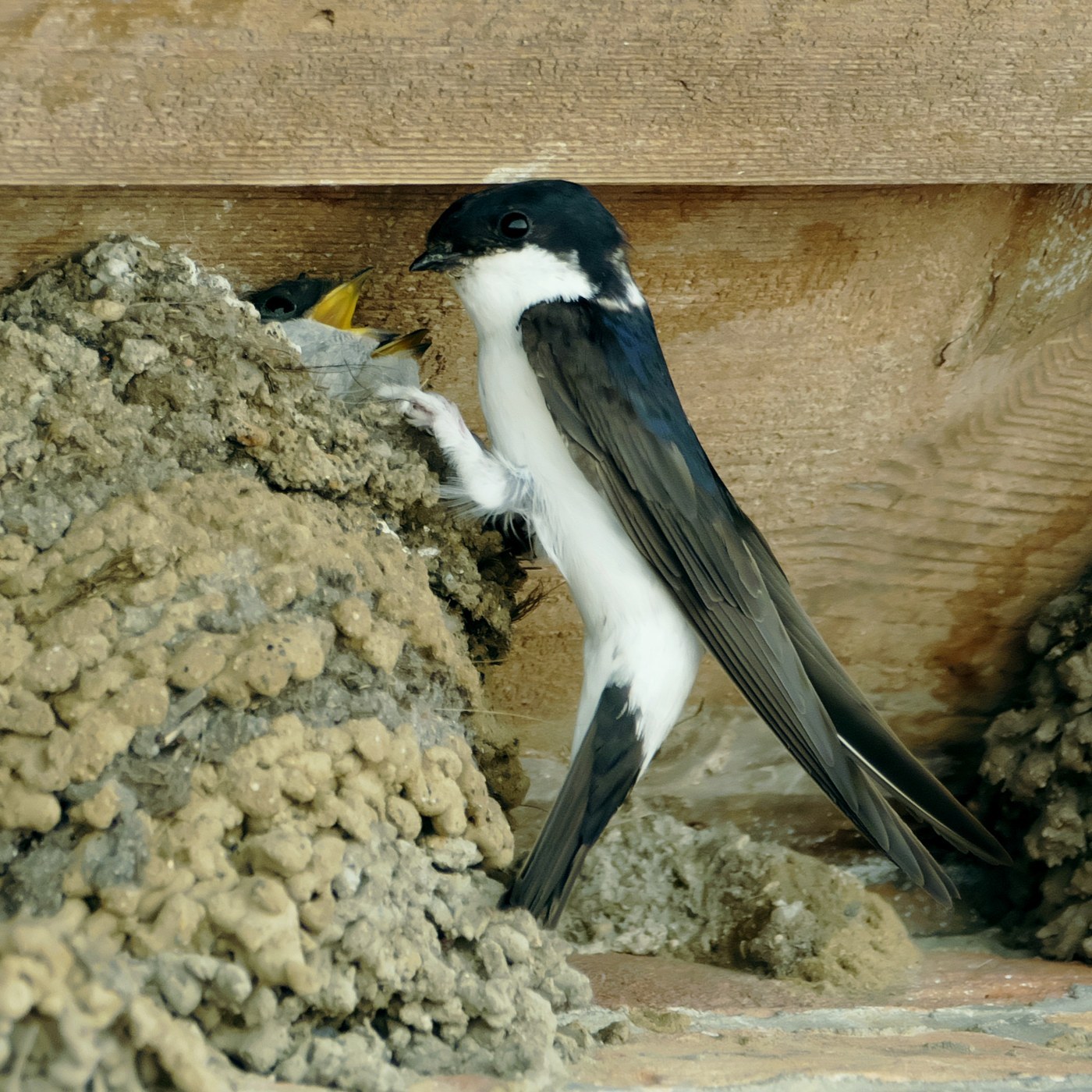
What House Martin Feathers Look Like
The (Common) House Martin is a small aerial-feeding swallow relative found across Europe, Asia, and Africa, easily recognized in flight by a bold white rump patch set against otherwise glossy blue-black upperparts. Back, crown, and wing covert feathers are a deep, glossy blue-black, showing iridescence in good light, while the rump feathers form a sharply contrasting pure white band — a genuinely unique feather-level clue, since few other aerial insectivores in its range show a solid white rump against dark upperparts.
Underparts, including the throat, breast, and belly, are clean white with no streaking, and the wings and tail are dark blue-black. The tail is only moderately forked — noticeably shorter and less deeply forked than a swallow's — and lacks the elongated outer tail streamers of Barn Swallow. Legs and feet are notably feathered with fine white down almost to the toes, an adaptation associated with its mud-nest-building lifestyle, and a useful clue if a foot/leg fragment is attached to a body feather.
Step-by-Step: Is This Feather From a House Martin?
- Look for a white rump feather paired with glossy blue-black back feathers — this specific pairing is close to diagnostic.
- Check the tail fork depth. It should be shallow to moderate, not deeply forked with long streamers.
- Confirm clean white underparts with no rufous tones and no streaking.
- Measure size. This is a small bird; flight feathers run roughly 8-11 cm.
- Check for white feathering on the legs/feet, if present — a distinctive trait among swallow-family birds.
Similar Species & How to Tell Them Apart
Barn Swallow, common across much of the same range, has a rufous/chestnut throat and forehead, a much more deeply forked tail with long thin streamers, and no white rump patch — its back is glossy blue-black like House Martin's, but the rump is concolorous dark, not white. Sand Martin (Bank Swallow) is plain brown above (not glossy blue-black) with a distinct brown breast band across otherwise white underparts, and also lacks a white rump. Swift species, while superficially similar in flight silhouette, are entirely sooty brown-black with no white rump or white underparts at all, and are unrelated to swallows despite similar aerial habits. The white rump combined with glossy (not plain brown) upperparts is the most decisive clue for House Martin.
Where & When You'll Find Them
House Martins breed across most of Europe and temperate Asia, building distinctive mud cup nests under eaves of buildings, bridges, and cliff overhangs, often in loose colonies. They are long-distance migrants, wintering in sub-Saharan Africa, so feathers on breeding grounds are found mainly from April through September, concentrated near nest colonies on buildings and bridges, with additional feathers possible along migration routes through the Mediterranean and North Africa in spring and autumn.
Frequently asked questions
What is the single best clue for a House Martin feather?
A pure white rump feather paired with glossy blue-black back feathers — a combination not shared by Barn Swallow or Sand Martin.
How is this different from a Barn Swallow feather?
Barn Swallow has a rufous throat and forehead, a deeply forked tail with long streamers, and no white rump, whereas House Martin has a white rump and only a shallow tail fork.
Are House Martin underparts streaked?
No, they're clean white with no streaking, unlike the brown breast band of Sand Martin.
Why might feathered legs be a useful clue?
House Martins have fine white feathering down their legs almost to the toes, an unusual trait among swallow-family birds that can help confirm identity if a leg fragment is present.
When are feathers most likely to be found near nest colonies?
From April through September while birds are on European or Asian breeding grounds, since the species winters in sub-Saharan Africa the rest of the year.