
House Martin
Delichon urbicum
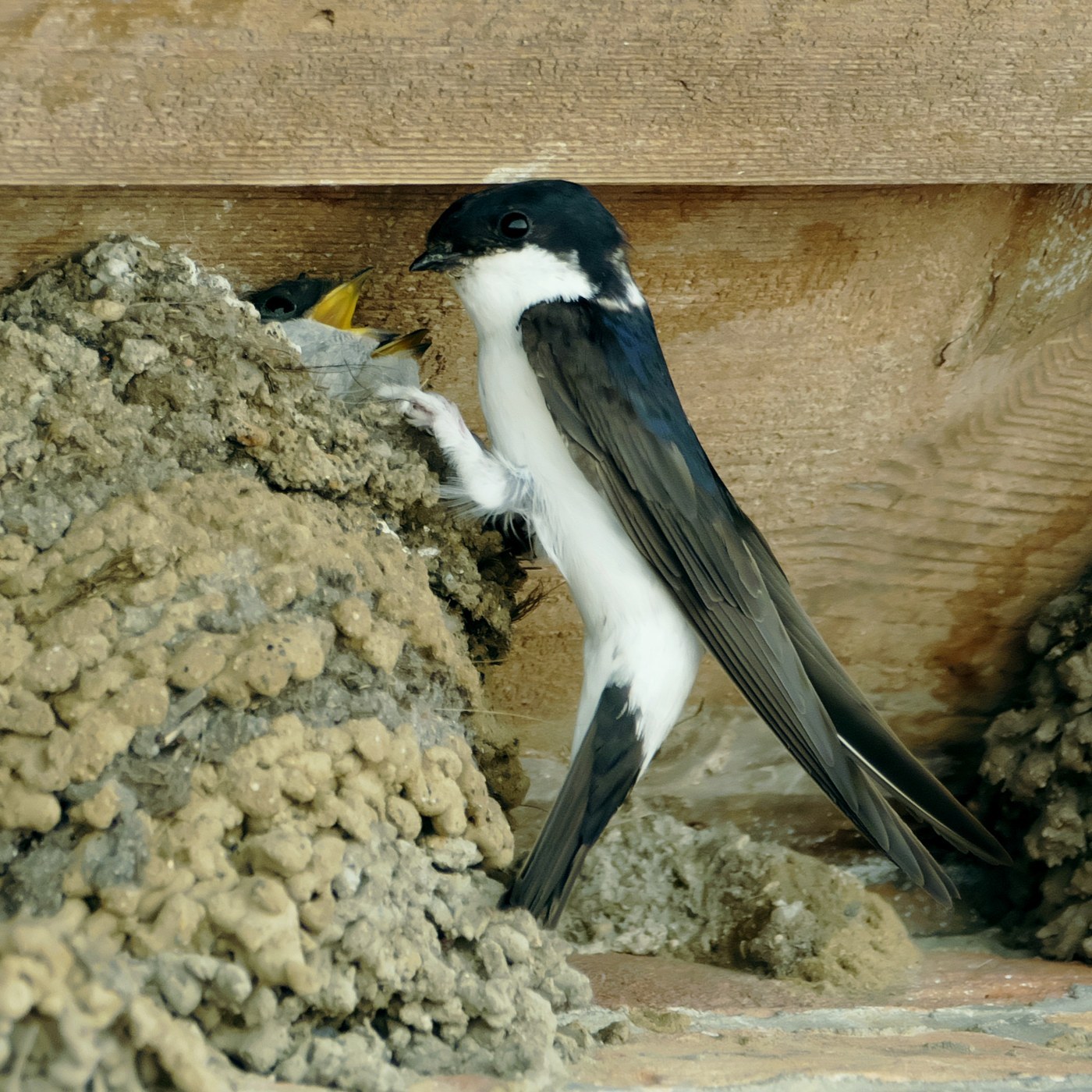
The House Martin is a small aerial songbird with glossy blue-black upperpart feathers, a bright white rump patch, and clean white underparts, built for a life spent almost entirely on the wing.
- Feather type
- Short, forked tail feathers; long pointed flight feathers built for aerial feeding
- Colours
- Glossy blue-black upperparts, pure white rump, white underparts
- Bird size
- Small, ~13 cm
Found a feather like this?
Identify any feather from a photo, free.
Overview
The House Martin is a summer-visiting songbird that nests in mud cup nests under the eaves of buildings, having largely traded natural cliff sites for human structures.
Its plumage is simple but striking: glossy blue-black above with a bright white rump band, and clean white underparts.
As an aerial feeder, its wing feathers are long and pointed, built for sustained flight while catching insects over fields, water, and villages.
Identifying the Feather
Size & Shape
- Flight feathers are long, narrow, and pointed, an adaptation for sustained aerial insect-catching.
- The tail is short and shallowly forked, with feathers shorter and less deeply cut than the Swallow's.
Color & Pattern
- Upperpart (back, crown) feathers: glossy blue-black with a metallic sheen.
- Rump feathers form a distinct, sharply demarcated white band, unique among common European aerial insectivores.
- Underparts, including legs, are white; the legs are feathered white down to the toes.
Similar Species
- The bright white rump patch immediately separates House Martin feathers from Swallow (which lacks a white rump) and Sand Martin (which is brown above, not glossy blue-black).
Plumage & Molt
Overall Plumage
Glossy blue-black above with a bold white rump band, white underparts, and white-feathered legs.
Sex & Age Differences
Sexes look similar. Juveniles are duller, browner above with a less glossy sheen, before their first complete molt.
Molt
Molts mainly on the African wintering grounds, replacing all feathers before returning to breed.
Habitat & Range
Habitat
Villages, towns, farms, and cliffs, generally near open country or water where aerial insects are abundant.
Range
Breeds across Europe, Asia, and North Africa; winters in sub-Saharan Africa.
Movements
Fully migratory, present in breeding areas only from spring to early autumn.
Behavior & Field Notes
Behavior
Feeds almost entirely on the wing, flying high to catch airborne insects, often in groups over villages and fields.
Diet
Feeds on flying insects caught in flight.
Nesting
Builds an enclosed mud cup nest under building eaves, often in loose colonies.
Voice
A soft, twittering call and song given both in flight and at the nest.
Field Notes
A feather with glossy blue-black upperparts and a clear white rump, found near buildings, is a reliable sign of House Martin.
Frequently asked questions
What is the single best feature for identifying a House Martin feather?
The bright white rump patch, sharply set off from the glossy blue-black back - a feature Swallow and Sand Martin lack.
How do House Martin feathers differ from Swallow feathers?
Swallows lack the white rump and have longer tail streamers; House Martin has a shorter, shallow fork and a white rump band.
Where would I find a House Martin feather?
Near buildings with eaves, especially villages and farms, during the spring-to-autumn breeding season.
Are House Martin legs feathered?
Yes, they are covered in short white feathers down to the toes, unusual among small songbirds.
House Martin guides
In-depth guides for identifying and understanding House Martin.
Other feathers you may enjoy

Yellow-breasted Bunting
Contour and flight feathers, chestnut-and-yellow breeding pattern

Sedge Wren
Tiny streaked crown and back feathers

Yellow-winged Cacique
Glossy black body feathers, yellow wing patch, shaggy crest

Yellow Warbler
Small contour and flight feathers

Yellow-throated Warbler
Small contour and flight feathers

Yellow-throated Vireo
Bright yellow throat and spectacle feathers; olive-green back feathers; two white wing-bar feathers

Yellow-rumped Warbler
Small contour and flight feathers

Yellow-hooded Blackbird
Contrasting hood and body feathers

Yellow-headed Blackbird
Glossy black body plumage with a bright yellow head and breast

Yellow-eyed Junco
Contour and flight feathers

Yellow-fronted Canary
Small, smooth body plumage

Yellow-breasted Greenfinch
Compact, smooth body plumage