
How to Identify Jenday Conure Feathers
A guide to recognizing the fiery orange-red, yellow, and green feathers of the Jenday Conure and telling them apart from Sun and Nanday Conure feathers.
Read the full Jenday Conure encyclopedia entry →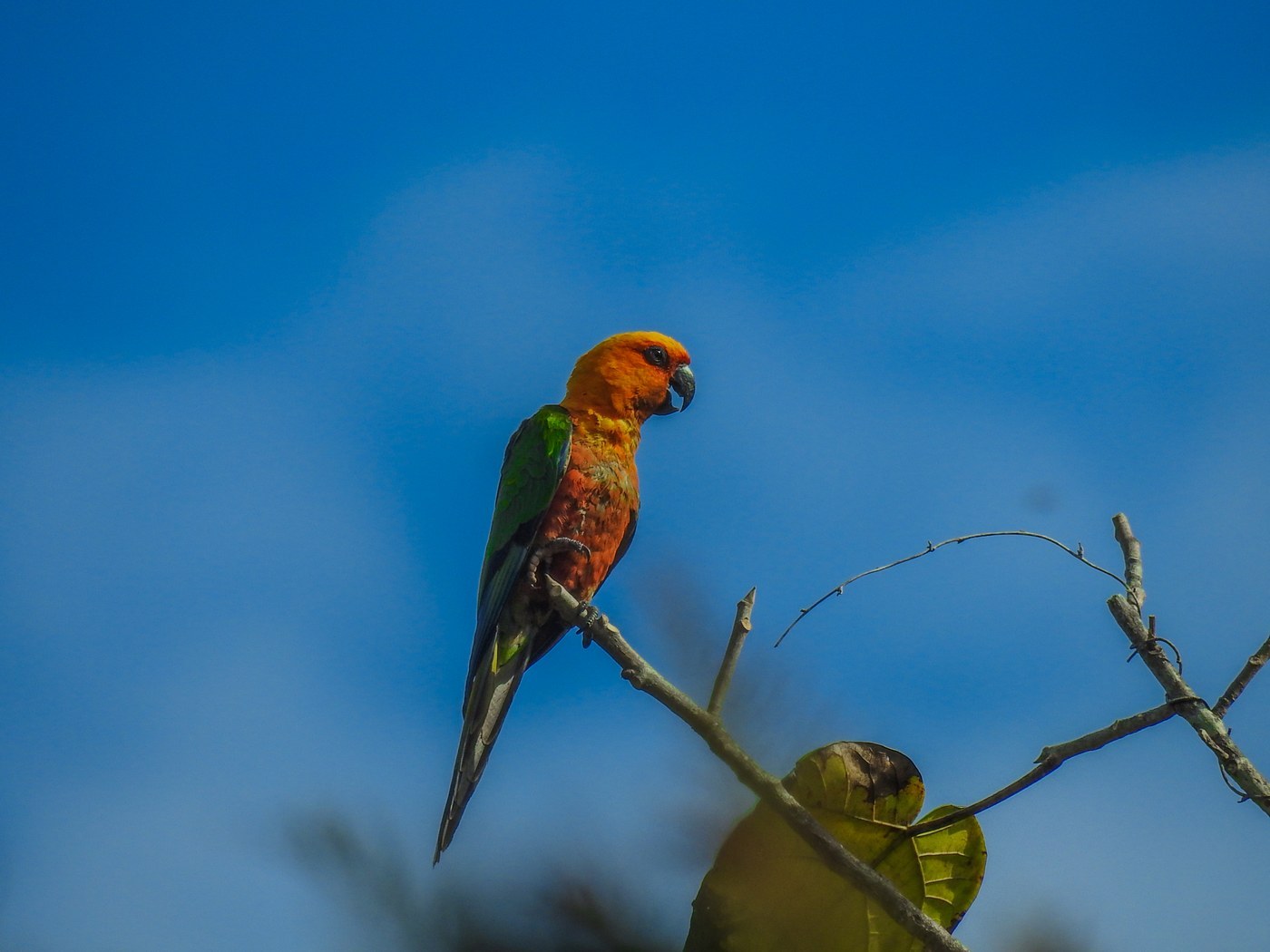
What Jenday Conure Feathers Look Like
The Jenday Conure is a small, showy parrot whose plumage runs through an intense color gradient rather than sitting in one flat tone. Head and neck feathers are bright golden-yellow to orange-yellow, shading down through the chest and belly into deep orange-red, sometimes with faint olive flecking on a young bird's crown feathers. Back and wing covert feathers are solid grass green, contrasting sharply with the fiery head and underparts. Flight feathers (primaries and secondaries) are green at the base with blue tips and blue outer webs, a two-tone effect that's easy to spot even on a single detached feather. The tail is long and tapered for the bird's size, olive-green above and a duller blue-green underneath, with the central feathers longest. All contour feathers have a fairly stiff, glossy parrot texture — smooth-barbed and slightly curved — rather than the softer, looser feel of songbird feathers. Down at the base, feathers are pale grayish-white fluff typical of parrots.
Step-by-Step: Is This Feather From a Jenday Conure?
- Check the color transition. A single body feather that's solid orange-red (belly/chest) or solid yellow-orange (head) with no barring or streaking is a strong parrot signature; look for other candidate feathers nearby to confirm the yellow-to-red gradient across the bird.
- Inspect flight feathers for blue tips. Green primaries/secondaries with distinctly bluer tips and outer edges point to a conure-type parrot rather than a native songbird.
- Feel the texture. Stiff, glossy, curved barbs with little softness indicate parrot plumage, not a dove, thrush, or blackbird feather of similar color.
- Measure the tail feathers. Long, tapered, olive-green tail feathers (often 10+ cm) fit a conure-sized parrot; shorter, rounder tail feathers suggest a different bird.
- Consider location. In the wild this species is Brazilian; anywhere else (including Florida, where escaped/feral populations persist) a matching feather likely comes from an aviary escapee or a naturalized flock rather than a native bird.
Similar Species & How to Tell Them Apart
- Sun Conure is very similar but tends toward more solid golden-yellow overall with less deep red on the belly, and juveniles show more green mottling on the body than a Jenday of the same age.
- Nanday Conure (Black-hooded Parakeet) is mostly green with a contrasting black head and face and blue on the belly — its body feathers are green, never the orange-red seen on a Jenday's underparts.
- Golden-capped Conure shows a golden-yellow cap restricted to the crown with a mostly green body, lacking the Jenday's full head-to-chest orange-red wash.
- Peach-fronted Conure has only a small orange patch on the forehead and is otherwise green, so an all-orange-red body feather rules it out.
Where & When You'll Find Them
Jenday Conures are native to a small range in northeastern Brazil, favoring palm groves, forest edges, and cultivated land with scattered trees. Outside their native range, feral and escaped populations turn up in warm-climate cities, most notably parts of Florida, where they associate with other conure species around fruiting trees and bird feeders. Because parrots molt gradually and continuously rather than all at once, their feathers can be found in any season, though body feather loss often ticks up after breeding season as birds refresh worn plumage. Look near roost trees, feeder areas, and palm canopies where small, noisy flocks gather.
Frequently asked questions
What color should I expect on a Jenday Conure body feather?
Solid yellow-orange on the head and neck grading into deep orange-red on the chest and belly, with no streaking or barring — a flat, saturated color block is typical of parrot contour feathers.
How do I tell a Jenday feather from a Sun Conure feather?
Sun Conure feathers skew more solidly golden-yellow with less deep red on the underparts, while Jenday feathers show a stronger, deeper orange-red wash on the belly and chest.
Why do the flight feathers look two-toned?
Jenday Conure primaries and secondaries are green at the base with blue tips and outer webs, a color split that's a reliable diagnostic even on an isolated flight feather.
Could I find a Jenday Conure feather outside Brazil?
Yes — feral and escaped populations are established in warm regions like Florida, so a matching feather there likely comes from a naturalized or escaped bird rather than a truly wild one.
Does feather texture help separate parrots from songbirds?
Yes — parrot feathers have stiffer, glossier, more curved barbs than the softer feathers of doves, thrushes, or blackbirds, which is a quick tactile check when the color is ambiguous.