
How to Identify Laughing Dove Feathers
How to recognize the pinkish-cinnamon body and speckled necklace feathers of the Laughing Dove, and separate it from the similar Collared Dove.
Read the full Laughing Dove encyclopedia entry →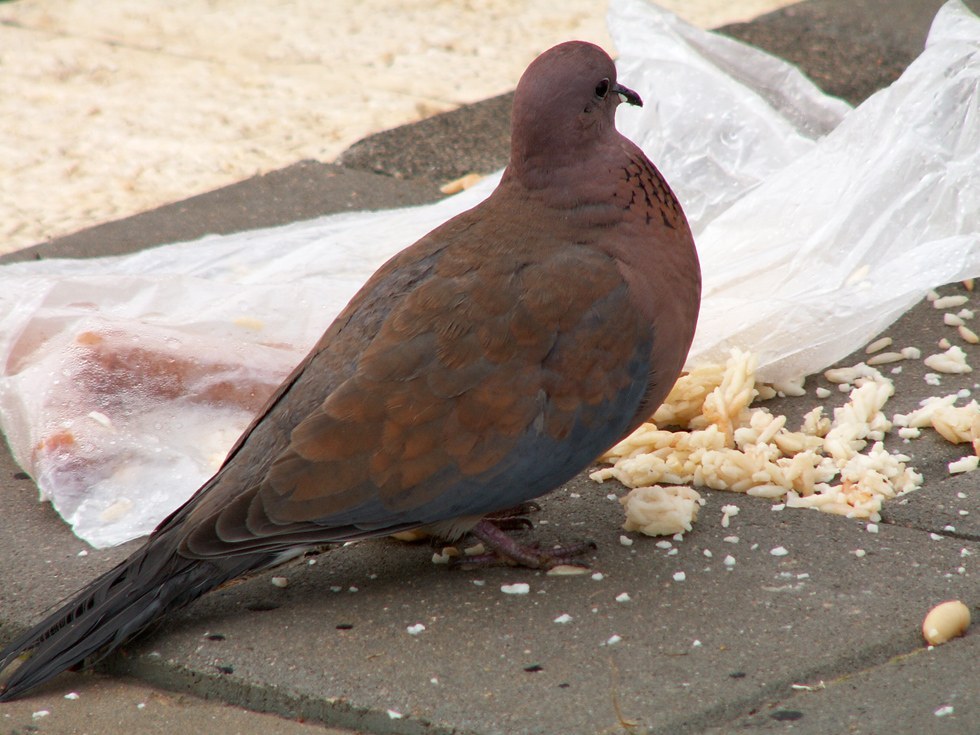
What Laughing Dove Feathers Look Like
The Laughing Dove is a small, slender dove with warm, soft coloring rather than the grayer tones of many related doves.
- Body/contour feathers: Warm pinkish-cinnamon on the breast and underparts, grading to soft gray-blue on the crown and grayish on the belly and undertail.
- Necklace patch feathers: A distinctive patch of small feathers on the upper breast/lower neck shows a black-and-rufous speckled or scaled pattern, quite different from a plain feather — this patch is a strong diagnostic if found intact.
- Wing covert feathers: Blue-gray with some showing small blackish spots, giving a subtly two-toned look.
- Flight feathers: Slate-gray, edged with a warm rufous or cinnamon fringe, especially on the coverts nearest the body.
- Tail feathers: Graduated (longer in the center, shorter at the edges), blackish, with white tips visible on the outer feathers from below, typical of many small doves.
- Size: Feathers are modest — flight feathers roughly 3-4 inches (7.5-10 cm), fitting a bird a bit smaller than a city pigeon.
Step-by-Step: Is This Feather From a Laughing Dove?
- Check the color first. A warm pinkish-cinnamon tone (rather than pale gray or brown) on a small, dove-shaped contour feather is a good starting clue.
- Look for the speckled necklace pattern. A small feather showing black-and-rufous mottling or scaling, rather than a solid or streaked pattern, likely came from the necklace patch — this is the most distinctive feather this species offers.
- Check for a full collar band. If the feather instead suggests a solid black half-collar rather than a speckled patch, you may have a Collared Dove instead (see below).
- Inspect the tail. Graduated shape with white tips on the outer feathers fits typical small-dove tail structure.
- Consider range. A find in Africa, the Middle East, or South Asia (with some introduced populations elsewhere) supports this identification over other regional doves.
Similar Species & How to Tell Them Apart
- Eurasian Collared-Dove: Shows a solid, clean black half-collar band on the back of the neck rather than a speckled patch on the front of the breast — the pattern type (solid band vs. speckled patch) and its location (nape vs. upper breast) are the key differences.
- Spotted Dove: Has a broader black-and-white spotted collar patch on the side/back of the neck, coarser and more contrasty than Laughing Dove's finer speckling.
- Mourning Dove: Lacks any necklace patch entirely and shows a plainer buffy-brown body feather with black wing spots rather than cinnamon tones.
- Rock Pigeon: Much more variable but generally lacks the warm cinnamon breast tone and speckled necklace pattern altogether.
Where & When You'll Find Them
Laughing Doves are widespread across Africa, the Middle East, and parts of South Asia, favoring dry open country, farmland, gardens, and urban areas, with introduced populations established in a few other regions. They are largely non-migratory, so feathers can be found year-round wherever the species is resident, most commonly near human settlements and cultivated land where they forage on the ground. Molt is gradual through the year rather than concentrated in a short window, so there's no single best season to search.
Frequently asked questions
What is the single best clue for identifying a Laughing Dove feather?
A small feather with a speckled black-and-rufous mottled pattern from the upper breast necklace patch is the most distinctive and easiest feature to key on.
How do I tell this apart from a Collared Dove feather?
Collared Dove shows a solid black half-collar band on the nape, while Laughing Dove shows a speckled, scaled patch on the front of the upper breast — check both the pattern type and its location.
Why does the breast feather look pink rather than gray?
Laughing Doves have a notably warmer, pinkish-cinnamon breast tone compared to the grayer or buffier tones of many related doves, which is a useful color clue on its own.
Are Laughing Dove feathers found year-round?
Yes, since the species is largely non-migratory and molts gradually through the year, feathers can be found in any season within its resident range.