
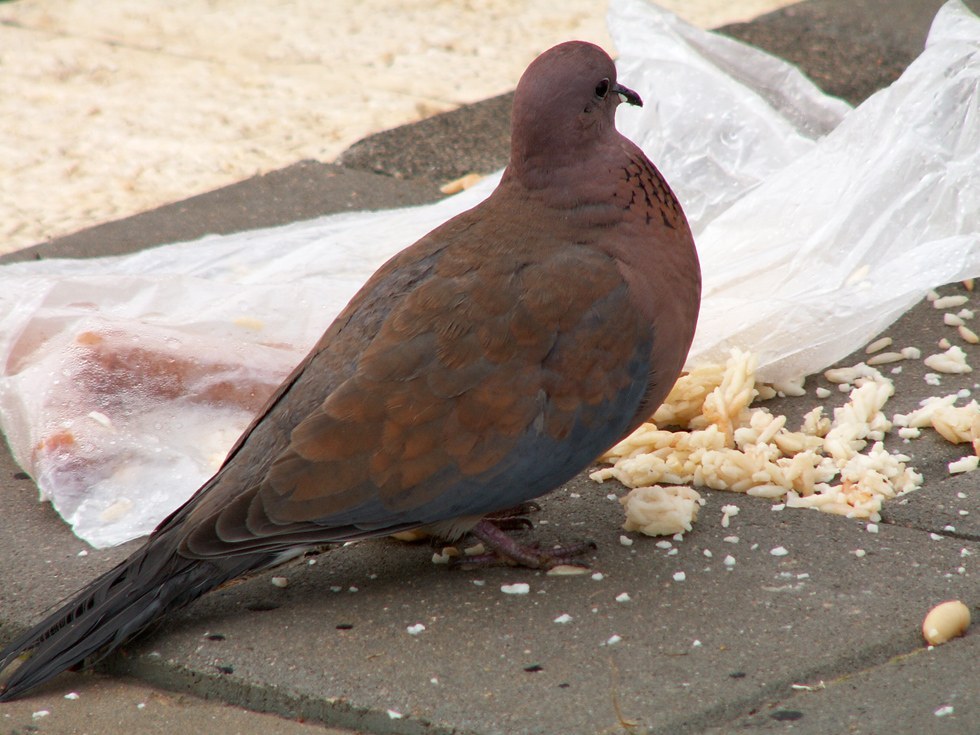
Laughing Dove
Spilopelia senegalensis
A small, warm pinkish-cinnamon dove named for its bubbling, laugh-like coo, with a distinctive speckled black patch across the upper breast.
- Feather type
- Fine contour feathers with a small speckled breast patch
- Colours
- Pinkish-cinnamon body with a small black-speckled patch on the upper breast and blue-gray wing coverts
- Bird size
- Small dove, ~25-27 cm
Found a feather like this?
Identify any feather from a photo, free.
Overview
The Laughing Dove is a small, slender dove widespread across Africa and into the Middle East and South Asia. It has a warm pinkish-cinnamon head and breast, blue-gray patches on the wing coverts, and a small, checkered black-and-rufous patch across the upper breast that resembles a scattering of fine speckles rather than a solid collar. It is one of the most familiar doves in gardens and villages across its range.
Identifying the Feather
- Upper breast feathers: rufous-buff with small black tips arranged in a checkered or speckled patch, unlike the solid black collar of Streptopelia doves
- Wing covert feathers: pale blue-gray, forming a soft panel that contrasts with the warmer body tones
- Tail feathers: dark brown with white outer tail-feather tips visible in flight
- Overall body feathers: notably small and slim compared to other regional doves, with a delicate, warm pinkish cast
- Compare with the Spotted Dove, which is larger with a bold black-and-white spotted neck collar rather than a speckled breast patch
Plumage & Molt
Sexes are similar, though males may show a slightly more vivid pinkish breast during the breeding season. Juveniles lack the speckled breast patch and appear duller and more uniformly buff until their first molt. The species undergoes regular molts that can occur somewhat opportunistically given its wide range of climates.
Habitat & Range
Laughing Doves occupy semi-arid savanna, scrubland, farmland, and human settlements across most of sub-Saharan Africa, North Africa, the Middle East, and into the Indian subcontinent. They are largely sedentary residents, well adapted to hot, dry climates and often found around villages and cultivated land.
Behavior & Field Notes
This dove forages on the ground for small seeds, often in pairs, and is notably tame around people. Its call is a soft, bubbling series of coos that gives rise to its common name. Nests are flimsy stick platforms built low in bushes, trees, or on structures. It is frequently seen dust-bathing and drinking at shared water sources with other small birds.
Frequently asked questions
What feather pattern distinguishes the Laughing Dove?
A small, checkered black-and-rufous speckled patch on the upper breast is the key identifying mark, rather than a full collar.
Are the wing feathers a useful clue?
Yes, the pale blue-gray wing covert panel contrasts noticeably with the warm pinkish body tones.
How do juvenile feathers differ?
Juveniles lack the speckled breast patch and appear more plainly buff-brown until they molt into adult plumage.
Does this species show any collar like other doves?
No, unlike Streptopelia doves it lacks a solid neck collar; its breast marking is finer and more speckled in appearance.
Laughing Dove guides
In-depth guides for identifying and understanding Laughing Dove.
Other feathers you may enjoy

Victoria Crowned Pigeon
Large lace-like fan crest plumes over dense body contour feathers

Plain Pigeon
Contour feathers, plain and uniformly toned, with a white wing patch

Zenaida Dove
Contour and flight feathers, faint iridescent sheen on neck

Pink Pigeon
Soft contour feathers with graduated tail

Nicobar Pigeon
Long, hackle-like elongated neck feathers with iridescent sheen
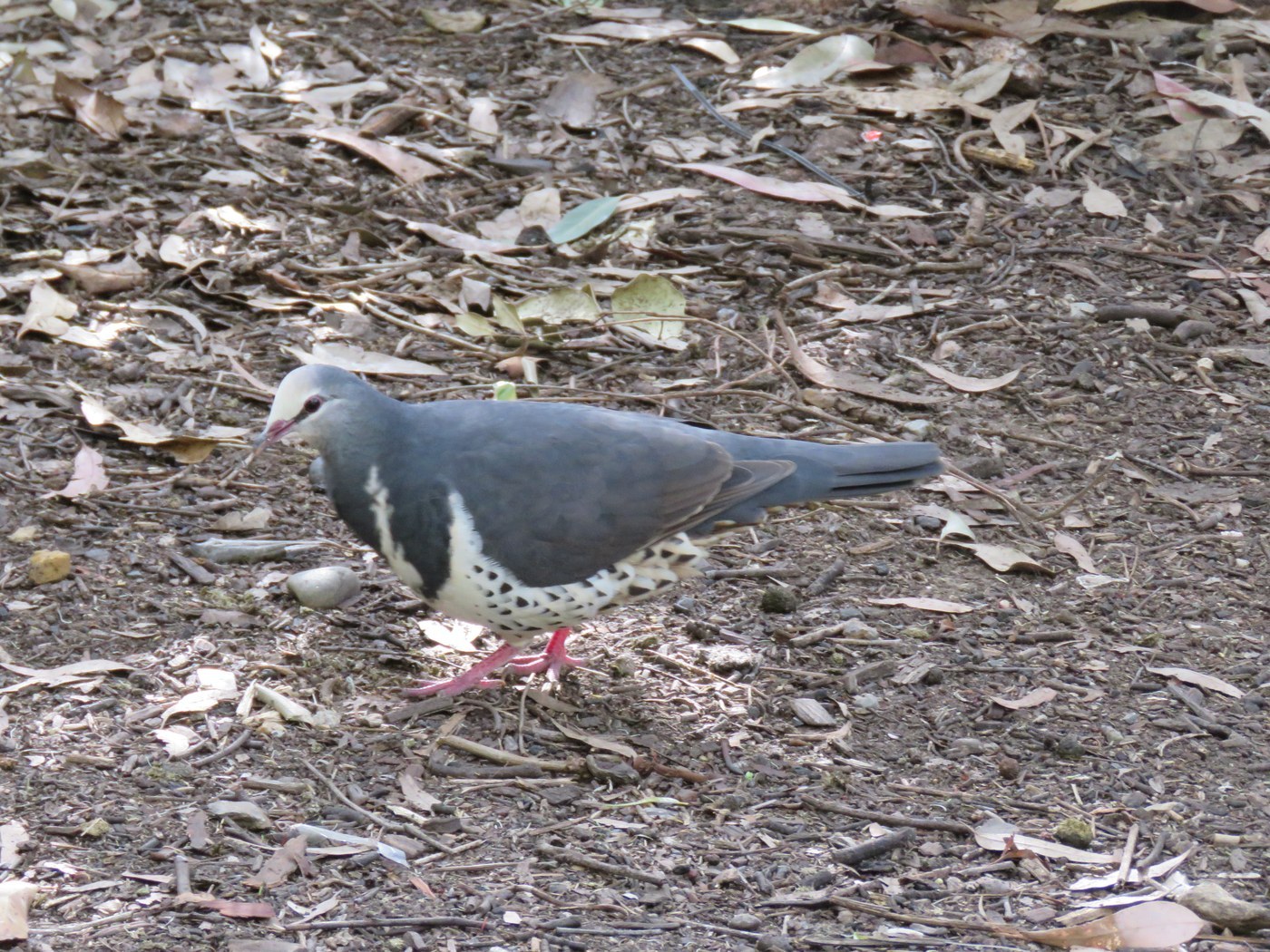
Wonga Pigeon
Dense, soft body contour feathers over a stocky frame

Squatter Pigeon
Dense, cryptic body contour feathers with a bold facial pattern

White-winged Dove
Broad, sturdy flight feathers with a bold white wing stripe

Western Crowned Pigeon
Rounded fan crest plumes over dense soft body feathers

Snow Pigeon
Dense insulating body contour feathers with a bold white rump and belly patch

Zebra Dove
Contour feathers with bold, extensive black-and-white barring

Scaly-naped Pigeon
Contour feathers with iridescent scaled nape pattern