
How to Identify Lesser Spotted Woodpecker Feathers
A guide to identifying Lesser Spotted Woodpecker feathers by their small size, ladder-barred black-and-white back, and lack of a red vent patch.
Read the full Lesser Spotted Woodpecker encyclopedia entry →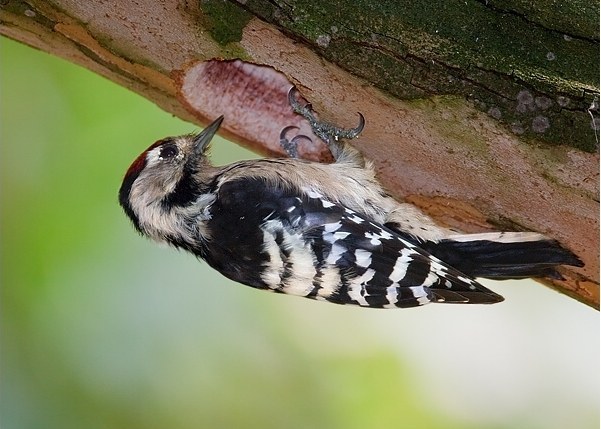
What Lesser Spotted Woodpecker Feathers Look Like
Lesser Spotted Woodpeckers are Europe's smallest woodpecker, barely bigger than a sparrow, and their feathers are correspondingly tiny — most body feathers are under 3 cm. The back is the key diagnostic area: rather than the bold solid white shoulder patches seen in larger relatives, this species shows a "ladder-barred" pattern of horizontal black-and-white bars running across the whole back, giving a striped rather than blotched look. Wing (flight) feathers are black with neat white spotting along both edges, creating fine white bars across the closed wing. The underparts are off-white to pale buff with light dark streaking on the flanks, unlike the clean white belly of some relatives. Males show a small red crown patch at the very top of the head with black bordering, while females have an entirely black-and-white crown with no red at all. Neither sex shows any red on the vent/undertail area, a useful negative clue. Tail feathers are black with white outer edges, stiffened at the tip like all woodpeckers for use as a prop against tree trunks.
Step-by-Step: Is This Feather From a Lesser Spotted Woodpecker?
- Check the size first. Body feathers under 3 cm and wing feathers under about 6–7 cm point strongly to this species over larger woodpeckers.
- Look at the back pattern. Horizontal black-and-white "ladder" barring across the whole back (not solid white patches) is the single best diagnostic.
- Check for a small red crown feather — present only in males, bordered by black, and confined to the very top of the head.
- Rule out red vent feathers. Absence of any red or pink feather from the undertail area supports this species over most other spotted woodpeckers.
- Look at flank feathers — light dusky streaking on an off-white background fits this species.
- Note the tail — small, stiff, black-and-white edged feathers consistent with a very small woodpecker.
Similar Species & How to Tell Them Apart
The Great Spotted Woodpecker is much larger and shows solid, bold white patches on the shoulders/scapulars rather than horizontal barring, plus a bright red vent patch that Lesser Spotted Woodpecker never has — these two features alone rule it out. The Middle Spotted Woodpecker (found in parts of continental Europe) is intermediate in size, with a pale pinkish (not bright red) vent and a different crown pattern, but is still notably larger than Lesser Spotted Woodpecker. Eurasian Wryneck feathers are cryptically barred brown and grey overall, entirely lacking the crisp black-and-white pattern of true woodpeckers, making it an easy separation.
Where & When You'll Find Them
Lesser Spotted Woodpeckers favor mature deciduous woodland, orchards, parks, and riverside trees with plenty of dead wood across Britain, continental Europe, and temperate Asia. Because they nest in small excavated cavities high in slender branches, feathers are most likely to be found beneath nest trees during the breeding season (April through June) or scattered in leaf litter below favored feeding trees where the birds forage for wood-boring insect larvae year-round, with an additional pulse during the post-breeding molt in late summer.
Frequently asked questions
What is the main feather difference from a Great Spotted Woodpecker?
Lesser Spotted Woodpecker shows horizontal black-and-white barring across the back rather than solid white shoulder patches, and it never has the red vent patch Great Spotted Woodpecker shows.
How can I tell a male feather from a female feather?
Only males show a small red crown patch bordered by black; females have an entirely black-and-white crown with no red.
How small are the feathers compared to other woodpeckers?
Very small — body feathers are typically under 3 cm and wing feathers under 6–7 cm, reflecting its status as Europe's smallest woodpecker.
Does this species ever show red under the tail?
No, neither sex shows red on the vent or undertail coverts, which helps rule it out from most other spotted woodpeckers.
Where should I look for these feathers?
Beneath mature deciduous trees with dead wood, especially near small nest cavities in slender branches during spring, or under feeding trees year-round.