
How to Identify Lesser Yellowlegs Feathers
A guide to identifying Lesser Yellowlegs feathers using their mottled grey-brown upperparts, fine straight bill proportions relative to Greater Yellowlegs, and bright yellow leg color.
Read the full Lesser Yellowlegs encyclopedia entry →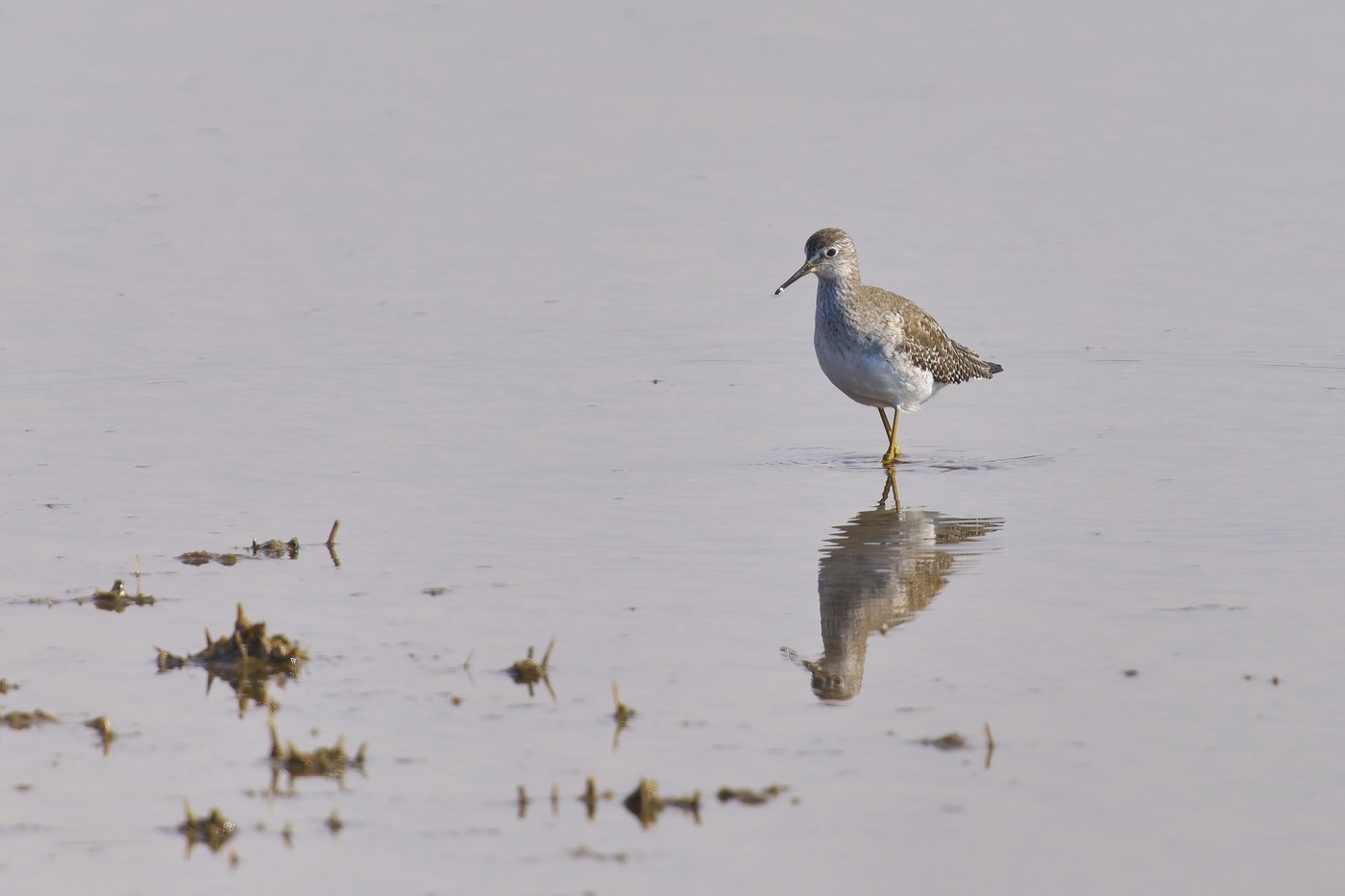
What Lesser Yellowlegs Feathers Look Like
Lesser Yellowlegs are slim, elegant shorebirds, and their feathers show a restrained, mottled palette suited to open mudflats. Upperpart (back and covert) feathers are grey-brown with fine pale spotting or notching along the edges, giving a soft, evenly speckled look rather than bold contrast. Underparts are white with light grey-brown streaking on the breast and flanks, becoming cleaner white toward the belly. Flight feathers are dark grey-brown and relatively unpatterned, with a plain, unbarred appearance compared to some other shorebirds — Lesser Yellowlegs lacks a bold white wing stripe in flight. The tail is white with narrow grey-brown barring across each feather. While the leg color itself (bright yellow to orange-yellow) isn't part of the feather, any leg fragment found attached to a feather sample is a strong supporting clue. Overall feather size is notably smaller and more delicate than the closely related Greater Yellowlegs, with covert and back feathers rarely exceeding 4–5 cm.
Step-by-Step: Is This Feather From a Lesser Yellowlegs?
- Measure it. Lesser Yellowlegs body and covert feathers are small and slim; anything notably larger and coarser suggests Greater Yellowlegs instead.
- Check the mottling pattern. Fine, evenly spaced pale spotting on grey-brown upperpart feathers fits this species well.
- Look for plain, dark flight feathers without a strong white wing stripe.
- Check for a bright yellow leg fragment, if present, as strong supporting (though not standalone) evidence.
- Assess overall daintiness. A slim, lightly built feather suggests the more delicate Lesser rather than the bulkier Greater Yellowlegs.
- Note habitat — shallow freshwater wetlands, flooded fields, and mudflats fit this species' preferences.
Similar Species & How to Tell Them Apart
The Greater Yellowlegs is the classic confusion species, being larger overall with coarser, bolder mottling on the upperparts and proportionally larger flight feathers — size is the main separator, though it can be subtle without a direct comparison. The Solitary Sandpiper shows more contrasting dark upperpart feathers with fine white spotting and a more strongly barred tail pattern than Lesser Yellowlegs. Wilson's Snipe feathers are much more boldly and intricately patterned with dark brown, buff, and black stripes, an easy contrast against the simpler mottling of a yellowlegs. Stilt Sandpiper feathers are similar in tone but generally show finer, more uniform barring on the underparts in breeding plumage.
Where & When You'll Find Them
Lesser Yellowlegs breed in boreal forest muskeg and open bogs across Canada and Alaska, then migrate through much of North America to winter on coastal mudflats, flooded fields, and wetlands from the southern U.S. through Central and South America. Feathers are most likely to be found during migration stopovers (spring and especially fall, from July through October) at shallow wetlands, sewage ponds, and flooded agricultural fields where flocks gather to feed, as well as on wintering grounds throughout the colder months.
Frequently asked questions
How do I tell Lesser Yellowlegs feathers from Greater Yellowlegs feathers?
Size and coarseness are the main clues — Lesser Yellowlegs feathers are smaller and show finer mottling, while Greater Yellowlegs feathers are larger with bolder, coarser patterning.
Do Lesser Yellowlegs feathers have a wing stripe?
No, the flight feathers are plain dark grey-brown without a bold white wing stripe, unlike some other shorebirds.
Is a yellow leg fragment a reliable identifier on its own?
It supports the ID but isn't conclusive alone since Greater Yellowlegs also has yellow legs; feather size and pattern should be checked together with it.
What habitat should I search for these feathers in?
Shallow freshwater wetlands, flooded fields, sewage ponds, and mudflats, especially during migration stopovers.
When is migration timing best for finding these feathers?
Fall migration from July through October brings the largest numbers through most of North America, alongside a smaller spring passage.