
How to Identify Little Bee-eater Feathers
A guide to identifying Little Bee-eater feathers by their green upperparts, yellow throat with a black gorget, and cinnamon underparts, without elongated tail streamers.
Read the full Little Bee-eater encyclopedia entry →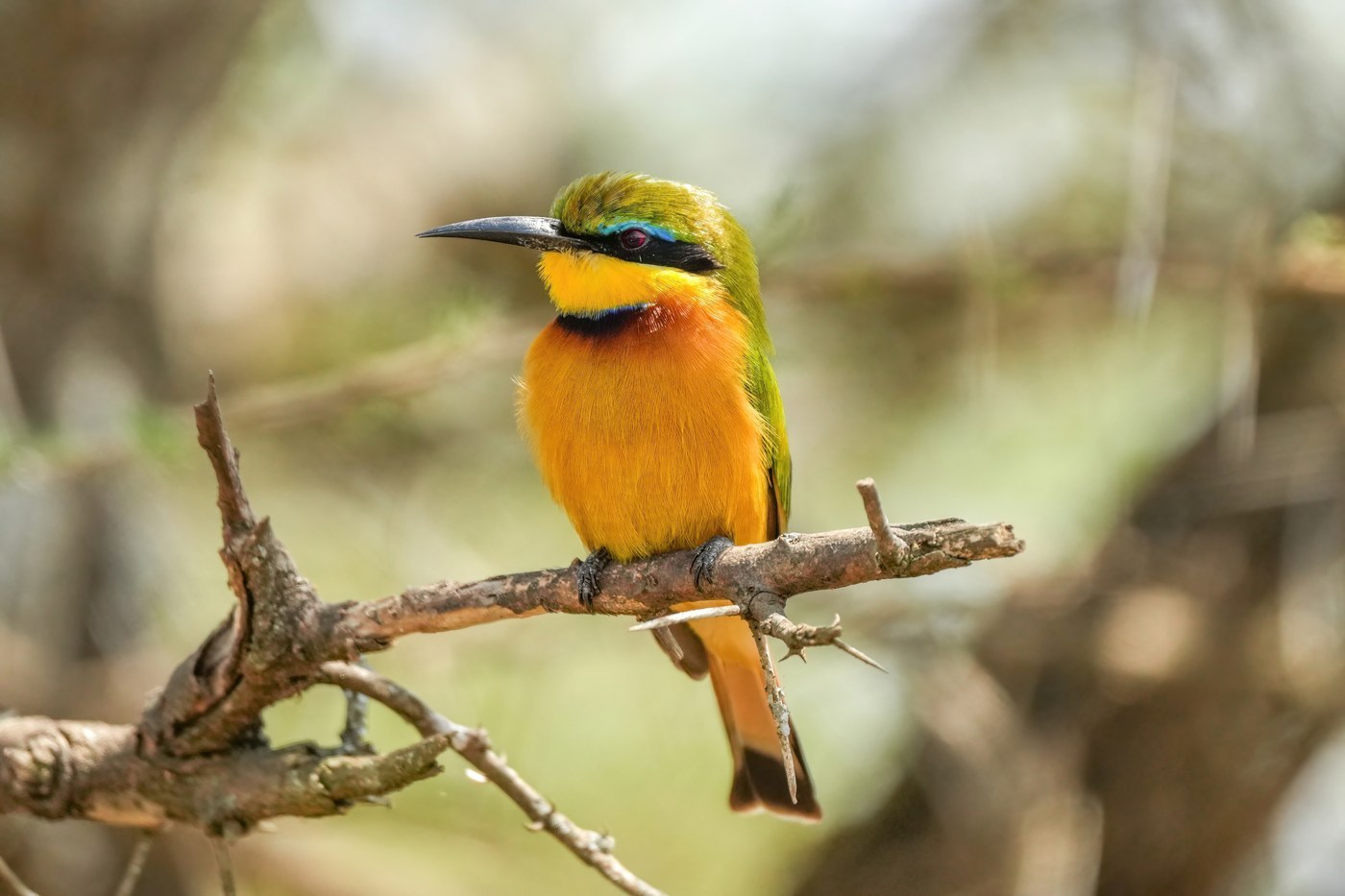
What Little Bee-eater Feathers Look Like
The Little Bee-eater is the smallest African bee-eater, and its compact size is reflected in every feather. Upperpart (crown, back, and wing covert) feathers are bright grass-green, giving strong camouflage against foliage. The throat feathers are bright yellow, bordered below by a narrow black gorget (breast band) that sharply separates the yellow throat from the underparts — this yellow-then-black sequence on the throat/breast feathers is a key diagnostic. Below the black band, the belly and underpart feathers turn warm cinnamon to rufous-orange, a distinctly warm tone compared to the cooler greens above. A black mask-like stripe runs through the eye, and the wing (flight) feathers are green with blackish tips, visible as a dark band along the trailing edge of the closed wing. Unlike several larger bee-eaters, the tail is relatively short and squared or slightly forked, without elongated central tail streamers — this lack of streamers is an important negative clue, since many related bee-eater species have prominent tail extensions.
Step-by-Step: Is This Feather From a Little Bee-eater?
- Check for a bright yellow throat feather bordered by a narrow black band, transitioning to cinnamon-orange below — a distinctive three-tone throat-to-belly sequence.
- Assess tail feather shape. Short and squared or only slightly forked, without elongated streamers, supports this species over several similar-looking bee-eaters.
- Look at overall size. Feathers should be small, consistent with one of the smallest bee-eaters in Africa.
- Check wing feather color. Green with blackish tips forming a dark trailing band on the closed wing.
- Look for a black eye mask feather, if facial feathers are present.
- Confirm habitat — open savanna, grassland, or wetland edge in sub-Saharan Africa fits this species.
Similar Species & How to Tell Them Apart
The Swallow-tailed Bee-eater is similarly small and green but shows a deeply forked, swallow-like tail with elongated outer feathers, quite different from the short tail of the Little Bee-eater. The Blue-cheeked Bee-eater is notably larger, with a blue facial stripe and elongated central tail streamers, plus a greener (less cinnamon) underside. The White-fronted Bee-eater shows a white forehead patch and a red throat patch rather than the yellow-to-black-to-cinnamon sequence of the Little Bee-eater, an easy distinction. Because tail length and the specific throat color sequence vary meaningfully across African bee-eater species, checking both together gives a reliable identification.
Where & When You'll Find Them
Little Bee-eaters favor open savanna, grassland, wetland margins, and cultivated land across much of sub-Saharan Africa, often perching low on shrubs or reeds while sallying out after flying insects. As a largely resident or short-distance nomadic species depending on local rainfall patterns, feathers can be found throughout the year, with some increase near nest burrows (excavated in sandy banks or flat ground) during the regional breeding season, which varies by location but often coincides with drier periods when insect prey and nesting conditions are favorable.
Frequently asked questions
What is the key throat-to-belly feather pattern for this species?
A bright yellow throat feather bordered by a narrow black band, transitioning into warm cinnamon-orange underparts below — a distinctive three-tone sequence.
Does the Little Bee-eater have long tail streamers like other bee-eaters?
No, its tail is short and squared or only slightly forked, lacking the elongated central streamers seen in species like the Blue-cheeked Bee-eater.
How is this different from a Swallow-tailed Bee-eater feather?
Swallow-tailed Bee-eater has a deeply forked, swallow-like tail, while Little Bee-eater's tail is short and unforked or only slightly notched.
What color are the wing feather tips?
Blackish, forming a dark band along the trailing edge of the green closed wing.
Where should I search for these feathers?
Open savanna, grassland, and wetland margins across sub-Saharan Africa, near low perches and sandy nest burrows.