
How to Identify Little Wattlebird Feathers
A guide to identifying Little Wattlebird feathers by their streaked grey-brown body plumage, chestnut wing panel, and lack of the visible red wattle found on its larger relative.
Read the full Little Wattlebird encyclopedia entry →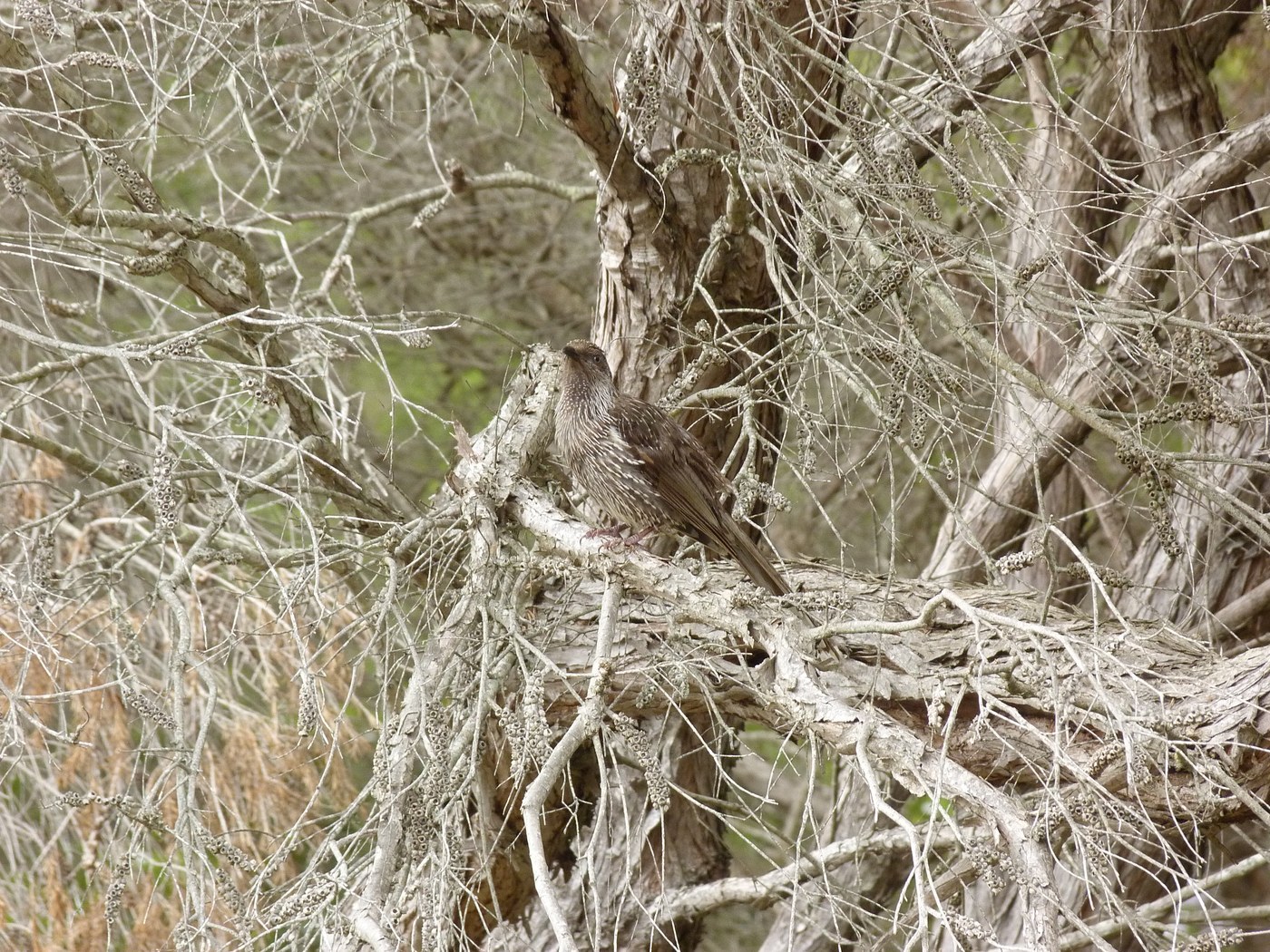
What Little Wattlebird's Feathers Look Like
Despite its name, Little Wattlebird actually lacks visible fleshy wattles on the face, unlike its larger relative the Red Wattlebird — an important point since it means no ornamental facial skin will be found, only feathers. Body (contour) feathers are a streaked grey-brown, with each feather showing a pale shaft-streak down the center, giving the whole bird a fine, lengthwise-streaked look rather than a solid or barred pattern. The lower belly and undertail feathers carry a soft yellowish wash, a useful secondary clue.
The most distinctive single feathers come from the wing: primaries and secondaries show a bold patch of chestnut-rufous at the base, visible as a flash of warm reddish-brown when the wing is spread, contrasting with otherwise dark brownish-grey flight feather tips. Tail feathers are long and graduated, dark brownish-grey with pale, whitish tips on the outer feathers — visible as a thin white edge when the tail is fanned. Overall feather size is moderate for a honeyeater, with primaries around 9-11 cm.
Step-by-Step: Is This Feather From a Little Wattlebird?
- Check for chestnut in the wing. A patch of warm rufous-chestnut at the base of a flight feather is one of the most diagnostic features.
- Look for pale shaft-streaks on body feathers. Fine streaking down a grey-brown feather, rather than barring or spotting, fits Little Wattlebird.
- Assess undertail color. A soft yellowish wash on lower belly/undertail feathers supports this species.
- Examine tail feather tips. Whitish tips on long, graduated dark tail feathers are consistent with Little Wattlebird.
- Confirm no red wattle skin fragment. The absence of any red fleshy tissue helps separate it from Red Wattlebird if any facial skin is attached.
Similar Species & How to Tell Them Apart
- Red Wattlebird — larger overall with a visible fleshy red wattle on the face (if skin is attached), a more prominent white patch on the belly, and a pinkish patch at the base of the bill; its flight feathers also show a chestnut wing patch but the bird is noticeably bigger throughout.
- Western Wattlebird — very similar in pattern to Little Wattlebird but restricted to south-western Australia, with slightly finer streaking; range is often the best separator.
- Noisy Friarbird — lacks the chestnut wing patch and pale streaking, showing instead bare dark facial skin and plainer grey-brown feathers.
Where & When You'll Find Them
Little Wattlebirds inhabit heathland, coastal scrub, and banksia or eucalypt woodland across southern and eastern Australia, feeding on nectar and insects, often aggressively defending flowering shrubs. Feathers are most commonly found around flowering banksia and grevillea stands during the main flowering season (autumn through spring depending on region), when the birds are most active and molt occurs progressively outside the breeding period.
Frequently asked questions
Does Little Wattlebird actually have a wattle I should look for?
No, despite the name, Little Wattlebird lacks visible fleshy facial wattles, unlike the larger Red Wattlebird, so you won't find any wattle skin attached to genuine feathers from this species.
What's the best flight feather clue for this species?
A patch of warm chestnut-rufous at the base of the primaries or secondaries, contrasting with darker brownish-grey feather tips.
How do body feathers differ from Red Wattlebird's?
Little Wattlebird feathers show fine pale shaft-streaking on a grey-brown background and a yellowish undertail wash, while Red Wattlebird is larger with a more prominent white belly patch.
How long are Little Wattlebird flight feathers?
Primaries measure roughly 9-11 cm, a moderate size consistent with a mid-sized honeyeater.
Where and when are these feathers most often found?
Around flowering banksia and grevillea stands in heathland and coastal scrub across southern and eastern Australia, especially during the region's main flowering season.