
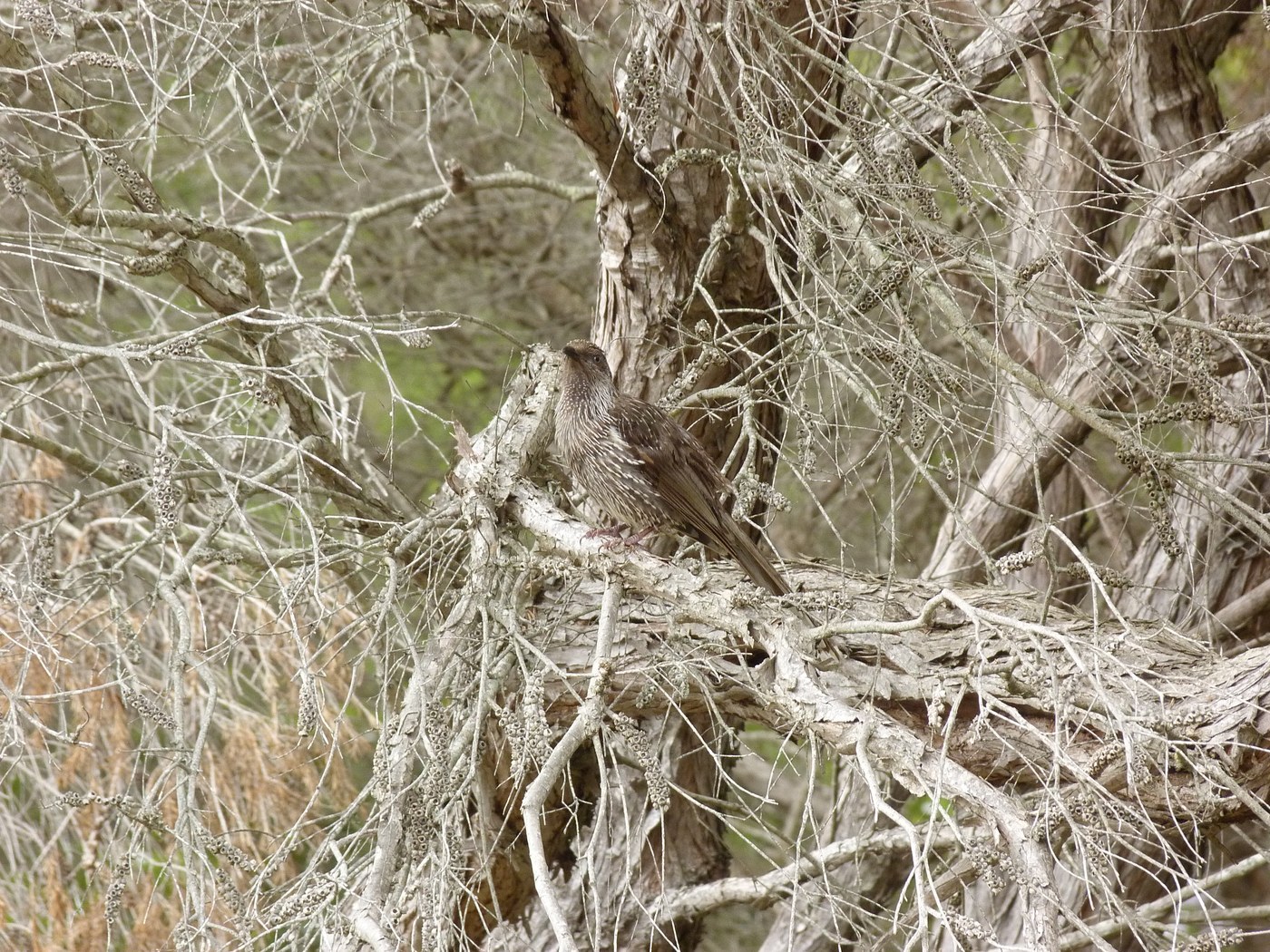
Little Wattlebird
Anthochaera chrysoptera
The Little Wattlebird is a large, grey-brown honeyeater with a rufous wing patch and a long tail, best known for its harsh, coughing calls.
- Feather type
- Coarse, streaked contour feathers with a long, loose-webbed tail
- Colours
- Grey-brown streaking with a warm rufous wing patch
- Bird size
- Large honeyeater, ~28 cm
Found a feather like this?
Identify any feather from a photo, free.
Overview
Overview
Despite its name, the Little Wattlebird is a substantial honeyeater, smaller only in comparison to its larger relative the Red Wattlebird. Unlike other wattlebirds it lacks conspicuous fleshy wattles on the face, which can make its common name puzzling to newcomers.
- Family: Meliphagidae (honeyeaters)
- Distribution: coastal southern Australia, including Tasmania
- Notable trait: obvious rufous patch in the open wing
Identifying the Feather
Feather Identification
Body feathers are streaked grey-brown overall, giving a somewhat scruffy, mottled appearance rather than bold patterning. The most distinctive feather feature is the rufous-chestnut patch across the primaries, conspicuous in flight or when the wing is spread. The tail is long and dark with narrow pale tips to the outer feathers.
- Overall tone: streaky grey-brown, no strong facial wattle
- Key mark: rufous wing patch
- Compare with: Red Wattlebird (larger, with a red facial wattle and yellow belly patch)
Plumage & Molt
Plumage
Sexes are alike in pattern, with males larger than females. Juveniles resemble adults but are duller with less defined streaking. There is no marked seasonal plumage change, with feather condition simply freshening after the post-breeding moult.
Habitat & Range
Habitat & Range
Little Wattlebirds favour coastal heath, banksia and eucalypt woodland, and scrubby forest edges across southern Australia, including Tasmania. They are largely sedentary but will move locally in response to flowering patterns of their preferred nectar plants.
Behavior & Field Notes
Behavior & Field Notes
This species feeds on nectar, especially from banksias, along with insects taken from foliage or in flight. It is a noisy, conspicuous bird, often first detected by its harsh, coughing or grating call notes given from an exposed perch. Nests are untidy stick cups placed in dense shrubbery.
- Diet: nectar and insects
- Voice: harsh, coughing, and grating calls
- Field note: often perches high on dead branches to call, exposing the rufous wing patch
Frequently asked questions
Does the Little Wattlebird have visible wattles?
No, unlike the Red Wattlebird it lacks obvious fleshy facial wattles, despite the name.
What is the best field mark for a Little Wattlebird?
A rufous-chestnut patch in the wing, most visible in flight, combined with overall grey-brown streaky plumage.
How does it sound?
It gives harsh, coughing or grating calls, quite unlike the melodic songs of many smaller honeyeaters.
Where would I find one?
In coastal heath and banksia woodland across southern Australia, especially where banksias are flowering.
Little Wattlebird guides
In-depth guides for identifying and understanding Little Wattlebird.
Other feathers you may enjoy

Yellow-breasted Bunting
Contour and flight feathers, chestnut-and-yellow breeding pattern

Sedge Wren
Tiny streaked crown and back feathers

Yellow-winged Cacique
Glossy black body feathers, yellow wing patch, shaggy crest

Yellow Warbler
Small contour and flight feathers

Yellow-throated Warbler
Small contour and flight feathers

Yellow-throated Vireo
Bright yellow throat and spectacle feathers; olive-green back feathers; two white wing-bar feathers

Yellow-rumped Warbler
Small contour and flight feathers

Yellow-hooded Blackbird
Contrasting hood and body feathers

Yellow-headed Blackbird
Glossy black body plumage with a bright yellow head and breast

Yellow-eyed Junco
Contour and flight feathers

Yellow-fronted Canary
Small, smooth body plumage

Yellow-breasted Greenfinch
Compact, smooth body plumage