
How to Identify Long-tailed Sylph Feathers
A guide to recognizing the tiny iridescent body feathers and extraordinary forked tail streamers of the Long-tailed Sylph, an Andean hummingbird.
Read the full Long-tailed Sylph encyclopedia entry →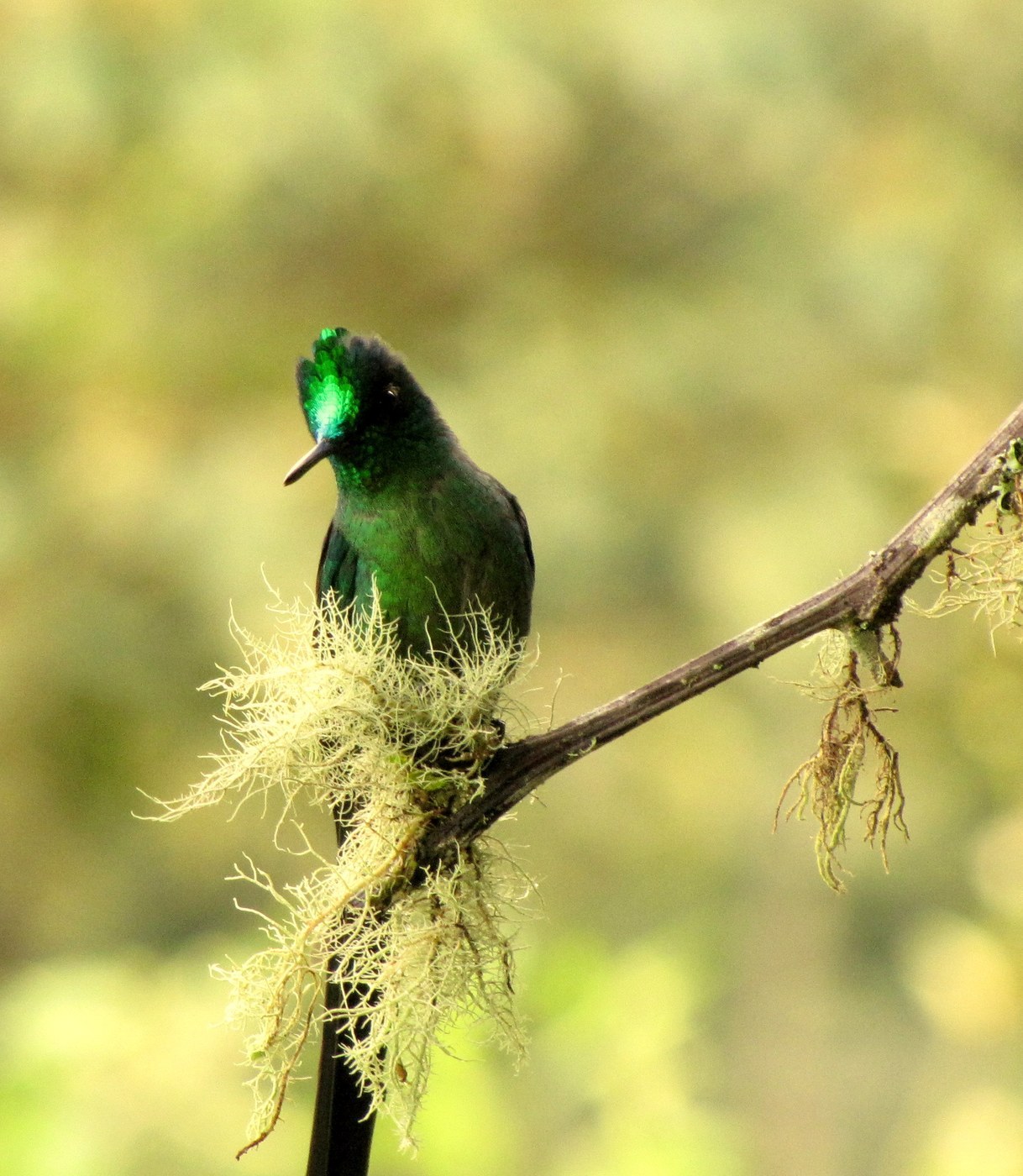
What Long-tailed Sylph's Feathers Look Like
The Long-tailed Sylph is an Andean cloud-forest hummingbird, and almost every feather it drops is small, glossy, and iridescent. Body (contour) feathers are tiny — usually under 1.5 cm — with a metallic sheen that shifts between green, blue, and violet depending on the angle of light, a trait called iridescent structural color rather than true pigment. The male's most distinctive feathers are the tail streamers: two central tail feathers extended into narrow, deeply forked, ribbon-like plumes that can be two to three times the length of the bird's body, colored a shimmering blue-violet to green. Females and juveniles lack these streamers; their tails are much shorter, dark, and often show white tips on the outer feathers. Wing (flight) feathers are short, stiff, dark brownish-black, and narrow — typical of a hummingbird built for rapid wingbeats rather than gliding.
Step-by-Step: Is This Feather From a Long-tailed Sylph?
- Check the size first. Any feather longer than about 5 cm is almost certainly not a body feather from this species — only the male's tail streamers reach that length.
- Look for extreme length paired with narrowness. If you have a very long, thin, forked feather with a metallic blue-green or violet sheen, that points strongly to a male sylph tail streamer.
- Test the iridescence. Tilt the feather in the light. True structural iridescence flashes between colors (green to blue to violet); a feather that stays one flat color is not from this species.
- Examine the shaft. Sylph tail streamers have a very fine, almost thread-like shaft compared to their length — unusually delicate for their size.
- Rule out short, dull feathers. Small dull brown or gray feathers with a hint of green sheen are more likely female or juvenile body feathers, or belong to another hummingbird entirely.
Similar Species & How to Tell Them Apart
Several other "sylph" and trainbearer hummingbirds share long forked tails, including the Violet-tailed Sylph and Green-tailed Trainbearers. The Long-tailed Sylph's streamers tend toward blue-violet rather than the more purple-violet of the Violet-tailed Sylph, and it lacks the trainbearers' straighter, less deeply forked shape. Booted Racket-tails have long tails too, but end in bare shafts with a small "racket" paddle at the tip rather than a smooth fork — a clear giveaway if the tip is intact. Without a visible fork and iridescence together, a long thin feather is more likely from a different long-tailed hummingbird or even a sunbird from another continent.
Where & When You'll Find Them
Long-tailed Sylphs live in humid montane forest and forest edge along the Andes, from Venezuela south through Colombia, Ecuador, and Peru, typically at 1,500–3,000 meters elevation. Feathers are most likely to be found near flowering shrubs and forest edges where the birds feed on nectar, or beneath perches used for display. Hummingbirds molt gradually and continuously through much of the year rather than in one synchronized event, so dropped feathers can turn up across most seasons, though molt often peaks after the breeding period when males replace worn tail streamers.
Frequently asked questions
Why don't I ever find a female Long-tailed Sylph's tail streamer?
Only males grow the elongated forked tail plumes; females have short, unremarkable dark tails, so any long iridescent streamer you find came from a male.
Can the color of the streamer tell me anything else?
The blue-to-violet iridescence is structural, so it shifts with viewing angle; a feather that looks flat and unchanging in color is unlikely to be from this species.
How can I tell a sylph feather from a sunbird feather if I'm unsure of location?
Sunbirds are Old World birds with slightly stiffer, more curved feather shapes and different shaft coloration; if you're in the Americas, especially the Andes, a sylph is far more likely.
Are the body feathers useful for identification at all?
They're difficult on their own since many small Andean hummingbirds share iridescent green body feathers; the forked tail streamer is by far the most diagnostic feather.
What time of year are dropped feathers most common?
Because molt is prolonged and not tightly seasonal in this species, feathers can appear nearly year-round, with a modest increase after breeding when tail streamers are replaced.