
How to Identify Malachite Kingfisher Feathers
A guide to recognizing the brilliant turquoise-blue and rufous-orange feathers of the tiny, jewel-like Malachite Kingfisher.
Read the full Malachite Kingfisher encyclopedia entry →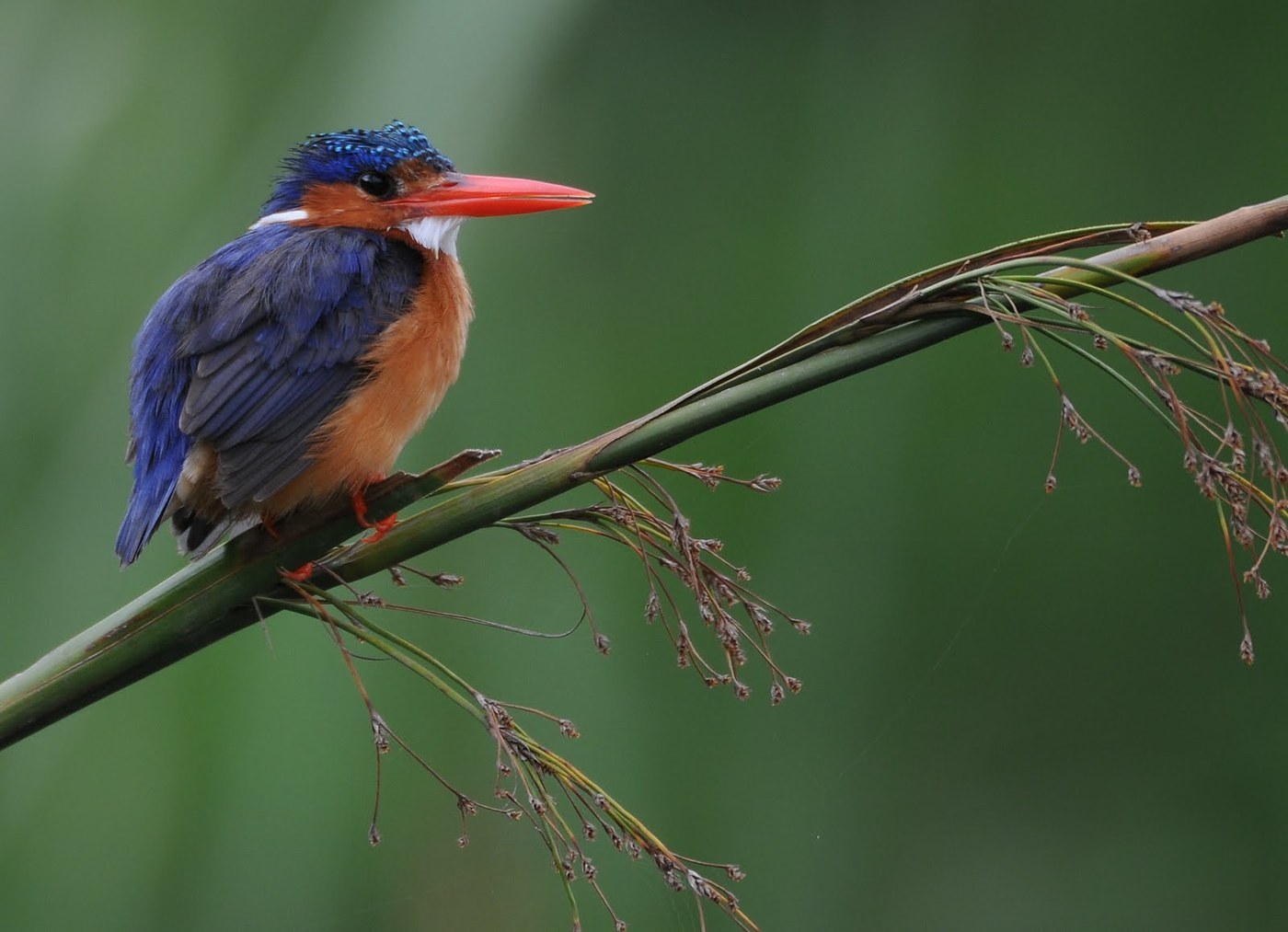
What Malachite Kingfisher's Feathers Look Like
The Malachite Kingfisher is a tiny, jewel-colored African kingfisher, and its feathers are among the most vividly colored of any small bird. Back and wing feathers show a brilliant iridescent turquoise-blue to cobalt, catching light with a metallic shine typical of kingfishers generally. The crest — a small, erectile patch of feathers on the crown — is distinctive on its own: crest feathers are barred blue-black, alternating narrow bands of deep blue and black, unlike the plain-colored crown feathers of most other small birds. Underpart feathers, from the cheek down through the breast and belly, are a rich rufous-orange, providing a warm contrast to the cool blue upperparts. A small patch of white feathers appears on the throat, sharply set off against the orange cheek and blue crown. Given the bird's tiny size (around 12–14 cm total length), individual feathers are correspondingly small, rarely exceeding 2–3 cm even for wing or tail feathers.
Step-by-Step: Is This Feather From a Malachite Kingfisher?
- Check for a striking turquoise-blue color. Bright, glossy cobalt-to-turquoise feathers are a strong first indicator, especially paired with small size.
- Look for barred blue-black crest feathers. A tiny feather with alternating blue and black bands is a specific clue tied to this species' erectile crest, not shared by most other small birds in the region.
- Confirm rufous-orange on underparts. Warm orange-rufous feathers from the cheek, breast, or belly complement the blue upperparts distinctively.
- Note the white throat patch. A small, clean white feather found alongside blue and orange ones supports this identification.
- Assess overall tiny size. Anything larger than a few centimeters is unlikely to be from this diminutive kingfisher; larger blue feathers likely belong to a bigger kingfisher species.
Similar Species & How to Tell Them Apart
The African Pygmy Kingfisher is similarly tiny and shares blue-and-orange tones, but it lacks the barred crest entirely, showing a plain violet-blue crown instead, and its underparts run a paler orange-buff rather than the Malachite's richer rufous — the barred crest feather is the clearest separator between the two. Larger kingfishers such as the Pied Kingfisher (black-and-white) or Giant Kingfisher (much bigger, duller) are easy to rule out by color and size respectively. Within its range, the specific combination of tiny size, barred blue-black crest, and rich rufous underparts makes Malachite Kingfisher fairly straightforward to confirm once a crest feather is available.
Where & When You'll Find Them
Malachite Kingfishers favor still or slow-moving fresh water — reed-fringed lakes, ponds, marshes, and slow rivers — across much of sub-Saharan Africa, typically perching low over water on reeds or overhanging branches to hunt small fish and aquatic insects. Feathers are most often found near such perches and around nest burrows dug into earthen banks near water, since kingfishers nest in tunnels rather than trees. Molt timing varies with the extended breeding seasons typical of tropical and subtropical Africa, so feathers can be found across much of the year, with some increase in activity following local breeding periods near reliable water sources.
Frequently asked questions
What's the single best feather for confirming this species?
A tiny feather with alternating blue and black bars, from the erectile crest, is a strong and fairly specific indicator for Malachite Kingfisher.
How is this different from an African Pygmy Kingfisher feather?
African Pygmy Kingfisher lacks the barred crest, showing a plain violet-blue crown instead, and its underparts are a paler orange-buff rather than the richer rufous of Malachite Kingfisher.
Why are the feathers so small?
The bird itself is tiny, only about 12-14 cm long, so even its flight and tail feathers rarely exceed a few centimeters.
Could a bright blue feather from a bigger bird be confused with this species?
Size is the key check — larger blue kingfisher feathers, such as from a Giant Kingfisher, would be noticeably bigger and duller than the small, brilliantly saturated feathers of Malachite Kingfisher.
Where near water should I search for feathers?
Look near low perches over still or slow water such as reeds and overhanging branches, and around earthen bank burrows used for nesting, since this species digs tunnel nests rather than using tree cavities.