
How to Identify Masked Lapwing Feathers
A field guide to the brown, black, and white wing and body feathers of the Masked Lapwing, Australia's large, wattled ground-nesting shorebird.
Read the full Masked Lapwing encyclopedia entry →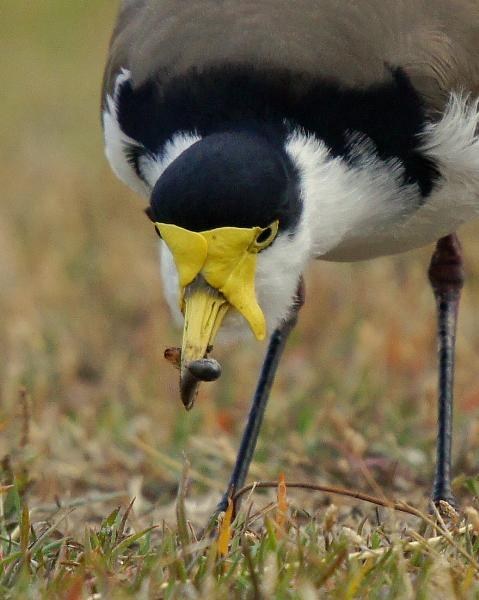
What Masked Lapwing Feathers Look Like
Masked Lapwing feathers combine earthy tones with bold contrast. Back and upperwing covert feathers are a soft grayish-brown to olive-brown, unmarked and fairly broad — practical camouflage for a bird that spends much of its time on open ground. The primary flight feathers, however, are strikingly blackish, long (14–18 cm), and sharply contrast with white underwing coverts and axillary feathers, so a wing that shows both dark outer flight feathers and clean white under-covert feathers together is a strong sign. Tail feathers are white at the base with a bold black terminal band, a pattern that's quite distinctive if you find several tail feathers together. Belly and breast contour feathers are clean white, unstreaked, while the crown and hindneck feathers are black, forming the bird's "capped" look. Overall the feathers are on the larger side for a shorebird, reflecting the species' size (up to 38 cm body length).
Step-by-Step: Is This Feather From a Masked Lapwing?
- Check for the black tail band. White tail feathers with a crisp black band near the tip are highly characteristic.
- Compare upper vs. under wing. Dark blackish primaries paired with white underwing coverts from the same bird is a strong combination.
- Look at size. Feathers noticeably larger than typical small sandpiper or plover feathers fit this bigger lapwing.
- Assess back feather color. Plain grayish-olive-brown, unpatterned — if you see bold spotting or streaking instead, consider a different shorebird.
- Factor in region. This species is native to Australia and New Guinea; elsewhere, consider other lapwing species with similar patterns.
Similar Species & How to Tell Them Apart
- Banded Lapwing: Shows a more strongly patterned head and breast with a distinct dark breast band, whereas Masked Lapwing has a cleaner white breast and relies on facial wattles (not visible on isolated feathers) for its "mask."
- Pacific Golden-Plover: Much smaller feathers overall, with gold-and-black spangled upperpart feathers in breeding plumage — a spangled pattern the Masked Lapwing lacks.
- Silver Gull and other white-bodied shorebirds/seabirds: Gull feathers tend to be softer-textured and lack the crisp black tail band; overall proportions and habitat context help separate them.
Where & When You'll Find Them
Masked Lapwings favor open grasslands, pastures, playing fields, wetland margins, and even suburban parks across Australia and New Guinea, nesting directly on the ground in short vegetation — a habit that makes shed feathers relatively easy to find near nesting territories. They are largely non-migratory residents in most of their range, so feathers can turn up at any time of year, though the highest feather turnover tends to follow the breeding season (which varies by region but often centers on the local wet season) when adults are most active defending territories and young birds are growing their first full set of flight feathers.
Frequently asked questions
What's the most distinctive Masked Lapwing feather?
A white tail feather with a bold black band near the tip — a quick, reliable field mark.
Are Masked Lapwing wing feathers patterned or plain?
The back and covert feathers are plain grayish-olive-brown, while the primaries are blackish and contrast with white underwing coverts.
How big are Masked Lapwing feathers compared to other shorebirds?
Larger — this is a big lapwing (up to 38 cm body length), so its feathers run noticeably bigger than small plovers or sandpipers.
Do Masked Lapwings migrate, affecting when feathers appear?
Most populations are resident, so feathers can be found year-round, with a modest peak around the regional breeding season.
Where should I look for feathers?
Open pastures, grassy parks, playing fields, and wetland edges across Australia and New Guinea, especially near ground nesting territories.