
How to Identify Mistle Thrush Feathers
A guide to the bold, rounded black spots on pale underparts feathers that distinguish the large Mistle Thrush from the smaller, more finely marked Song Thrush.
Read the full Mistle Thrush encyclopedia entry →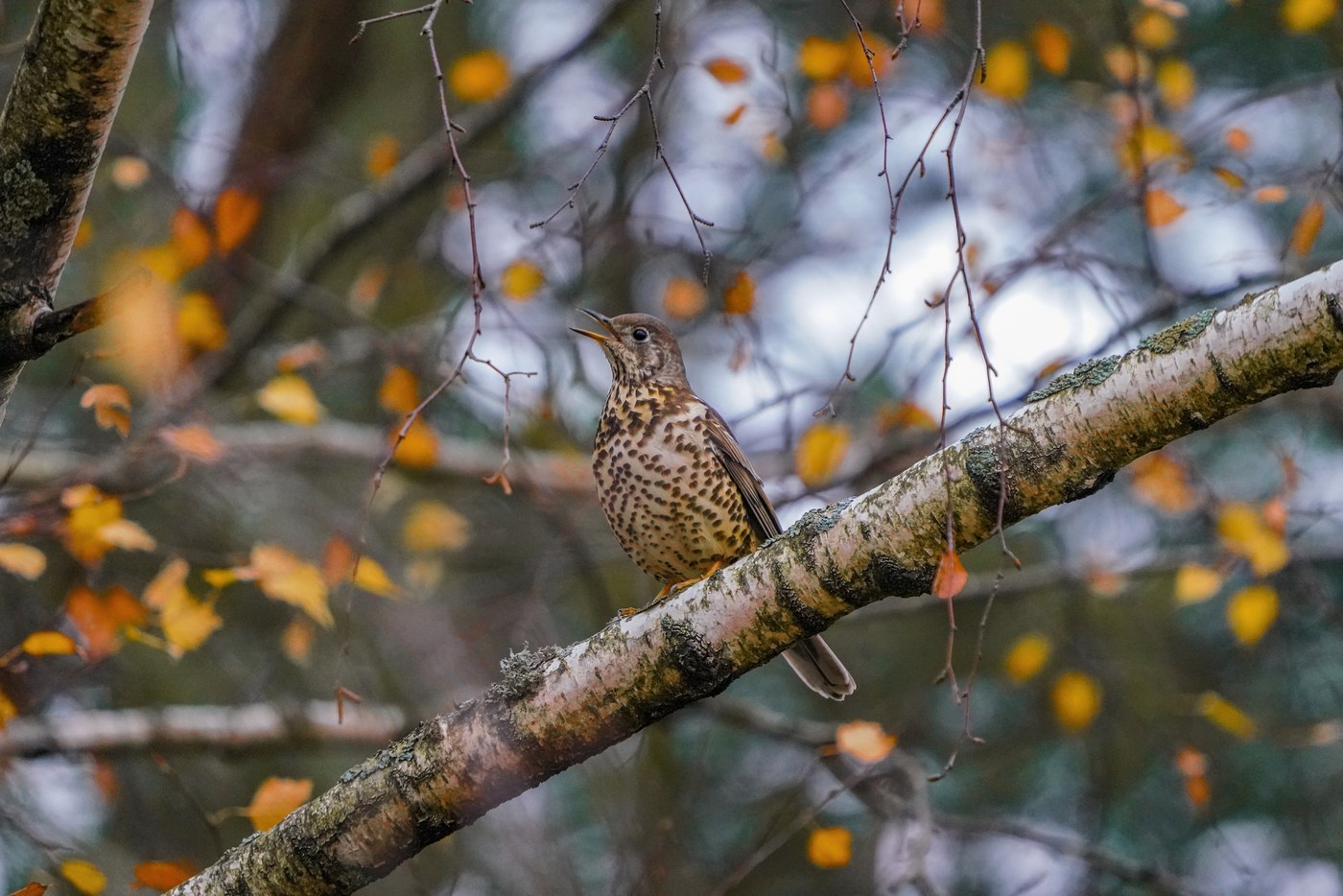
What Mistle Thrush Feathers Look Like
Mistle Thrush feathers are built on a larger scale than most other European thrushes, and the underparts pattern is the most useful identification tool. Breast and belly feathers are creamy-white to pale buff, marked with bold, rounded-to-oval black spots that are notably larger and more widely spaced than the fine, arrow-shaped markings of the similar Song Thrush — think of the difference between blotchy round spots and fine, dense streaks. Back and mantle feathers are a cool grayish-brown, plainer and less warm-toned than Song Thrush's more rufous-brown back. A key flight-feather clue is visible on the underwing: the underwing covert feathers are whitish, a helpful contrast when compared to the buffier underwing of Song Thrush. Tail feathers are grayish-brown, and the outer tail feathers show pale to whitish corners/tips, visible as a flash in flight and identifiable on a shed outer tail feather. Overall feather size runs larger across the board, consistent with the species being one of the largest thrushes in its range (around 27–28 cm body length).
Step-by-Step: Is This Feather From a Mistle Thrush?
- Check spot shape and size on breast/belly feathers. Bold, rounded-to-oval black spots, well-spaced rather than densely packed, indicate Mistle Thrush over the finer-marked Song Thrush.
- Compare underwing covert color if available. Whitish underwing coverts favor Mistle Thrush; buffier/orangey tones favor Song Thrush.
- Assess back feather tone. Cool grayish-brown rather than warm rufous-brown.
- Look at outer tail feathers. Pale or whitish corners/tips support the ID.
- Weigh overall size. Larger than a typical Song Thrush feather set, closer to or exceeding Blackbird proportions.
Similar Species & How to Tell Them Apart
- Song Thrush: Smaller, warmer rufous-brown above, with finer, more numerous, arrow- or teardrop-shaped spots below (versus Mistle Thrush's bolder, rounder, more sparse spotting) and buffier underwing coverts.
- Fieldfare: Shows a gray head and rump contrasting with a chestnut back, a much more strikingly multi-toned pattern than Mistle Thrush's more uniform grayish-brown upperparts.
- Redwing: Notably smaller, with a bold pale eyebrow-stripe feather tract and rufous-orange (not whitish) underwing coverts and flanks, quite different from Mistle Thrush.
- American Robin (unrelated but sometimes confused by pattern-searchers): Has plain rufous-orange underparts rather than spotted, an easy separator.
Where & When You'll Find Them
Mistle Thrushes favor open woodland, parkland, farmland with scattered trees, and large gardens across much of Europe, parts of North Africa, and western Asia, often perching prominently and singing from treetops even in poor weather. Many northern and eastern populations migrate to milder areas for winter, while some populations are resident, so feathers can be found on breeding territories in the warmer months and across a broader wintering range — including farmland with berry-bearing trees and shrubs — in winter. Post-breeding molt runs through summer, so fresh feathers are most likely from July into September, with the species' fondness for mistletoe and other berries in winter drawing it to specific fruiting trees where feathers may also be found.
Frequently asked questions
What's the main clue that separates Mistle Thrush from Song Thrush feathers?
Spot shape and size — Mistle Thrush shows bold, rounded, widely-spaced black spots, while Song Thrush has finer, more numerous, arrow-shaped markings.
Does underwing color help with identification?
Yes, Mistle Thrush shows whitish underwing coverts, while Song Thrush's are buffier or more orange-toned.
How does the back color compare between the two species?
Mistle Thrush has a cooler grayish-brown back, while Song Thrush is warmer and more rufous-brown.
Is Mistle Thrush bigger than Song Thrush?
Yes, noticeably — Mistle Thrush is one of the larger European thrushes, and its feathers run larger across the board.
When are fresh feathers most likely to be found?
July through September, following the post-breeding molt, though winter feathers can also turn up near berry-bearing trees the species visits for food.