
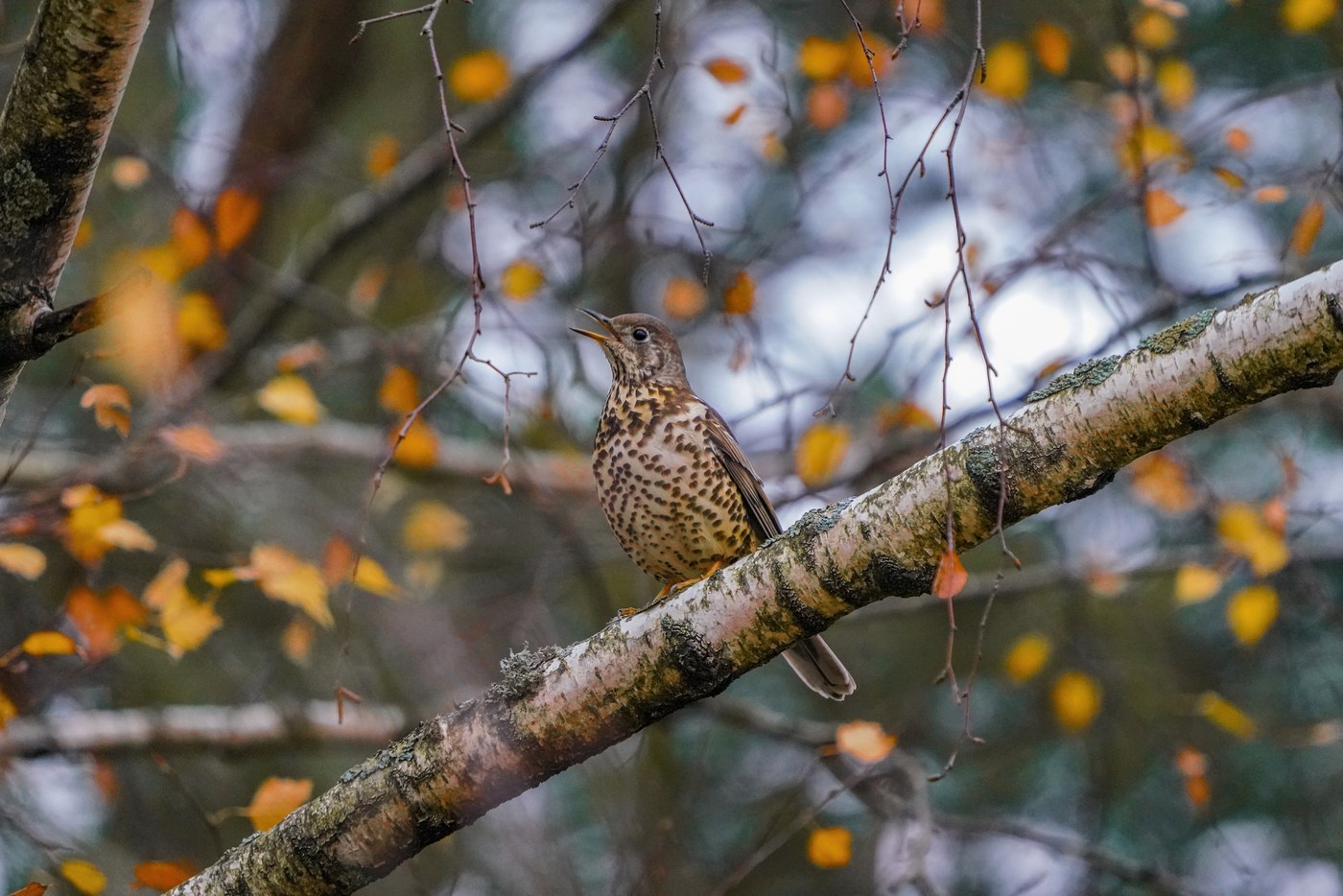
Mistle Thrush
Turdus viscivorus
The largest and boldest-marked of the common European thrushes, with large, rounded blackish spots on cream underparts and white corners visible on the outer tail feathers.
- Feather type
- Grey-brown upperpart feathers; cream underparts with bold, rounded blackish spots; whitish underwing feathers
- Colours
- Cold grey-brown above, cream below with bold rounded dark spots, white tail corners
- Bird size
- Large songbird, ~27 cm, the largest common European thrush
Found a feather like this?
Identify any feather from a photo, free.
Overview
The Mistle Thrush is the biggest thrush regularly encountered across much of Europe, noticeably larger and more upright than the closely related Song Thrush, with a bolder, more strongly marked plumage pattern.
It favors open parkland, large gardens, and farmland with mature trees, often perching prominently and singing from high, exposed treetops even in poor weather.
A Mistle Thrush feather is distinguished from the smaller Song Thrush by larger, more rounded blackish spots on the underparts, a colder grey-brown tone above, whitish (rather than buff) underwing feathers, and white corners on the outer tail feathers.
Identifying the Feather
Underpart feathers
- Cream to whitish background marked with large, bold, rounded blackish spots, more sparsely distributed and much larger than those of a Song Thrush.
Underwing feathers
- Underwing coverts are whitish, lacking the buff-orange wash seen in Song Thrush.
Upperpart feathers
- Back and wing feathers show a colder, greyer brown tone compared to the warmer brown of Song Thrush.
Tail feathers
- Outer tail feathers show white corners or tips, a feature useful when an isolated tail feather is found.
Confusion species
Song Thrush is smaller with smaller, spear-shaped spots and a buff underwing; Fieldfare shows a grey head and chestnut back rather than the more uniform grey-brown tone of Mistle Thrush.
Plumage & Molt
Adults are grey-brown above with cream to whitish underparts boldly marked with large, rounded blackish spots, whitish underwing coverts, and white corners on the outer tail feathers. Males and females look alike.
Juveniles show pale spotting on the back in addition to the spotted underparts, fading after the first molt.
Mistle Thrushes undergo a complete post-breeding molt, typically in summer.
Habitat & Range
Mistle Thrushes favor open woodland, parkland, large gardens, and farmland with scattered mature trees, often seen perched prominently or feeding on open ground.
The species is resident across much of its western and southern European range, with some northern and eastern populations migrating short distances for winter.
Behavior & Field Notes
Mistle Thrushes feed on invertebrates and, particularly in autumn and winter, berries, sometimes aggressively defending a favored berry-bearing tree from other birds. They are bold and can be quite vocal.
Their song is loud and far-carrying, often delivered from an exposed treetop perch even in windy or wet weather, giving rise to old folk names referencing storms. They build a bulky cup nest in a tree fork.
A large, bold-spotted cream feather with a whitish underwing and cold grey-brown upperpart tone, found in open parkland or farmland, points to Mistle Thrush rather than Song Thrush.
Frequently asked questions
How do Mistle Thrush feathers differ from Song Thrush feathers?
Mistle Thrush feathers are larger overall, with bigger, more rounded spots, a whitish (not buff) underwing, and a colder grey-brown upperpart tone.
Does the Mistle Thrush have white in the tail?
Yes, the outer tail feathers show white corners or tips, a useful clue on isolated tail feathers.
What is the underwing color of a Mistle Thrush?
Whitish, lacking the warm buff-orange wash found in Song Thrush underwing feathers.
Is the Mistle Thrush bigger than other common European thrushes?
Yes, it is the largest thrush regularly encountered in the region, noticeably bigger than Song Thrush, Redwing, or Fieldfare.
Where would I find a Mistle Thrush feather?
In open woodland, parkland, large gardens, or farmland with scattered mature trees.
Mistle Thrush guides
In-depth guides for identifying and understanding Mistle Thrush.
Other feathers you may enjoy

Yellow-breasted Bunting
Contour and flight feathers, chestnut-and-yellow breeding pattern

Sedge Wren
Tiny streaked crown and back feathers

Yellow-winged Cacique
Glossy black body feathers, yellow wing patch, shaggy crest

Yellow Warbler
Small contour and flight feathers

Yellow-throated Warbler
Small contour and flight feathers

Yellow-throated Vireo
Bright yellow throat and spectacle feathers; olive-green back feathers; two white wing-bar feathers

Yellow-rumped Warbler
Small contour and flight feathers

Yellow-hooded Blackbird
Contrasting hood and body feathers

Yellow-headed Blackbird
Glossy black body plumage with a bright yellow head and breast

Yellow-eyed Junco
Contour and flight feathers

Yellow-fronted Canary
Small, smooth body plumage

Yellow-breasted Greenfinch
Compact, smooth body plumage