
How to Identify Nelson's Sparrow Feathers
Nelson's Sparrow feathers are small, warm orange-buff, and softly streaked; use blurry (not crisp) markings and marsh habitat to separate them from other sharptail sparrows.
Read the full Nelson's Sparrow encyclopedia entry →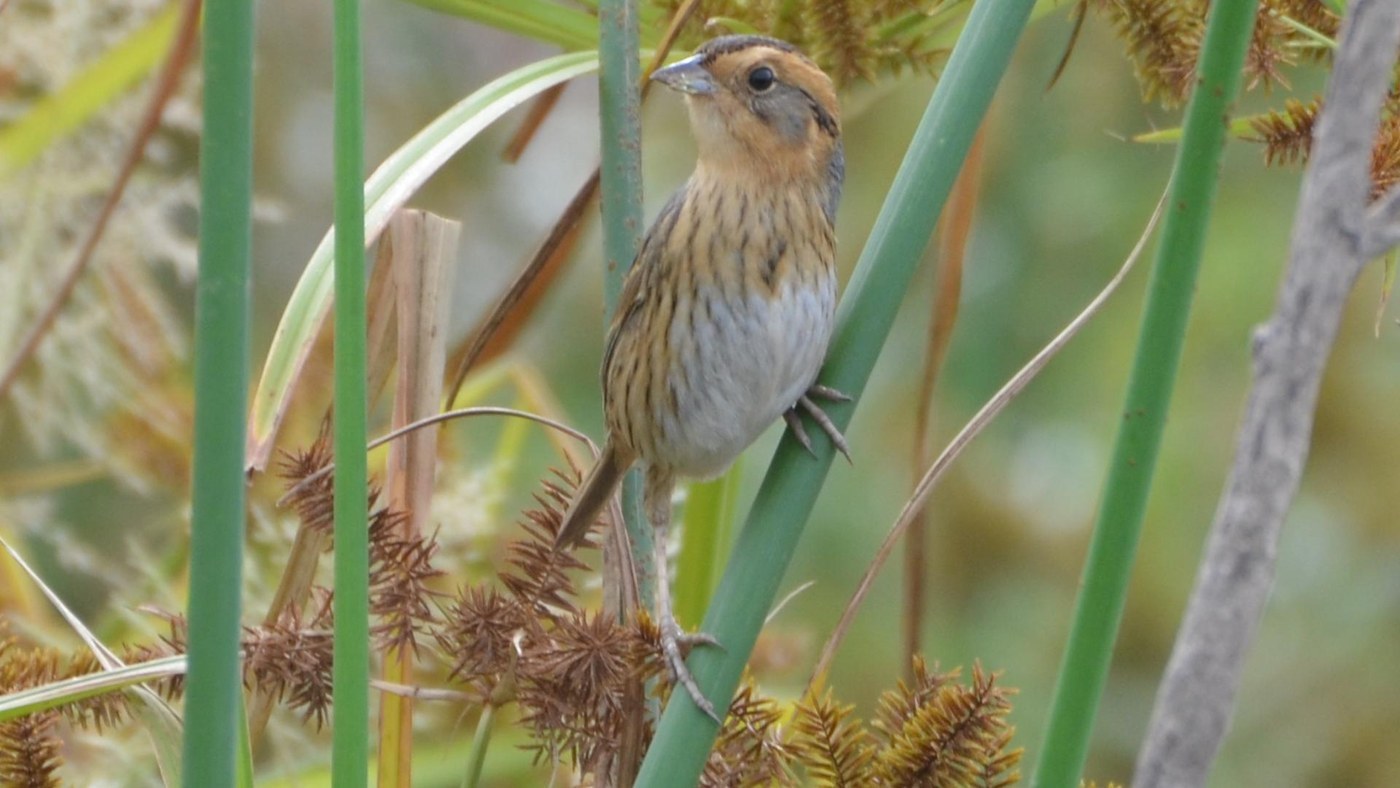
What Nelson's Sparrow's Feathers Look Like
Nelson's Sparrow is a small, secretive marsh sparrow, and its feathers reflect that: nothing on this bird is showy or long. Body (contour) feathers are tiny, mostly 2-4 cm, with a warm orange-buff wash across the face, breast, and flanks that fades to whitish on the belly. The flank and breast markings are soft, blurry gray-brown streaks rather than crisp lines — this smudged look is one of the most useful clues you can find on a single feather. Back feathers are dark brown-black in the center with wide chestnut/rust edges, giving a scaled look when feathers overlap. The crown has a gray median stripe bordered by dark brown lateral stripes, and the nape is plain gray, a shade you'll sometimes see on isolated crown or nape feathers. Flight feathers (primaries/secondaries) are short and rounded relative to open-country sparrows, plain grayish-brown with narrow buffy edges, typically 4-6 cm long. Tail feathers are notably pointed and somewhat stiff-tipped — a shared trait of the "sharptail" sparrow group — usually brown with faint pale edges, 4-5 cm long. Shafts are pale tan to whitish on all feather types; there is no black or brightly colored shaft on this species.
Step-by-Step: Is This Feather From a Nelson's Sparrow?
- Measure it. Body feathers under 4 cm and flight feathers under 6-7 cm fit; anything longer is from a bigger bird.
- Check the tip shape. Tail feathers that are narrow and pointed (not rounded or squared) support a sharptail-sparrow ID.
- Look for warm orange-buff coloring, especially on feathers that would sit on the face or breast — a true, saturated orange wash (not pale buff) is a strong sign.
- Inspect the streaking. Streaks on flank/breast feathers should look soft-edged and blurry, not sharply defined black lines.
- Note the back pattern. Feathers with a dark center and broad chestnut fringe, overlapping into a scaled look, match this species' mantle.
- Confirm habitat. A feather found in a salt marsh, coastal grass, or interior wet prairie meadow adds strong supporting evidence.
Similar Species & How to Tell Them Apart
The closest look-alike is the Saltmarsh Sparrow, which overlaps in range along the Atlantic coast and can even hybridize with Nelson's Sparrow. Saltmarsh Sparrow feathers show crisper, darker, more defined breast/flank streaking and a slightly grayer, less orange face wash — if the streaks look sharp rather than smudged, lean Saltmarsh. LeConte's Sparrow is another sharptail relative with orange face tones, but its back feathers show bold white/cream stripes running lengthwise (not just chestnut scaling), and it favors drier grassy fields rather than tidal marsh. Savannah Sparrow feathers are similarly streaked but lack the orange face wash and have a yellowish tinge over the eye instead. Seaside Sparrow, sharing the same tidal habitat, is notably larger, grayer overall, and has a longer, heavier bill with duller, olive-gray (not orange) facial tones.
Where & When You'll Find Them
Nelson's Sparrow breeds in freshwater and brackish marshes across the northern Great Plains and around Hudson Bay, and in salt marshes along the Atlantic coast in a separate population, wintering in coastal marshes from the mid-Atlantic states to the Gulf Coast. Because it nests low in dense marsh grass and molts on the breeding grounds in late summer, most found feathers turn up in marsh vegetation from July through September, or blown into tideline wrack and grass tussocks during fall migration. Winter feathers tend to be more worn and paler, so a crisp, richly colored feather is more likely a fresh late-summer molt feather from the breeding marsh.
Frequently asked questions
What color are Nelson's Sparrow feathers?
Mostly warm orange-buff on the face and breast, blending to soft grayish-brown streaked flanks and a dark-centered, chestnut-edged back.
How long are Nelson's Sparrow flight feathers?
Typically 4-6 cm, short and rounded compared with open-country sparrows.
Why is the streaking described as "blurry"?
Unlike sharply outlined streaks on species like Savannah or Saltmarsh Sparrow, Nelson's Sparrow's markings have soft, diffuse edges that blend into the buff background.
Can I tell Nelson's Sparrow from Saltmarsh Sparrow feathers alone?
It's difficult since they can hybridize, but sharper streaking and grayer face tones lean Saltmarsh, while a blurrier pattern and stronger orange wash lean Nelson's.
Where should I look for a molted Nelson's Sparrow feather?
In dense marsh grass or tideline wrack near salt or freshwater marshes, especially in late summer during the post-breeding molt.