
Nelson's Sparrow
Ammospiza nelsoni
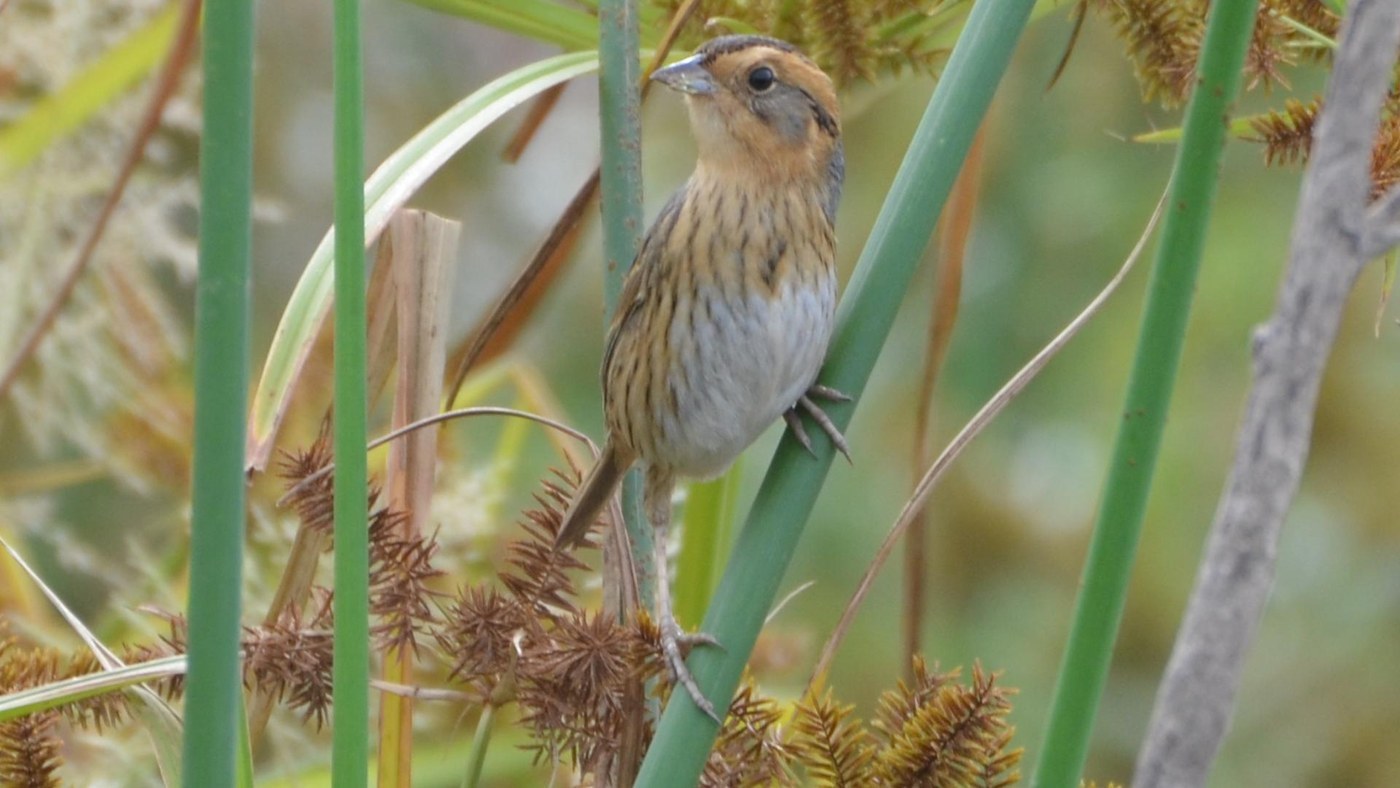
A softly patterned marsh sparrow with a blurry orange face and grayish back streaking, found in both interior and coastal wetlands.
- Feather type
- Contour and flight feathers
- Colours
- Orange-buff, gray, and brown
- Bird size
- Sparrow-sized, ~12.5 cm
Found a feather like this?
Identify any feather from a photo, free.
Overview
Overview
Nelson's Sparrow is a small, marsh-dependent sparrow that breeds in both interior freshwater marshes of the northern Great Plains and coastal salt marshes along the Atlantic and Hudson Bay coasts, then winters in coastal marshes farther south. Its soft, blended coloration is well suited to camouflage within dense marsh grass.
It is closely related to and can be confused with Saltmarsh Sparrow where their winter ranges overlap, requiring attention to facial pattern and back streaking for a confident identification.
Identifying the Feather
Feather Identification
- Face feathers: orange-buff face and supercilium blending softly into the gray ear patch, without sharp demarcation
- Back feathers: grayish, relatively unstreaked to lightly streaked mantle, less boldly patterned than some marsh sparrow relatives
- Breast and flank feathers: fine, somewhat blurry streaking over an orange-buff wash
- Nape: grayish, without strong contrast
- Compared to Saltmarsh Sparrow: Nelson's shows a softer, more blended facial pattern and grayer, less crisply streaked back, whereas Saltmarsh Sparrow shows crisper black streaking on a whiter belly and a more sharply outlined face pattern
Plumage & Molt
Plumage Notes
Several geographically distinct populations of Nelson's Sparrow show subtle plumage differences, with interior breeding birds sometimes appearing slightly brighter than coastal breeders. Sexes look alike. Juveniles show a buffier, more diffusely streaked plumage before acquiring the adult pattern through their first fall molt. A single complete molt follows breeding in adults, and the soft, blended facial and back pattern remains fairly stable through the year with minor changes from feather wear.
Habitat & Range
Habitat & Range
Nelson's Sparrows breed in two very different settings: freshwater sedge marshes of the northern Great Plains and prairie provinces, and coastal salt marshes around Hudson Bay and portions of the Atlantic coast. In winter, the species occupies coastal salt marshes along the Atlantic and Gulf coasts. This dual breeding habitat use, spanning both interior wetlands and coastal marsh, is somewhat unusual compared to other members of its sparrow group.
Behavior & Field Notes
Behavior & Field Notes
Nelson's Sparrows forage low within dense marsh vegetation, gleaning invertebrate prey and seeds from mud and grass stems, and tend to stay well hidden except when singing. They can be difficult to flush and often prefer to run rather than fly when disturbed. The song is a soft, wheezy, buzzy hiss, quieter and less far-carrying than the songs of many other sparrows. Nests are built low in marsh grass, positioned to avoid all but the highest tides in coastal populations.
Frequently asked questions
Where does Nelson's Sparrow breed?
It breeds in two distinct habitat types: freshwater sedge marshes of the northern Great Plains and prairie provinces, and coastal salt marshes around Hudson Bay and parts of the Atlantic coast.
How can I separate this species from Saltmarsh Sparrow?
Nelson's Sparrow shows a softer, more blended orange-and-gray face pattern and a grayer, less crisply streaked back compared to the sharper markings of Saltmarsh Sparrow.
What does the song sound like?
A soft, wheezy, buzzy hiss that is quieter and carries less far than the songs of many other sparrow species.
Is Nelson's Sparrow easy to observe in the field?
It tends to stay low and hidden within dense marsh vegetation, making prolonged, clear views uncommon without patience or a flush.
Nelson's Sparrow guides
In-depth guides for identifying and understanding Nelson's Sparrow.
Other feathers you may enjoy

Yellow-breasted Bunting
Contour and flight feathers, chestnut-and-yellow breeding pattern

Sedge Wren
Tiny streaked crown and back feathers

Yellow-winged Cacique
Glossy black body feathers, yellow wing patch, shaggy crest

Yellow Warbler
Small contour and flight feathers

Yellow-throated Warbler
Small contour and flight feathers

Yellow-throated Vireo
Bright yellow throat and spectacle feathers; olive-green back feathers; two white wing-bar feathers

Yellow-rumped Warbler
Small contour and flight feathers

Yellow-hooded Blackbird
Contrasting hood and body feathers

Yellow-headed Blackbird
Glossy black body plumage with a bright yellow head and breast

Yellow-eyed Junco
Contour and flight feathers

Yellow-fronted Canary
Small, smooth body plumage

Yellow-breasted Greenfinch
Compact, smooth body plumage