
How to Identify Orchard Oriole Feathers
How to identify the small size and deep chestnut underparts of the Orchard Oriole, and separate it from the brighter orange Baltimore Oriole.
Read the full Orchard Oriole encyclopedia entry →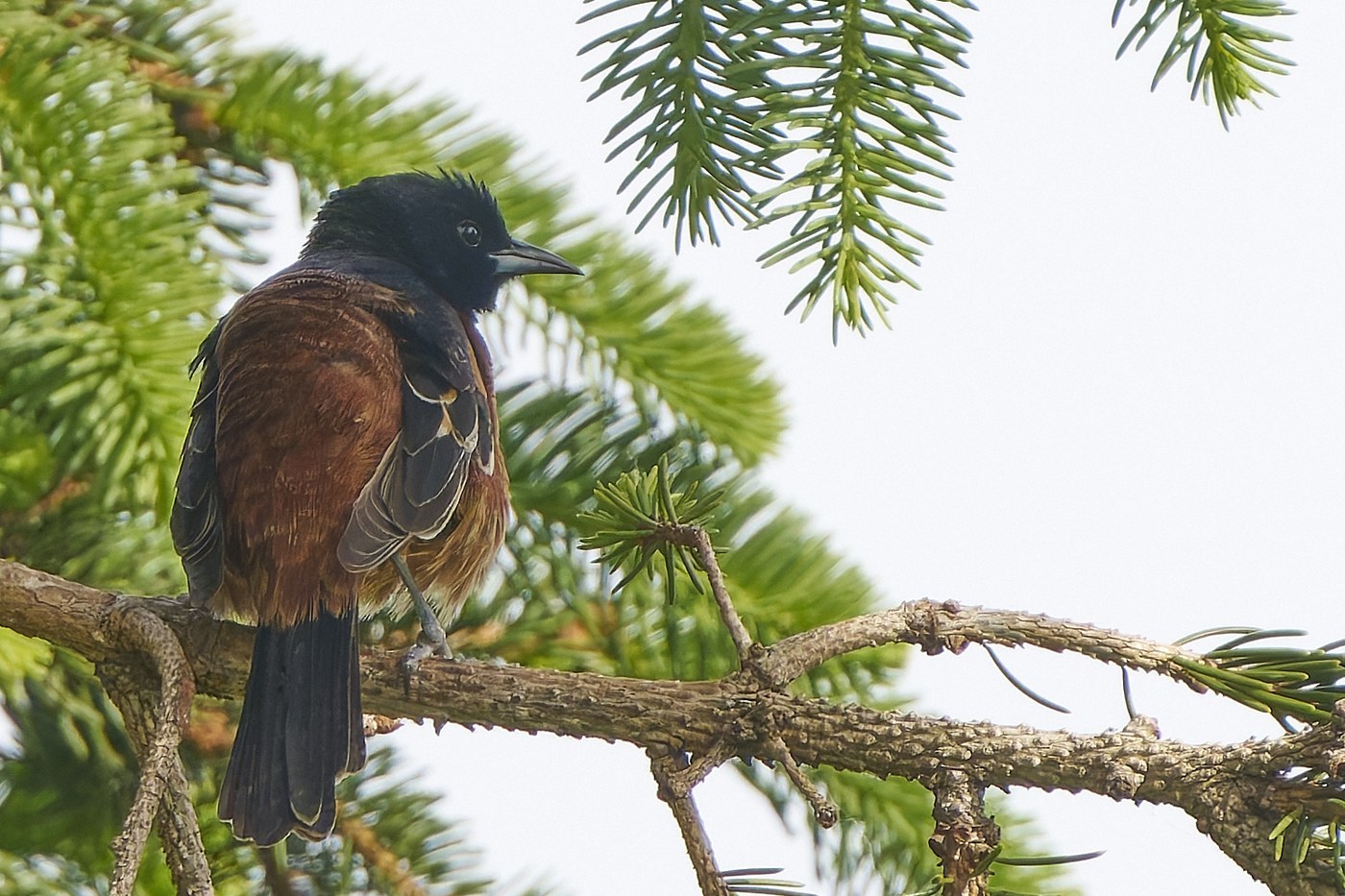
What Orchard Oriole's Feathers Look Like
The Orchard Oriole is the smallest oriole in North America, and its feather colors run darker and richer than people often expect from an "orange" bird. Adult males show a black head, back, wings, and tail, contrasted with deep chestnut to brick-red underparts and rump — a notably darker, more maroon tone than the bright orange of a Baltimore Oriole. The wing carries a single crisp white wingbar. Females and first-year birds are far plainer: olive-yellow-green overall, with two clean white wingbars on grayish-brown wings and a yellow-green tail. First-year males add a distinctive twist: they look like females but grow a solid black throat patch (bib), so a small, plain olive-yellow bird's feather paired with a black throat feather is a useful clue on its own. Overall feather size is small, fitting a bird under 7 inches long.
Step-by-Step: Is This Feather From an Orchard Oriole?
- Check underparts color and depth. Deep chestnut or brick-red, rather than bright orange, on a black-bodied bird points to an adult male Orchard Oriole.
- Count the wingbars. A single white wingbar fits an adult male; two crisp white wingbars fit a female or immature.
- Judge overall size. Small, distinctly smaller than a typical oriole, supports this species over Baltimore or Bullock's Oriole.
- Look for a black throat patch on an otherwise plain olive-yellow bird. This combination points to a first-year male.
- Rule out orange in the tail corners. Orchard Oriole's tail is plain black or olive, without the orange tail-corner patches seen in some other orioles.
Similar Species & How to Tell Them Apart
The Baltimore Oriole male shows bright, saturated orange underparts (not the darker chestnut of Orchard Oriole) plus orange patches in the tail corners, and it's a noticeably larger bird overall. The Bullock's Oriole, a western species, shows a larger white wing patch and an orange face, differing in both pattern and range from Orchard Oriole. The Hooded Oriole male has orange-yellow body plumage with black confined to the face and throat rather than covering the whole head, plus a more slender, downcurved bill shape reflected in a more elongated head-feather profile. Female Orchard Oriole is more uniformly olive-yellow without any orange tinge, while female Baltimore Oriole tends to show a warmer, more orange-yellow tone overall.
Where & When You'll Find Them
Orchard Orioles breed in open woodland, orchards, and shade trees near water across the eastern and central United States, then migrate to Mexico and Central America for the winter — one of the earliest-departing songbirds, often leaving by late summer. Molt occurs shortly after breeding, so feathers are most likely to be found at breeding sites in mid-to-late summer, before the birds head south; winter-season feathers would be more likely encountered across the Central American wintering range instead.
Frequently asked questions
What is the key color difference between Orchard Oriole and Baltimore Oriole?
Orchard Oriole's underparts are a deep chestnut or brick-red, distinctly darker than the bright, saturated orange of Baltimore Oriole.
How many wingbars does an Orchard Oriole have?
Adult males show a single white wingbar, while females and immatures show two crisp white wingbars.
I found a plain olive-yellow feather with a black throat patch — what does that mean?
That combination is typical of a first-year male Orchard Oriole, which looks female-like overall but grows a solid black throat bib.
Does Orchard Oriole have orange patches in the tail like Baltimore Oriole?
No, its tail is plain black or olive-yellow without the orange tail-corner patches seen in Baltimore Oriole.
When is the best time to find Orchard Oriole feathers?
Mid-to-late summer at breeding sites across the eastern and central US, since the species migrates south unusually early, often by late summer.