
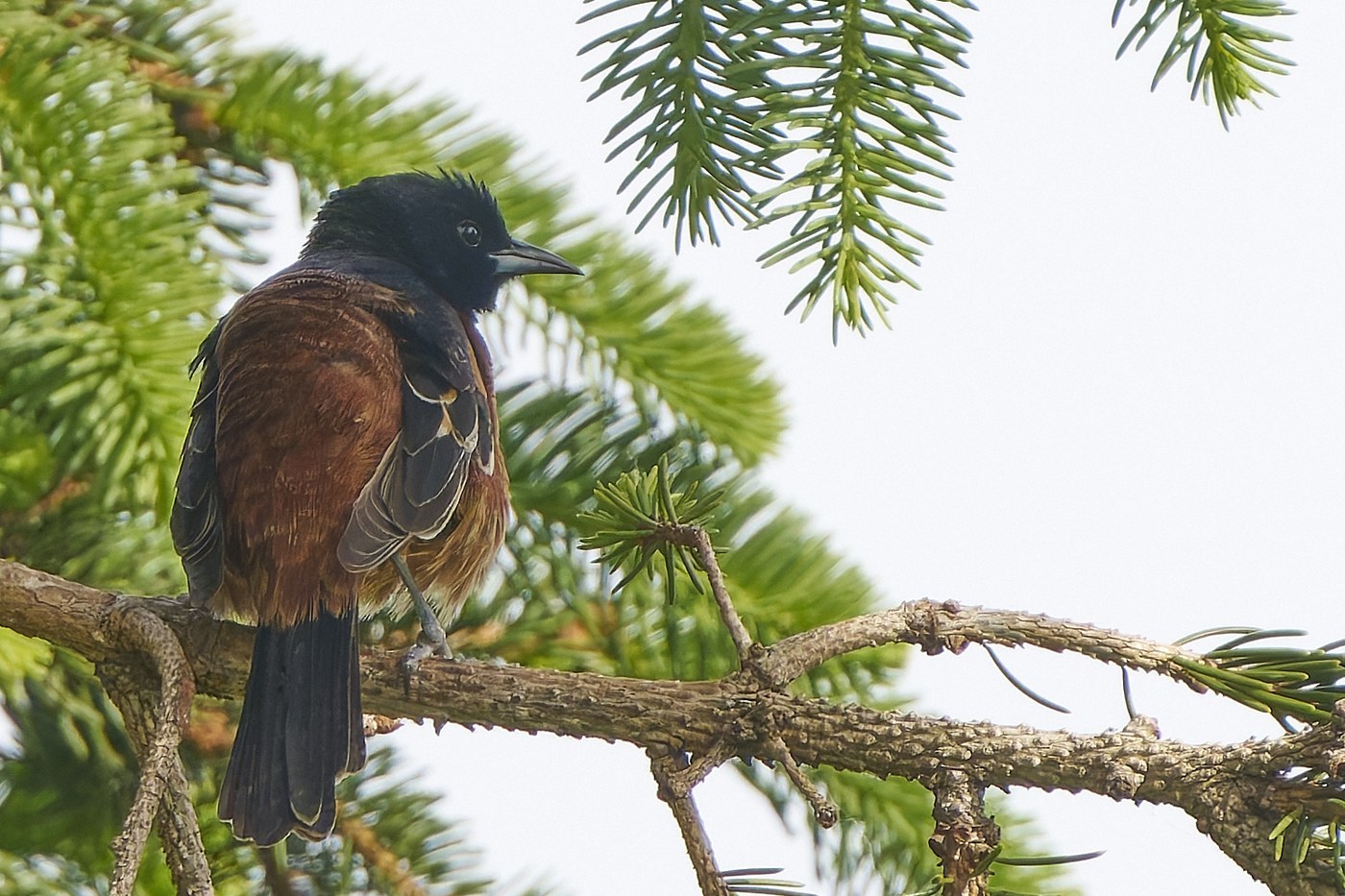
Orchard Oriole
Icterus spurius
The smallest North American oriole, with adult males showing a rich chestnut body against a black hood and back, while females and young males wear a more subdued olive-yellow plumage.
- Feather type
- Compact body feathers, glossy black hood
- Colours
- Chestnut and black (adult male); olive-yellow with white wing bars (female/immature)
- Bird size
- Small oriole, ~15-18 cm
Found a feather like this?
Identify any feather from a photo, free.
Overview
Overview
The Orchard Oriole is the smallest oriole in North America, notable for the adult male's deep chestnut body set against a glossy black head, back, and tail. Females and immatures show a much plainer olive-yellow plumage with white wing bars, and first-year males display an intermediate look with a black throat patch on an otherwise female-like body.
Identifying the Feather
Feather Identification
- Adult male body feathers: Rich chestnut underparts, rump, and shoulder, contrasting with glossy black head, back, wings, and tail
- Female/immature feathers: Olive-yellow overall with two white wing bars, lacking chestnut tones
- First-year male feathers: Female-like olive-yellow body with an added black throat patch
- Size: Noticeably smaller and slimmer than other North American orioles
- Similar species: Adult males are distinctive; females can resemble female Hooded Orioles but are smaller with a shorter, straighter bill
Plumage & Molt
Plumage Details
Adult males show a glossy black hood, back, wings, and tail contrasting with rich chestnut underparts, rump, and shoulder patch. Females and immature birds are olive-yellow above and below with two white wing bars, lacking any chestnut. First-year (second-calendar-year) males add a black throat patch to the otherwise female-like plumage before acquiring full adult plumage in their second year. Molt occurs on the wintering grounds.
Habitat & Range
Habitat & Range
Orchard Orioles breed across the eastern and central United States and into parts of Mexico, favoring open woodlands, orchards, shade trees, and areas near water. They are long-distance migrants, wintering from Mexico south through Central America to northern South America.
Behavior & Field Notes
Behavior & Field Notes
Orchard Orioles forage actively in foliage for insects and also take nectar and fruit. Males sing a rich, chattering warble from exposed perches in trees. They weave a cup-shaped hanging nest, often suspended from a fork in a tree branch, and may nest in loose association with other orioles or near kingbirds for added protection from predators.
Frequently asked questions
How can I identify an Orchard Oriole feather?
Adult male feathers combine rich chestnut on the underparts and rump with glossy black on the head, back, and wings; females and young birds are plainer olive-yellow with white wing bars.
Why do young male Orchard Orioles look different from adults?
First-year males retain a female-like olive-yellow body but add a black throat patch, only acquiring the full chestnut-and-black adult plumage in their second year.
What is the smallest oriole in North America?
The Orchard Oriole is the smallest, noticeably more compact than species like the Baltimore or Altamira Oriole.
Where do Orchard Orioles spend the winter?
They migrate to Mexico, Central America, and northern South America outside the breeding season.
Orchard Oriole guides
In-depth guides for identifying and understanding Orchard Oriole.
Other feathers you may enjoy

Yellow-breasted Bunting
Contour and flight feathers, chestnut-and-yellow breeding pattern

Sedge Wren
Tiny streaked crown and back feathers

Yellow-winged Cacique
Glossy black body feathers, yellow wing patch, shaggy crest

Yellow Warbler
Small contour and flight feathers

Yellow-throated Warbler
Small contour and flight feathers

Yellow-throated Vireo
Bright yellow throat and spectacle feathers; olive-green back feathers; two white wing-bar feathers

Yellow-rumped Warbler
Small contour and flight feathers

Yellow-hooded Blackbird
Contrasting hood and body feathers

Yellow-headed Blackbird
Glossy black body plumage with a bright yellow head and breast

Yellow-eyed Junco
Contour and flight feathers

Yellow-fronted Canary
Small, smooth body plumage

Yellow-breasted Greenfinch
Compact, smooth body plumage