
How to Identify Ortolan Bunting Feathers
How to identify the olive-gray head, yellow throat, and chestnut rump of the Ortolan Bunting, a migratory European and West Asian songbird.
Read the full Ortolan Bunting encyclopedia entry →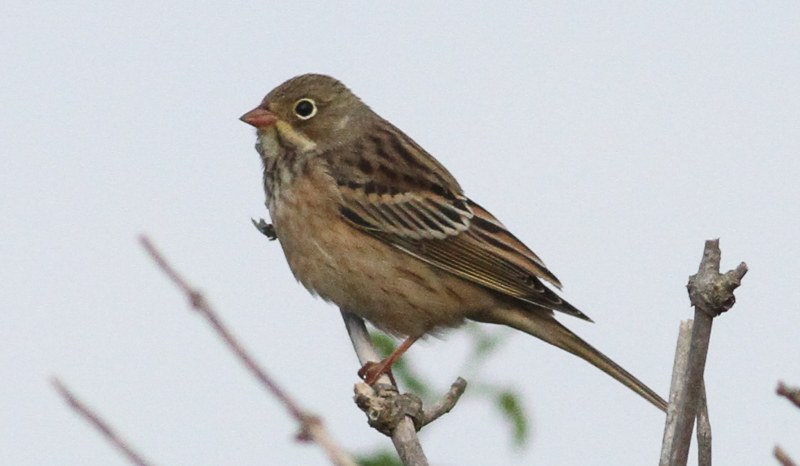
What Ortolan Bunting's Feathers Look Like
The Ortolan Bunting is a subtly colored migratory songbird of Europe and western Asia, and its feathers reward attention to a few key regions of the body. The head and breast feathers are an olive-gray, softening into a pale yellow throat — a yellow throat feather set against an olive-gray head/breast feather is a strong starting combination. A thin, pale yellow eye-ring rims the eye. Below the breast, feathers shift to a warm pinkish-buff or cinnamon tone across the belly. The back is streaked brown, but the standout feature is the rump and uppertail coverts, which are a rich chestnut-rufous — a warm rusty patch clearly distinct from the streaked brown back above it. Outer tail feathers show white on the outer web. Feather size is small, fitting a bunting around 6-6.5 inches long.
Step-by-Step: Is This Feather From an Ortolan Bunting?
- Check head and throat color together. Olive-gray head/breast feathers paired with a pale yellow throat feather is the core combination to look for.
- Look for a pale eye-ring feather. A thin yellow-white ring around the eye supports this species.
- Check the belly tone. Pinkish-buff or cinnamon, rather than plain white or gray, fits Ortolan Bunting.
- Find the rump. A rich chestnut-rufous rump or uppertail covert feather, clearly warmer than the streaked brown back, is a strong diagnostic.
- Factor in range and season. Feathers found across Europe or western Asia during the breeding season, or along migration routes into Africa, support this identification.
Similar Species & How to Tell Them Apart
Cretzschmar's Bunting, a close relative found more in the southeastern Mediterranean and Middle East, is very similar but shows a blue-gray (not olive-gray) head and a more orange-rufous throat rather than plain yellow — a warmer, more saturated head-and-throat combination than Ortolan Bunting. The Yellowhammer is much more extensively and brightly yellow across the head and underparts, also with a chestnut rump, but it lacks the pale eye-ring and the contrasting olive-gray breast band that Ortolan Bunting shows. The Cirl Bunting male has a solid black throat and bold yellow facial stripes, a much more boldly patterned head than Ortolan Bunting's plainer olive-gray one, plus a greenish (not olive-gray) breast band.
Where & When You'll Find Them
Ortolan Buntings breed in open farmland, dry grassland, and vineyards across much of Europe and western Asia, then migrate long distances to winter in sub-Saharan Africa. Molt occurs mainly on or near the wintering grounds after the long migratory journey, so feathers found on the breeding grounds are most likely from the spring and summer breeding season itself, while post-molt feathers would be found much further south in Africa during the winter months.
Frequently asked questions
What is the best feather combination to look for on Ortolan Bunting?
An olive-gray head/breast feather paired with a pale yellow throat feather, a thin yellow eye-ring, and a chestnut-rufous rump feather.
How do I tell this apart from Cretzschmar's Bunting?
Cretzschmar's Bunting shows a blue-gray head and a more orange-rufous throat, a warmer combination than Ortolan Bunting's olive-gray head and plain yellow throat.
What separates this from a Yellowhammer feather?
Yellowhammer is much more extensively bright yellow across the head and underparts and lacks the pale eye-ring and olive-gray breast band that Ortolan Bunting shows.
Why is the rump feather so useful for identification?
The chestnut-rufous rump and uppertail coverts contrast clearly with the streaked brown back, making it one of the most distinctive single feathers on this species.
Where and when are these feathers most likely to be found?
On breeding-ground farmland and grassland across Europe and western Asia in spring and summer, or in sub-Saharan Africa during the winter months after migration.