
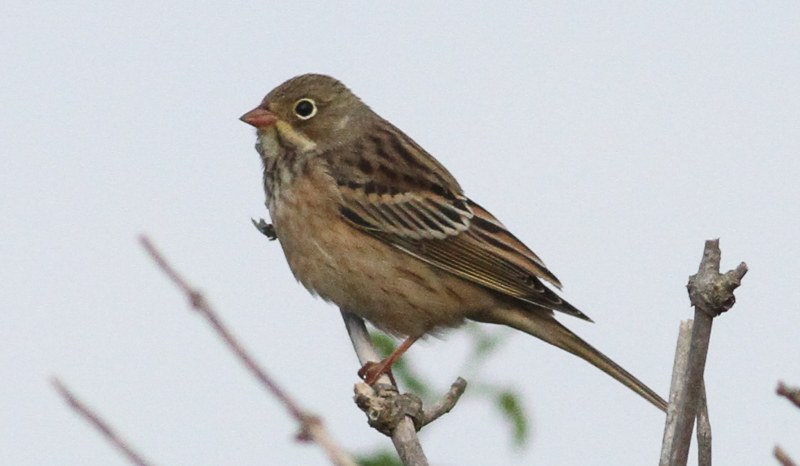
Ortolan Bunting
Emberiza hortulana
The Ortolan Bunting is a migratory Eurasian farmland bird notable for its gray-green head, yellow throat, and pinkish underparts, breeding across open, warm agricultural landscapes.
- Feather type
- Contour and flight feathers, streaked olive-brown
- Colours
- Olive-brown streaked back with a gray-green head and yellow throat
- Bird size
- Sparrow-sized, ~16 cm
Found a feather like this?
Identify any feather from a photo, free.
Overview
Overview
The Ortolan Bunting is a widespread but declining Eurasian bunting of open, sun-warmed farmland and scrub, historically well known in parts of Europe, now a focus of conservation concern due to population declines.
- Family: Buntings (Emberizidae)
- Genus: Emberiza, the Old World buntings
- Long migration between European breeding grounds and sub-Saharan African wintering areas
Identifying the Feather
Feather Identification
Ortolan Bunting feathers show a streaked olive-brown back, with breeding males displaying a gray-green head and breast, yellow throat, and pale pinkish-buff underparts.
- Shape: Rounded contour feathers; tail feathers show white outer edges typical of many buntings
- Size: Small, sparrow-sized feathers
- Color pattern: Streaked olive-brown upperparts, gray-green head and breast, yellow throat and eye-ring, pinkish-buff belly and flanks; females and juveniles are duller with more streaking on the underparts
- Shaft: Pale, not diagnostic
- Vs. similar species: The combination of a gray-green head, yellow throat, and pinkish underparts distinguishes breeding males from most other streaked Emberiza buntings
Plumage & Molt
Plumage Details
Breeding males show a gray-green head and breast, yellow throat and eye-ring, and pinkish-buff underparts; females and juveniles are duller and more heavily streaked below.
- Sexes: Males show more contrast between the gray-green head and pinkish body than females
- Juveniles: Streaked buff-brown overall, lacking strong head color
- Seasonal changes: Minor wear-related dulling outside the breeding season
- Molt: Complete molt after breeding, generally completed before autumn migration
Habitat & Range
Habitat & Range
Ortolan Buntings breed across open, dry farmland and scrub from western Europe to central Asia, wintering in sub-Saharan Africa.
- Range: Breeds from western Europe across to central Asia; winters in sub-Saharan Africa
- Habitat: Open farmland, vineyards, orchards, and dry scrubby hillsides with scattered trees
- Migratory status: Long-distance migrant, undertaking one of the longer migrations among European buntings
Behavior & Field Notes
Behavior & Field Notes
Ortolan Buntings forage on the ground and among low vegetation, feeding on insects and seeds depending on the season.
- Diet: Insects during the breeding season; seeds and grain during migration and winter
- Nesting: Builds a well-hidden ground nest among crops or low vegetation
- Voice: A simple, repeated song of clear whistled notes, often described as unhurried compared to related buntings
- Field notes: Population declines across parts of its European range have made this a species of conservation concern
Frequently asked questions
What field marks identify a breeding male Ortolan Bunting?
A gray-green head and breast, yellow throat and eye-ring, and pinkish-buff underparts together are the key identifying features.
Where does the Ortolan Bunting spend the winter?
It migrates long distances to winter in sub-Saharan Africa after breeding across Europe and central Asia.
What habitat does the Ortolan Bunting prefer?
It favors open, warm farmland, vineyards, orchards, and dry scrubby hillsides with scattered trees.
Is the Ortolan Bunting a species of conservation concern?
Yes, it has experienced notable population declines across parts of its European breeding range.
Ortolan Bunting guides
In-depth guides for identifying and understanding Ortolan Bunting.
Other feathers you may enjoy

Yellow-breasted Bunting
Contour and flight feathers, chestnut-and-yellow breeding pattern

Sedge Wren
Tiny streaked crown and back feathers

Yellow-winged Cacique
Glossy black body feathers, yellow wing patch, shaggy crest

Yellow Warbler
Small contour and flight feathers

Yellow-throated Warbler
Small contour and flight feathers

Yellow-throated Vireo
Bright yellow throat and spectacle feathers; olive-green back feathers; two white wing-bar feathers

Yellow-rumped Warbler
Small contour and flight feathers

Yellow-hooded Blackbird
Contrasting hood and body feathers

Yellow-headed Blackbird
Glossy black body plumage with a bright yellow head and breast

Yellow-eyed Junco
Contour and flight feathers

Yellow-fronted Canary
Small, smooth body plumage

Yellow-breasted Greenfinch
Compact, smooth body plumage