
How to Identify Palm Cockatoo Feathers
A guide to identifying the large, all-black, crested feathers of the Palm Cockatoo, one of the world's biggest parrots, and separating them from other black cockatoos.
Read the full Palm Cockatoo encyclopedia entry →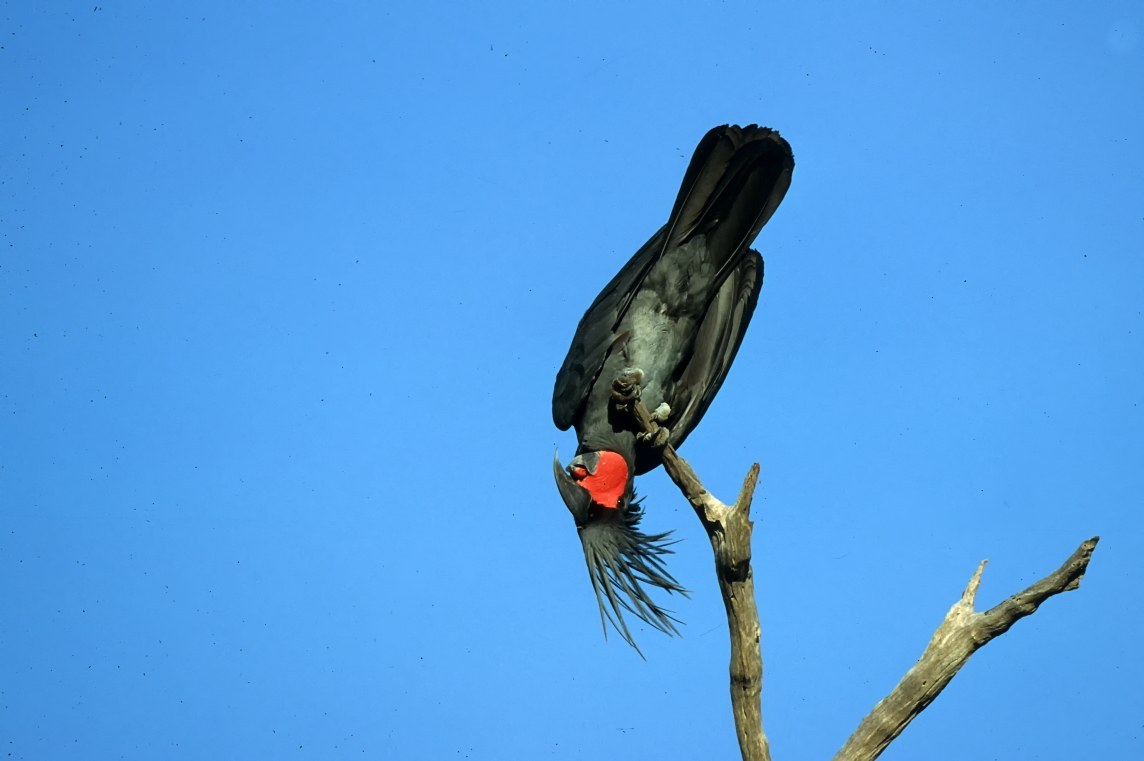
What Palm Cockatoo's Feathers Look Like
Palm Cockatoo feathers are among the largest parrot feathers you're likely to encounter, reflecting a bird that ranks among the largest cockatoos in the world. Body feathers are a deep, sooty black to grayish-black, often with a subtle powdery bloom (a fine dust that cockatoos produce to waterproof their feathers) giving them a slightly matte, chalky look rather than a glossy sheen. The most distinctive feathers come from the crest — long, backward-curving, wispy black feathers that can exceed 15 cm, forming the bird's dramatic, erectile head crest unlike almost any other parrot. Flight feathers are large and broad, often 20–35 cm, solidly black with a slightly rounded tip, built for the powerful flight of a large forest parrot. A useful secondary clue is the bare, bright red facial skin patch near the eye, which sometimes leaves a faint reddish tint on adjacent short facial feathers. Shafts throughout are thick and pale grayish, reflecting the sheer size and weight of these feathers compared to almost any songbird.
Step-by-Step: Is This Feather From a Palm Cockatoo?
- Check size first. Feathers this large and entirely black immediately narrow the field to a handful of big black parrots or corvids.
- Look for the crest shape. Long, wispy, backward-curving black feathers with little webbing near the tip are highly distinctive and point to the head crest.
- Assess texture. A fine powdery, chalky bloom on the surface (rather than a glossy sheen) is typical of cockatoo feathers, including this species.
- Rule out gloss. A feather with strong iridescent blue-green-purple sheen is more likely a crow or raven than this species, which lacks true iridescence.
- Match range. An all-black, large parrot feather found in New Guinea, the Aru Islands, or far northern Australia strongly supports this identification.
Similar Species & How to Tell Them Apart
The main potential confusion within its limited range is with other black cockatoos, such as the Australian Black-Cockatoos (e.g., Red-tailed or Yellow-tailed Black-Cockatoo), which share overlapping range in northern Australia. Those species, however, show colorful tail panels — red, yellow, or orange patches on the tail feathers — that Palm Cockatoo entirely lacks; a Palm Cockatoo tail feather is uniformly black with no colored panel. Corvids (crows and ravens) sharing the region have glossy, iridescent black feathers with a slicker, more compact structure and lack the powdery bloom and crest-specific wispy feather shape of a cockatoo. The distinctive elongated, sparse-barbed crest feather has essentially no equivalent among other regional black birds, making it the single best diagnostic feather if you're lucky enough to find one.
Where & When You'll Find Them
Palm Cockatoos inhabit lowland and monsoon tropical forest, forest edges, and savanna woodland across New Guinea, the Aru Islands, and the Cape York Peninsula of far northern Australia, generally favoring areas with large trees for nesting and feeding on hard-shelled fruits and seeds. As a non-migratory resident, feathers can be found year-round, but the best time to search is during and after the breeding season, which varies by region but often falls in the dry season (roughly May–October in Australia), when adults are most active around nest hollows and prone to feather wear and loss from courtship displays, which famously include drumming on hollow trees with a stick. Search beneath large hollow-bearing trees, along forest edges near feeding sites with cracked nut and seed debris, and in monsoon forest clearings where this species is known to display.
Frequently asked questions
What is the most distinctive feather of this species?
The long, wispy, backward-curving black crest feathers, which can exceed 15 cm and have sparse webbing near the tip — a shape essentially unique among parrots.
How does the texture help confirm this is a cockatoo feather?
Cockatoo feathers, including this species, carry a fine powdery bloom that gives them a matte, chalky look rather than a glossy sheen, distinguishing them from glossy black corvid feathers.
How do I rule out a crow or raven feather?
Corvid feathers are glossy and often show iridescent blue-green-purple sheen with a slicker structure, while Palm Cockatoo feathers are matte black without true iridescence.
Does the tail have any color on it?
No. Unlike Australian black-cockatoos with colorful red, yellow, or orange tail panels, the Palm Cockatoo's tail feathers are uniformly black.
Where should I look for these feathers?
Beneath large hollow-bearing trees in lowland or monsoon forest across New Guinea, the Aru Islands, or Cape York Peninsula in far northern Australia, especially near nest and display sites.