
How to Identify Palm Tanager Feathers
A guide to identifying the muted olive-gray and greenish feathers of the Palm Tanager, a common Neotropical songbird, and distinguishing it from similarly toned tanagers.
Read the full Palm Tanager encyclopedia entry →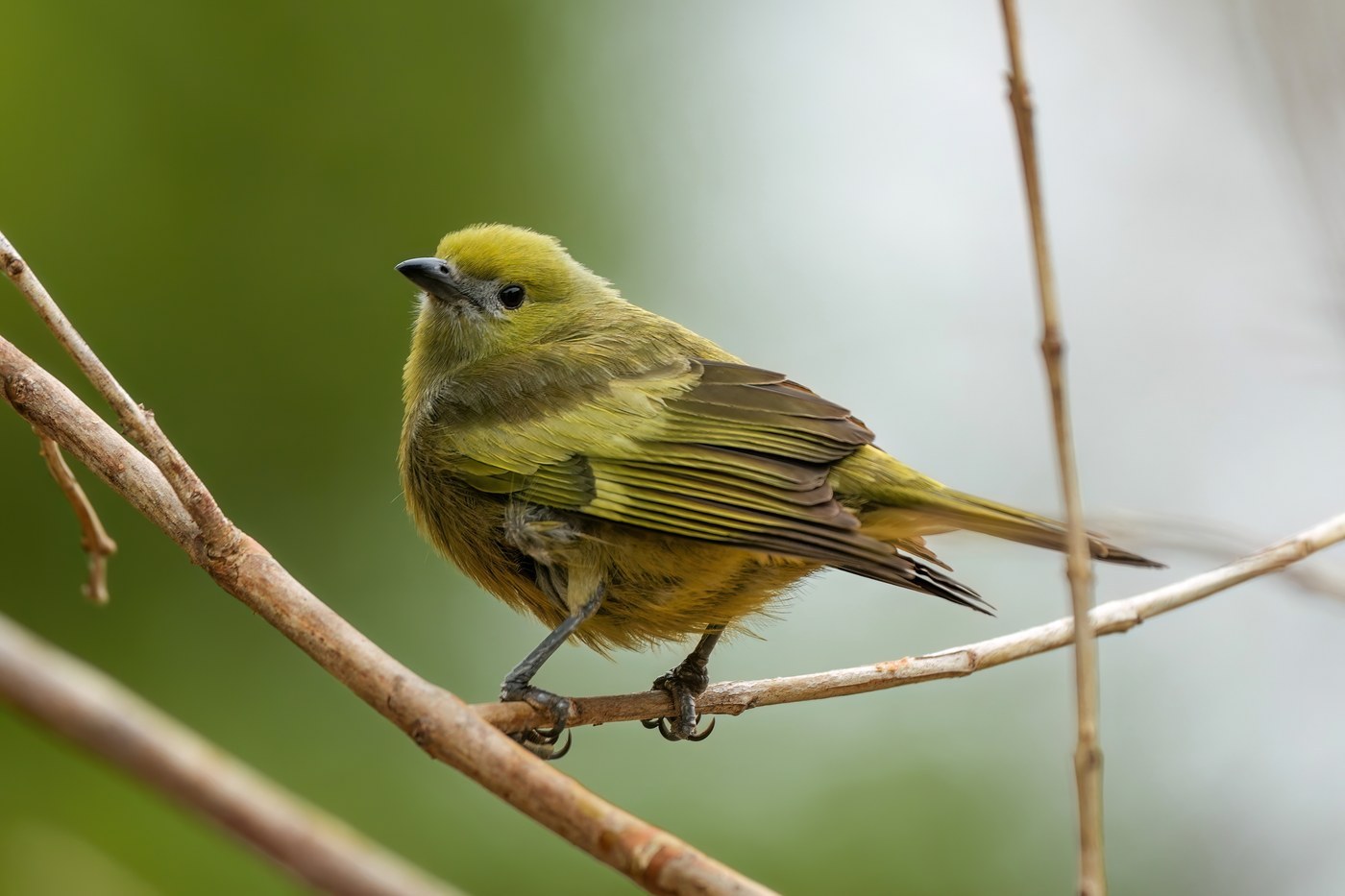
What Palm Tanager's Feathers Look Like
Palm Tanager feathers are understated compared to many of their flashy tanager relatives, showing a muted but distinctive olive-gray to grayish-green overall tone. Back and wing feathers tend toward a darker olive-green, often with a subtly contrasting blackish panel visible on the wing (formed by darker flight feather edges), while the head, throat, and underparts are a paler, softer gray-green. There's no bright color anywhere in this plumage — no red, yellow, or blue patches — which is itself a useful clue, since it rules out most of the more vividly colored tanagers found in the same habitat. Flight feathers are medium-sized for a tanager, typically 6–9 cm, with a slightly darker, almost blackish-olive tone that contrasts gently with the paler body feathers. Shafts are pale tan to grayish. The overall texture is soft and smooth, typical of a fruit- and nectar-feeding songbird rather than anything built for power or speed.
Step-by-Step: Is This Feather From a Palm Tanager?
- Check for drabness first. A soft olive-gray to grayish-green feather with no bright color patches is consistent with this species, unlike many showier tanagers.
- Look for a darker wing panel. A subtly blackish-olive tone on flight feathers, contrasting gently with paler body feathers, supports this identification.
- Measure size. A 6–9 cm range for flight feathers fits a mid-sized tanager.
- Rule out bold patterns. No streaking, spotting, or barring should be present — this is a smoothly, evenly colored bird.
- Match habitat. A muted olive-gray feather found near palm trees, gardens, or forest edges in the Neotropics fits this species, which is strongly associated with palms as its name suggests.
Similar Species & How to Tell Them Apart
The closest look-alike is the Blue-gray Tanager, which frequently associates with Palm Tanagers in mixed foraging flocks and shares a similar body shape and size. Blue-gray Tanager feathers, however, show an actual blue-gray wash with a distinctly blue tone rather than the greener, more olive cast of Palm Tanager, and Blue-gray Tanager's wing feathers often show a more defined lighter blue shoulder patch. Female or immature tanagers of more colorful species (such as female euphonias or female Summer Tanagers) can sometimes appear drab, but they typically show at least a hint of yellow-green rather than the grayer olive tone of the Palm Tanager, or a different overall shape reflecting a smaller-bodied bird. If the feather you have is a genuinely gray-olive, unpatterned tone with a darker wing panel and no blue or yellow tint, Palm Tanager is a strong candidate.
Where & When You'll Find Them
Palm Tanagers are common residents of gardens, parks, forest edges, and — true to their name — areas with palm trees, ranging from Mexico and Central America through much of tropical South America. As a non-migratory resident species, feathers can be found year-round, with no strong seasonal pattern tied to migration. The best time to search is during the breeding season, which varies by location but often follows local wet-season patterns, when pairs are actively nesting (often in the crowns of palm trees, hence the name) and more prone to losing feathers during courtship and chick-rearing. Search near palm trees in gardens, parks, and semi-open habitats, along forest edges, and around fruiting trees, since this species is a frequent visitor to gardens and readily tolerates human-modified landscapes.
Frequently asked questions
What color should I expect from a Palm Tanager feather?
A muted olive-gray to grayish-green tone with no bright color patches — quite plain compared to many showier tanagers, which is itself a useful identifying clue.
How is this different from a Blue-gray Tanager feather?
Blue-gray Tanager shows an actual blue-gray wash with a distinct blue tone, while Palm Tanager is greener and more olive overall, without any blue tint.
Does this species have any bold wing markings?
Only a subtle darker, blackish-olive panel on the flight feathers contrasting gently with the paler body — no bold bars, spots, or bright patches.
How big are the feathers?
Medium for a tanager, with flight feathers typically 6–9 cm long.
Where would I most likely find these feathers?
Near palm trees in gardens, parks, and forest edges from Mexico through tropical South America, since this species is strongly associated with palms and common around human habitation.