
How to Identify Paradise Tanager Feathers
A guide to identifying the vividly multicolored feathers of the Paradise Tanager, one of the Amazon's most colorful songbirds, and separating them from other rainbow-colored tanagers.
Read the full Paradise Tanager encyclopedia entry →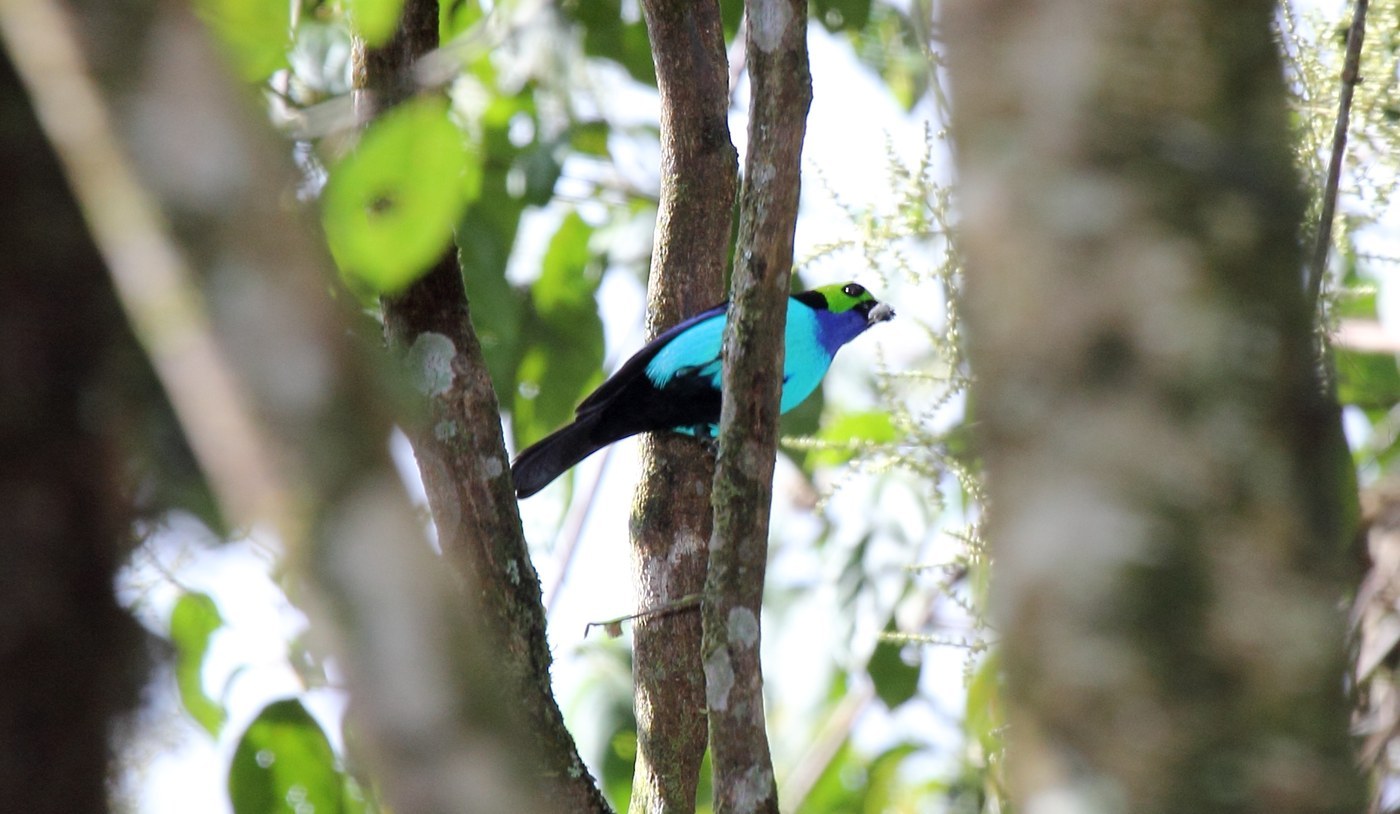
What Paradise Tanager's Feathers Look Like
Paradise Tanager feathers are among the most colorful in the entire Amazon basin, combining multiple saturated colors on a single small bird. Head feathers are a bright light green to turquoise-green, transitioning to a vivid deep turquoise-blue on the throat and underparts, then a contrasting black patch across the back, and finishing with a fiery red to orange-red rump, which is often the most eye-catching single feather you might find. Wing and tail feathers are mostly black, edged narrowly in the same turquoise-green as the head, giving even flight feathers a hint of the bird's color scheme rather than being plainly dark. Feathers are small, typical of a tanager at 5–7 cm for flight feathers, with a soft, smooth texture. Shafts are dark on the black-based feathers and pale on the brightly colored ones. This is a case where nearly every body feather, regardless of which part of the bird it came from, shows some distinctive color, making Paradise Tanager one of the easier colorful tanagers to narrow down from a single feather.
Step-by-Step: Is This Feather From a Paradise Tanager?
- Check for a turquoise-green and blue combination. Head and underpart feathers showing both green and turquoise-blue tones together is a strong positive sign.
- Look for a red or orange rump feather. A fiery red-orange feather found alongside green-blue ones is highly diagnostic for this species.
- Confirm a black back patch. A contrasting black feather from the upper back, sitting between the green head and red rump, supports this identification.
- Measure size. A 5–7 cm flight feather range fits a small tanager.
- Weigh location. A rainbow-colored small feather found in Amazonian lowland forest canopy strongly supports this species, since it favors the high canopy of humid tropical forest.
Similar Species & How to Tell Them Apart
Several other Tangara tanagers in the Amazon share a multicolored palette, most notably Green-headed Tanager and Seven-colored Tanager, both of which can show green, blue, and red tones. The key difference is the specific arrangement: Paradise Tanager's black back patch sitting directly between a green head and red rump is a distinctive layout, whereas Green-headed Tanager shows more blue on the back rather than solid black, and Seven-colored Tanager (found further south, in the Atlantic Forest rather than Amazon) has a more orange-dominated crown and different underpart pattern. Because these species have somewhat separate ranges (Amazon basin for Paradise Tanager versus Atlantic Forest for Seven-colored Tanager), location is often the deciding factor when feather patterns are very close. If the feather shows turquoise-green, deep blue, black, and red-orange all represented across a small feather set, and it was found in Amazonian lowland forest, Paradise Tanager is far and away the most likely source.
Where & When You'll Find Them
Paradise Tanagers are residents of the humid lowland and foothill forests of the Amazon basin, ranging across Colombia, Ecuador, Peru, Bolivia, and Brazil, typically foraging in the mid-to-upper canopy, often joining mixed-species flocks with other tanagers. As a non-migratory resident species, feathers can be found year-round in suitable habitat, with no strong seasonal migration pattern. The best time to search is during the breeding and post-breeding molt period, which varies regionally but often aligns with the transition from wet to dry season, when adults are most active feeding young and undergoing feather replacement. Search beneath tall canopy trees in humid forest, along forest edges, and near fruiting trees where mixed tanager flocks commonly forage, since this species rarely descends to the ground or low understory.
Frequently asked questions
What color combination makes this species so identifiable?
Turquoise-green head, deep blue-turquoise underparts, a contrasting black back patch, and a fiery red-orange rump — a distinctive layout of colors found together on one small bird.
How do I tell it apart from a Green-headed Tanager feather?
Green-headed Tanager shows more blue on the back rather than the solid black patch found in Paradise Tanager, so the presence of true black between the green head and red rump favors Paradise Tanager.
Does range help separate it from Seven-colored Tanager?
Yes — Seven-colored Tanager is found in the Atlantic Forest of southeastern Brazil, while Paradise Tanager is an Amazon basin species, so location is a strong tiebreaker.
How large are the feathers?
Small, typical of a tanager, with flight feathers around 5–7 cm.
Where in the forest would I find these feathers?
Beneath tall canopy trees in humid Amazonian lowland or foothill forest, especially near fruiting trees where mixed-species tanager flocks forage.