
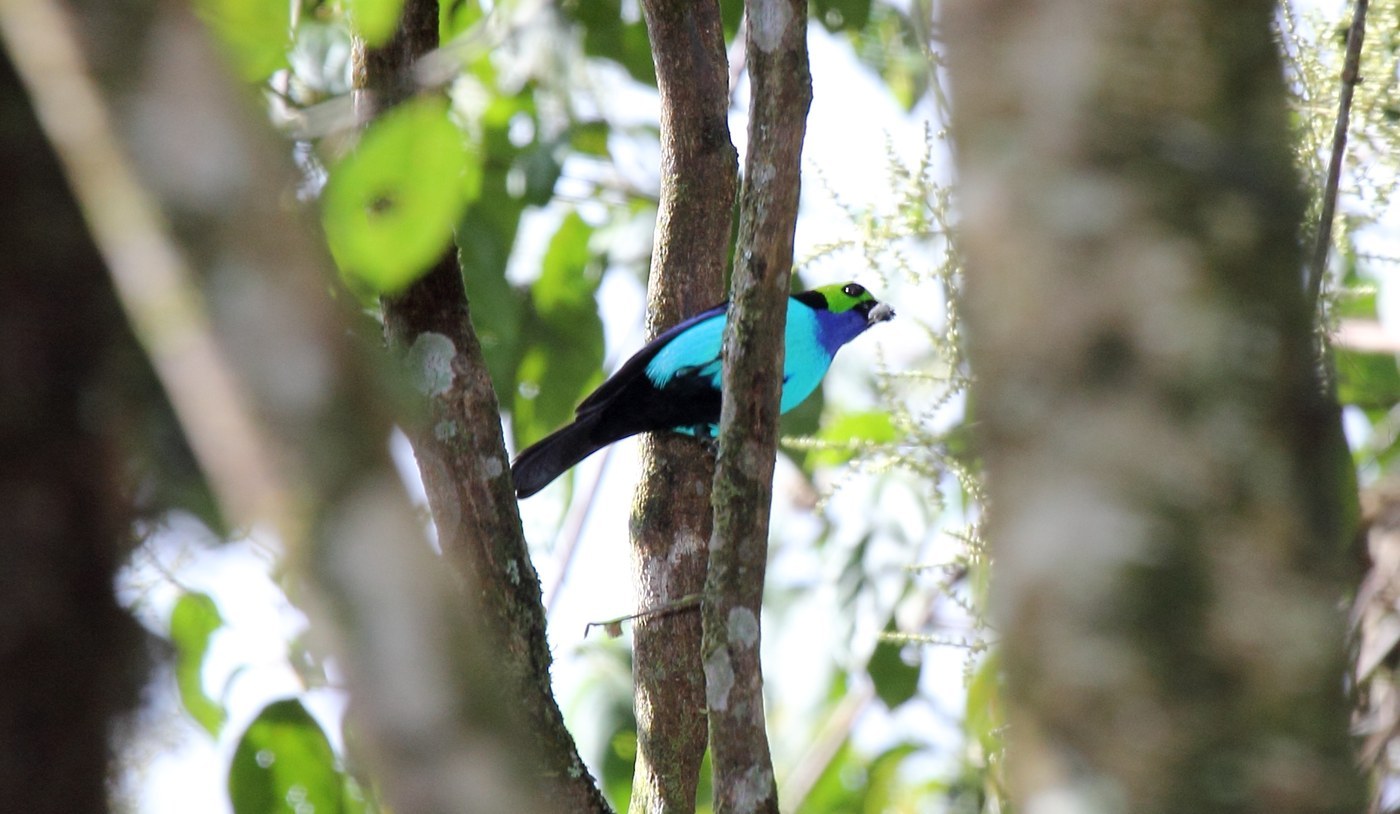
Paradise Tanager
Tangara chilensis
One of the most vividly colored songbirds in the world, the Paradise Tanager combines a turquoise-green head, black back, red rump, and purplish-blue throat in a single small canopy bird.
- Feather type
- Small, intensely multicolored contour feathers with a red rump patch
- Colours
- Turquoise-green head, black back, red rump, yellow-green underparts, purplish-blue throat
- Bird size
- ~14 cm
Found a feather like this?
Identify any feather from a photo, free.
Overview
The Paradise Tanager is widely regarded as one of the most spectacularly colored songbirds in the Amazon basin, where it inhabits humid lowland forest canopy. Both sexes share an elaborate, multicolored plumage combining a turquoise-green head, contrasting black back, a bright red rump patch, yellow-green underparts, and a purplish-blue throat, a combination of colors packed into a single small bird that makes it a favorite among birdwatchers visiting the region.
Identifying the Feather
Body feathers show a bright turquoise-green crown and face, a solid black back and wings, and a vivid red patch across the rump that stands out clearly against the black, especially visible in flight or when the tail is lifted. The throat shows a rich purplish-blue tone, distinct from the surrounding turquoise-green of the head and the yellow-green of the lower underparts, creating a layered, multi-toned pattern across the body. Sexes are essentially alike in plumage, sharing the same combination of colors, which is typical for Tangara tanagers.
Plumage & Molt
Adult plumage remains consistent year-round with no strong seasonal variation, and males and females are essentially identical in appearance. Immatures show a somewhat duller and less sharply defined version of the adult color pattern before completing their molt into full adult plumage.
Habitat & Range
Paradise Tanagers inhabit humid lowland forest canopy across the Amazon basin of South America. The species is a year-round resident throughout its range, generally remaining within the forest canopy rather than venturing into more open or edge habitats.
Behavior & Field Notes
This species forages for fruit and insects high in the forest canopy, often joining mixed-species foraging flocks with other tanagers and canopy songbirds. The voice includes thin, high-pitched calls typical of the genus. Nests are cup-shaped, built in the canopy. Because Paradise Tanagers stay high in the forest canopy, they are often first detected as part of a mixed flock moving through the treetops, with their vivid multicolored plumage becoming apparent once seen in good light.
Frequently asked questions
What makes the Paradise Tanager's feathers so distinctive?
A combination of a turquoise-green head, black back, bright red rump, yellow-green underparts, and a purplish-blue throat all in one small bird.
Do male and female Paradise Tanagers differ in color?
No, both sexes share the same vivid multicolored plumage pattern.
Where is the Paradise Tanager found?
It inhabits humid lowland forest canopy across the Amazon basin of South America.
How is the Paradise Tanager typically observed?
It is usually seen high in the forest canopy, often as part of a mixed-species foraging flock with other tanagers.
Paradise Tanager guides
In-depth guides for identifying and understanding Paradise Tanager.
Other feathers you may enjoy

Yellow-breasted Bunting
Contour and flight feathers, chestnut-and-yellow breeding pattern

Sedge Wren
Tiny streaked crown and back feathers

Yellow-winged Cacique
Glossy black body feathers, yellow wing patch, shaggy crest

Yellow Warbler
Small contour and flight feathers

Yellow-throated Warbler
Small contour and flight feathers

Yellow-throated Vireo
Bright yellow throat and spectacle feathers; olive-green back feathers; two white wing-bar feathers

Yellow-rumped Warbler
Small contour and flight feathers

Yellow-hooded Blackbird
Contrasting hood and body feathers

Yellow-headed Blackbird
Glossy black body plumage with a bright yellow head and breast

Yellow-eyed Junco
Contour and flight feathers

Yellow-fronted Canary
Small, smooth body plumage

Yellow-breasted Greenfinch
Compact, smooth body plumage