
How to Identify Pink-footed Goose Feathers
A guide to the dark head, pale scaled body, and white-tipped tail that identify Pink-footed Goose feathers among Europe's wintering gray geese.
Read the full Pink-footed Goose encyclopedia entry →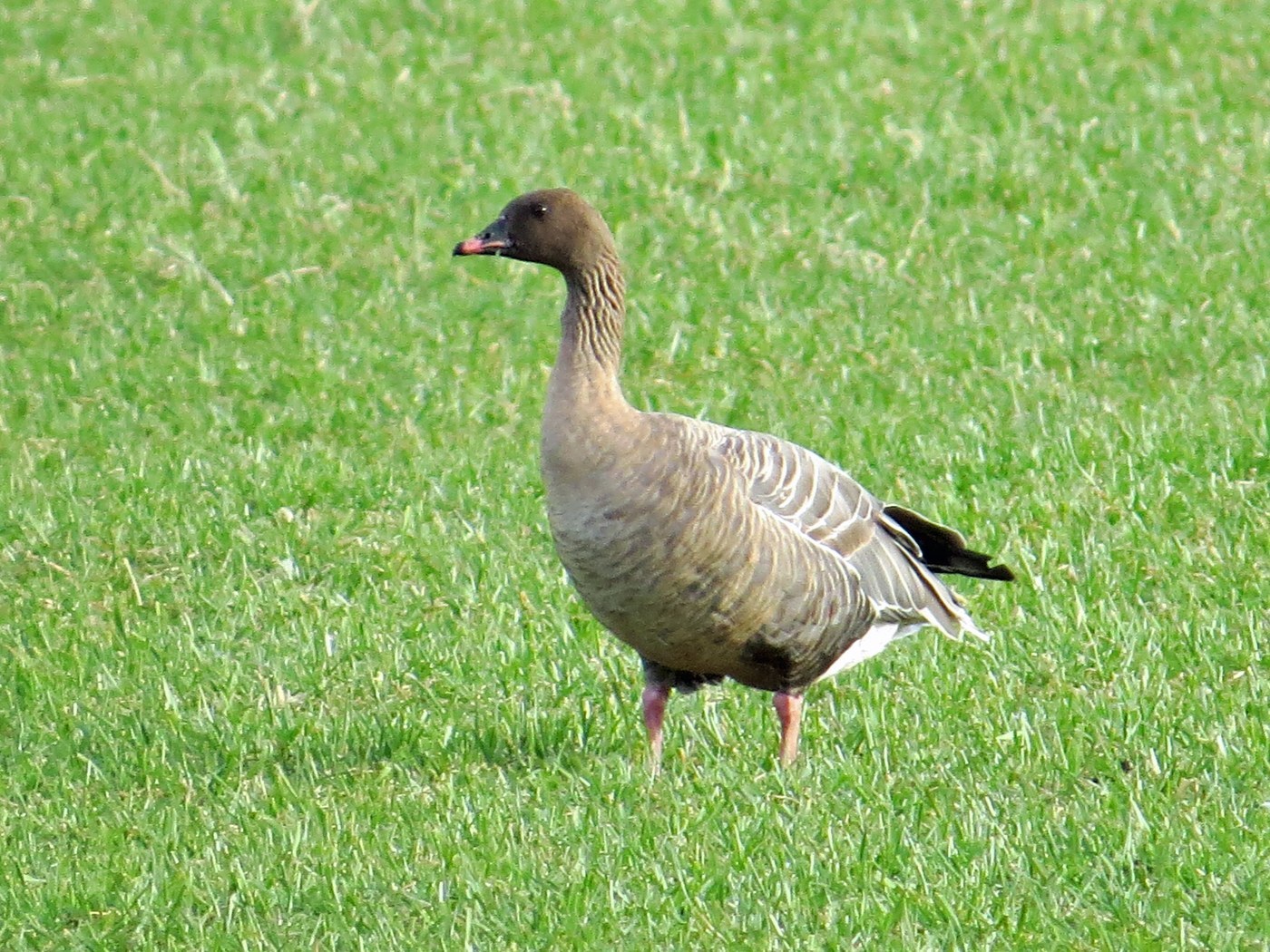
What Pink-footed Goose Feathers Look Like
Pink-footed Goose is a medium-sized gray goose, and its feathers show a clear two-tone pattern. Head and neck feathers are noticeably darker blackish-brown than the rest of the body — a stronger contrast than in most other gray geese. Body and mantle feathers are grayish-brown with pale gray-buff fringes, giving overlapping feathers a scaled, barred look. Flight feathers (primaries and secondaries) are dark gray-brown, and the upperwing covert feathers are pale gray, forming a pale forewing patch visible in flight — a trait shared with other gray geese, so it should be used alongside the head/body contrast rather than alone. Tail feathers are gray-brown ending in a crisp white terminal band, and the uppertail coverts are white. Flight feathers run 10-12.5 inches, with smaller body feathers 1.5-3 inches.
Step-by-Step: Is This Feather From a Pink-footed Goose?
- Compare head/neck feathers to body feathers. A distinctly darker, blackish head and neck against a paler grayish-brown body is the hallmark of this species.
- Check mantle feather fringes. Pale buff-gray scalloped edges create a scaled or barred look when feathers overlap.
- Measure flight feathers. In the 10-12.5 inch range, solidly in "gray goose" territory — too large for ducks or small geese like Brant.
- Check the tail. Gray-brown feathers ending in a crisp white band.
- Look for pale forewing coverts if a wing section is available, then rely on the head/neck contrast to separate this species from its close relatives.
Similar Species & How to Tell Them Apart
Greylag Goose is more uniformly gray-brown from head to body, lacking the strong dark head/neck contrast, and its forewing tends to look paler and more even overall. Taiga/Tundra Bean Goose has a dark head and neck too, but the tone leans warm brown rather than blackish, and the mantle feathers are duller, without the frosty pale fringing. Greater White-fronted Goose shows dark barring or blotching on individual belly feathers, which Pink-footed Goose lacks, and reads as a more uniform brown overall without the blackish head contrast.
Where & When You'll Find Them
Pink-footed Geese breed in Greenland, Iceland, and Svalbard, then winter in large flocks on farmland and estuaries across northwestern Europe, especially Britain, Denmark, and the Netherlands. Feathers are most commonly found on these wintering grounds — stubble fields, salt marshes, and roost lakes — from autumn through early spring, when large flocks gather and preening debris and lost feathers accumulate at roost sites. The main flight-feather molt happens on the Arctic breeding grounds in summer, so any worn wing feathers found in winter are more likely the result of preening loss or predation than active molt.
Frequently asked questions
What's the single best clue for this species?
The contrast between a distinctly darker, blackish head and neck and a paler grayish-brown body — most other gray geese are more uniform in tone.
Could this be a domestic or farmyard goose feather?
Domestic geese tend to be more uniformly pale or white; the crisp dark head-body contrast and scaled mantle pattern point instead to a wild Pink-footed Goose.
Is feather size alone enough to identify this species?
No — several gray geese overlap broadly in size, so you need the head/neck color contrast and mantle fringing pattern, not measurements alone.
When are Pink-footed Goose feathers most likely to turn up?
On wintering grounds in northwestern Europe from autumn to early spring, near farmland roosts and estuaries where large flocks gather.