
Pink-footed Goose
Anser brachyrhynchus
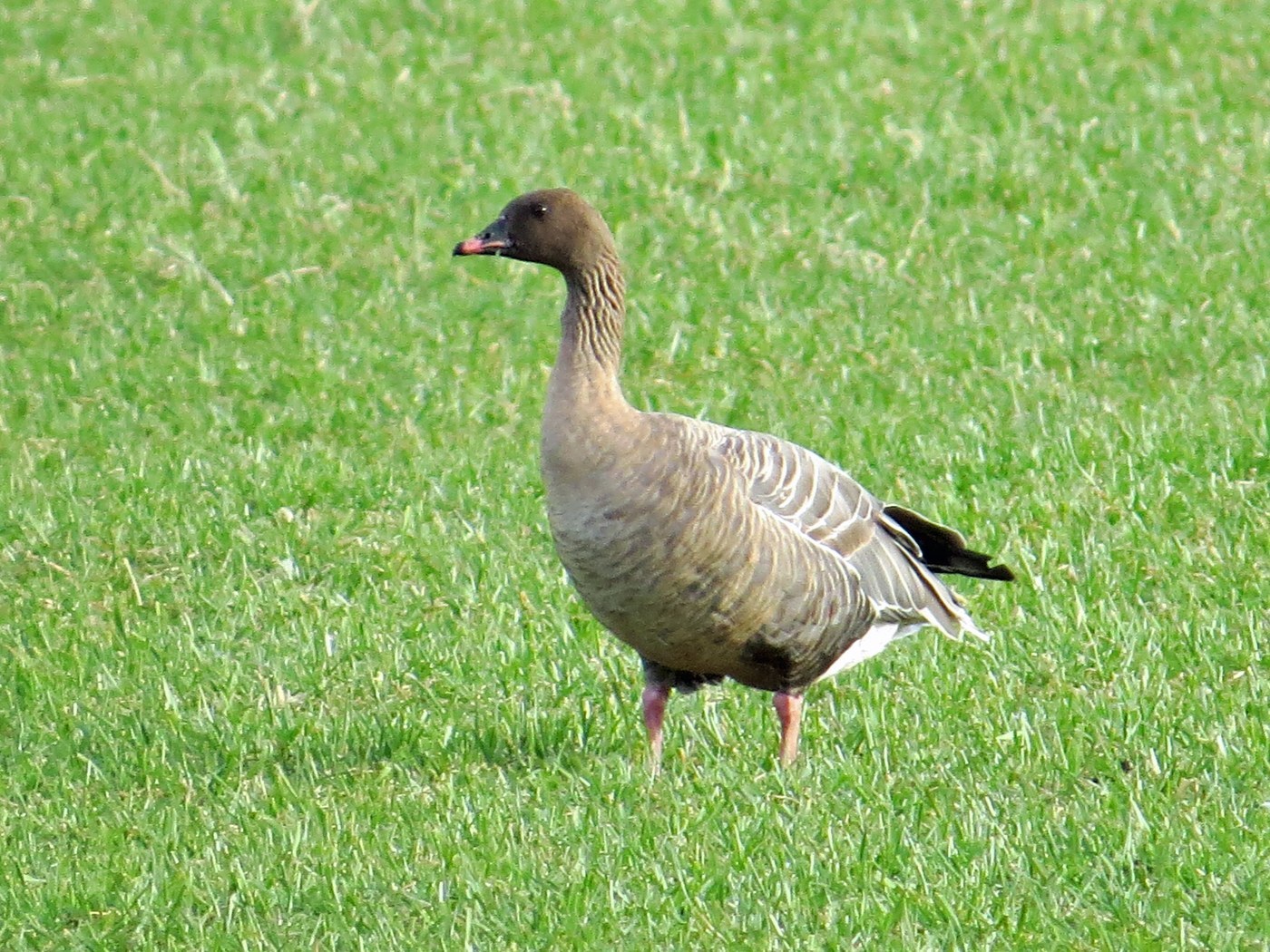
A compact gray goose with a notably darker head and neck than its body, a short pink-banded bill, and pink legs, breeding in the far North Atlantic and wintering on European farmland.
- Feather type
- Contour and flight feathers
- Colours
- Gray-brown with pale fringing, darker head
- Bird size
- Small-medium goose, ~65 cm
Found a feather like this?
Identify any feather from a photo, free.
Overview
The Pink-footed Goose is a relatively small, short-billed member of the gray goose group, breeding in Greenland, Iceland, and Svalbard and wintering in large numbers on farmland and estuaries in the British Isles and neighboring countries. Its dark head contrasting with a paler body, short bill, and pink legs distinguish it from the similar Bean Goose.
Identifying the Feather
Body feathers are grayish-brown neatly fringed pale gray or white, giving fine, even scaling across the back and flanks. Head and neck feathers are noticeably darker brown than the body, creating a subtle hooded effect useful for identification even without seeing the bill. The bill is short and stubby with a variable pink band, and legs are pink—both useful distinctions from the orange-legged, longer-billed Bean Goose, which is also more uniformly dark overall without the contrasting darker head.
Plumage & Molt
Sexes are alike. Juveniles are duller and less evenly scaled than adults, with a less pronounced dark hood. Adults molt flight feathers after breeding on Arctic and subarctic nesting grounds, undergoing a flightless period.
Habitat & Range
Breeds on Arctic tundra and rocky terrain in Greenland, Iceland, and Svalbard. Winters on estuaries, farmland, and coastal grassland in Britain, the Netherlands, and Denmark, forming some of the densest goose concentrations in Europe.
Behavior & Field Notes
Grazes heavily on waste grain, root crop remains, and grassland, often in enormous single-species flocks on wintering grounds. Nests on the ground, sometimes on cliff ledges in areas with predators. Highly gregarious and vocal, with a distinctive high, musical honking heard from large flocks moving between roosts and feeding fields at dawn and dusk.
Frequently asked questions
What makes the Pink-footed Goose's head look different from its body?
The head and neck feathers are distinctly darker brown than the paler, more finely scaled body feathers, creating a subtle hooded look.
How can you tell Pink-footed Goose from Bean Goose?
Pink-footed Goose has a shorter bill, pink (not orange) legs, and a darker head contrasting with the body, while Bean Goose is more uniformly dark with orange legs.
Where does the Pink-footed Goose breed?
In Arctic and subarctic regions of Greenland, Iceland, and Svalbard.
Why do Pink-footed Geese form such large winter flocks?
They concentrate on productive farmland and estuaries in northwest Europe, where waste grain and root crop fields provide abundant winter food.
Pink-footed Goose guides
In-depth guides for identifying and understanding Pink-footed Goose.
Other feathers you may enjoy

Mallard
Wing (speculum), body, and tail feathers

Spectacled Eider
Large sea-duck body feathers with distinctive eye-ring patches

Canada Goose
Body and flight feathers
Mute Swan
Body (contour) and flight feathers

Wood Duck
Iridescent crest feathers; ornate scapular and flank feathers; white teardrop facial feathers (female)
Whooper Swan
Contour and flight feathers

White-winged Scoter
Large sea-duck body feathers with a white wing patch

Ruddy Duck
Stiff tail feathers and compact body plumage

Ross's Goose
Contour and flight feathers

White-cheeked Pintail
Contour and elongated tail feathers

Torrent Duck
Dense, sleek contour feathers; stiff, pointed tail feathers used for bracing against rocks

Tundra Swan
Contour and flight feathers