
How to Identify Plum-headed Parakeet Feathers
A guide to the wine-red male head, black-and-turquoise neck ring, and long blue-tipped tail feathers that identify Plum-headed Parakeet feathers.
Read the full Plum-headed Parakeet encyclopedia entry →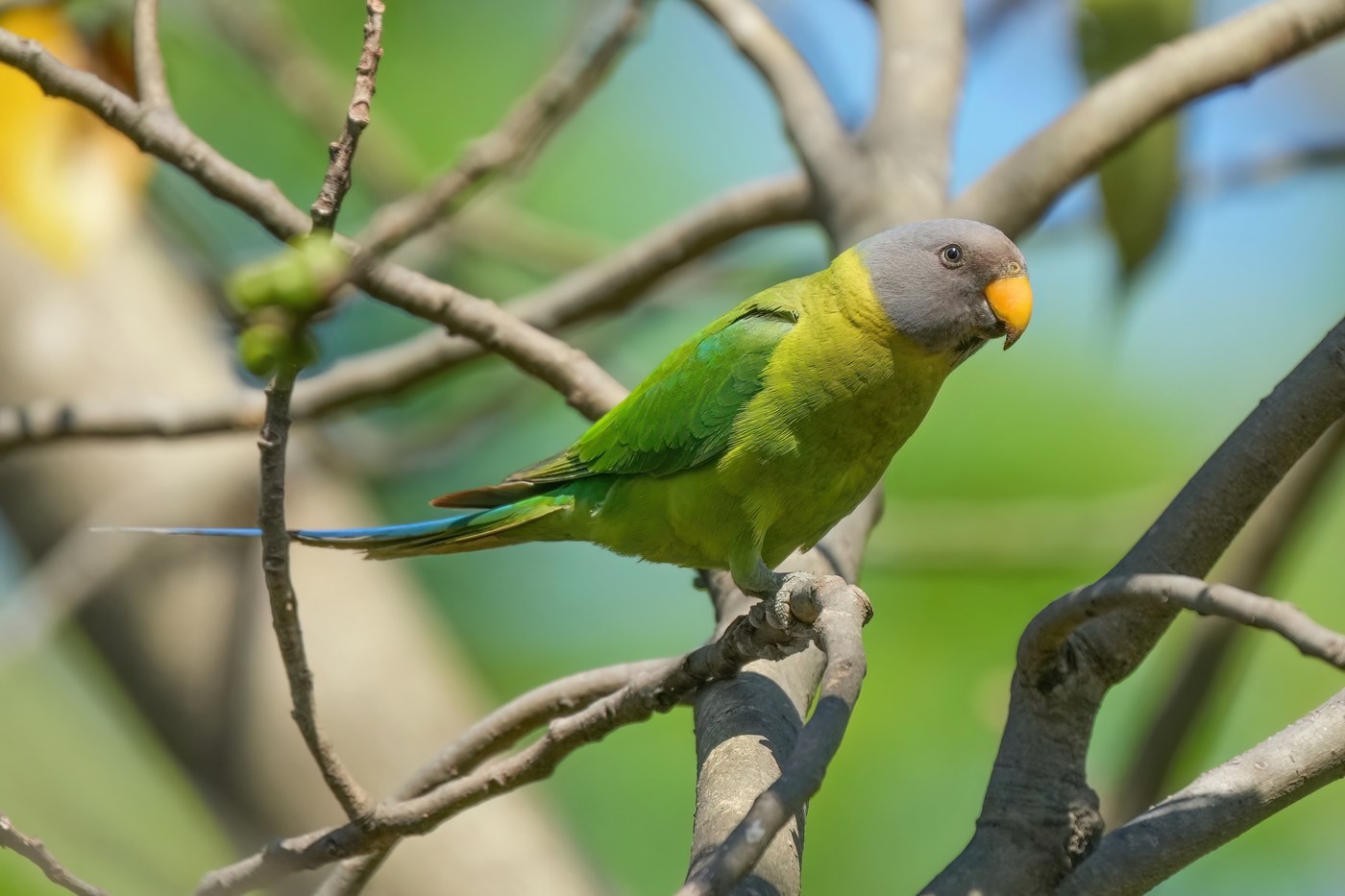
What Plum-headed Parakeet Feathers Look Like
Plum-headed Parakeet is a medium parakeet with an unusually long, graduated tail whose central feathers can exceed 8 inches in adult males. Male head feathers are a rich plum or wine-red to purplish-maroon, shading to bluish on the cheeks and nape, separated from the green body by a thin black band across the upper neck and a narrow turquoise-blue band just below it — a two-tone neck-ring combination found in no other parakeet in its range. Body and back feathers are bright grass-green. Wing covert feathers show a small dark maroon-red shoulder patch in males, often faint or absent in females. Central tail feathers are long, blue-green above, fading to a pale yellowish-white tip — one of the most recognizable single feathers of the species. Female head feathers are gray rather than plum, with a yellow (not black-and-blue) neck ring.
Step-by-Step: Is This Feather From a Plum-headed Parakeet?
- Check head color. A rich plum or wine-red to purple feather immediately suggests an adult male of this species.
- Check for the neck-ring bands. Look for a thin black band and a thin turquoise band together, sandwiched between the colored head and the green body — if both are present, that's close to diagnostic.
- Measure central tail feathers. Unusually long (potentially over 8 inches) with a blue-green shaft fading to a pale yellowish tip.
- If the head feather is gray, check for a yellow (not black/blue) neck ring, consistent with a female or young bird.
- Check the shoulder for a small dark red patch, present in mature males.
Similar Species & How to Tell Them Apart
Rose-ringed Parakeet has a pink-and-black neck ring but a green (not plum or gray) head, an immediate separator at the head-color level. Blossom-headed Parakeet is extremely similar overall — the male shows a pinkish-lilac rather than deep plum/wine head, with blue restricted more to the crown — and ranges overlap only marginally in northeast India; head-color saturation and the extent of blue are the main separators, and it can genuinely be difficult to call from a single detached feather. Blue-winged (Malabar) Parakeet has a gray head but lacks the distinct black-and-turquoise double neck ring and shows a bluish wash more extensively over the head and breast.
Where & When You'll Find Them
Plum-headed Parakeets are widespread residents of forest, farmland, and wooded gardens across the Indian subcontinent. Non-migratory, so feathers can be found year-round, with a modest increase after the breeding-season molt, which generally follows the main dry-to-monsoon transition and varies by region, especially near roost trees where large flocks gather at dusk and preening debris and molted feathers accumulate below.
Frequently asked questions
How do I know if the feather is from a male or female?
Male head feathers are plum or wine-red with a black-and-turquoise double neck ring; female head feathers are gray with a yellow neck ring instead.
What's the easiest single diagnostic feather to find?
The elongated central tail feather, blue-green fading to a pale yellow tip, is much longer and more distinctive than the rest of the tail.
How do I separate this from Rose-ringed Parakeet?
Rose-ringed Parakeet has a plain green head, while Plum-headed Parakeet males show a plum or wine-colored head — head color alone separates them.
What about Blossom-headed Parakeet - how close is that?
Very close; look for a deeper, more saturated plum-red (versus paler pink-lilac) and more extensive blue to lean toward Plum-headed, though range is the more reliable guide since the two barely overlap.