
How to Identify Powerful Owl Feathers
A guide to the huge size, bold chevron barring, and plain rounded face that identify Powerful Owl feathers, Australia's largest owl.
Read the full Powerful Owl encyclopedia entry →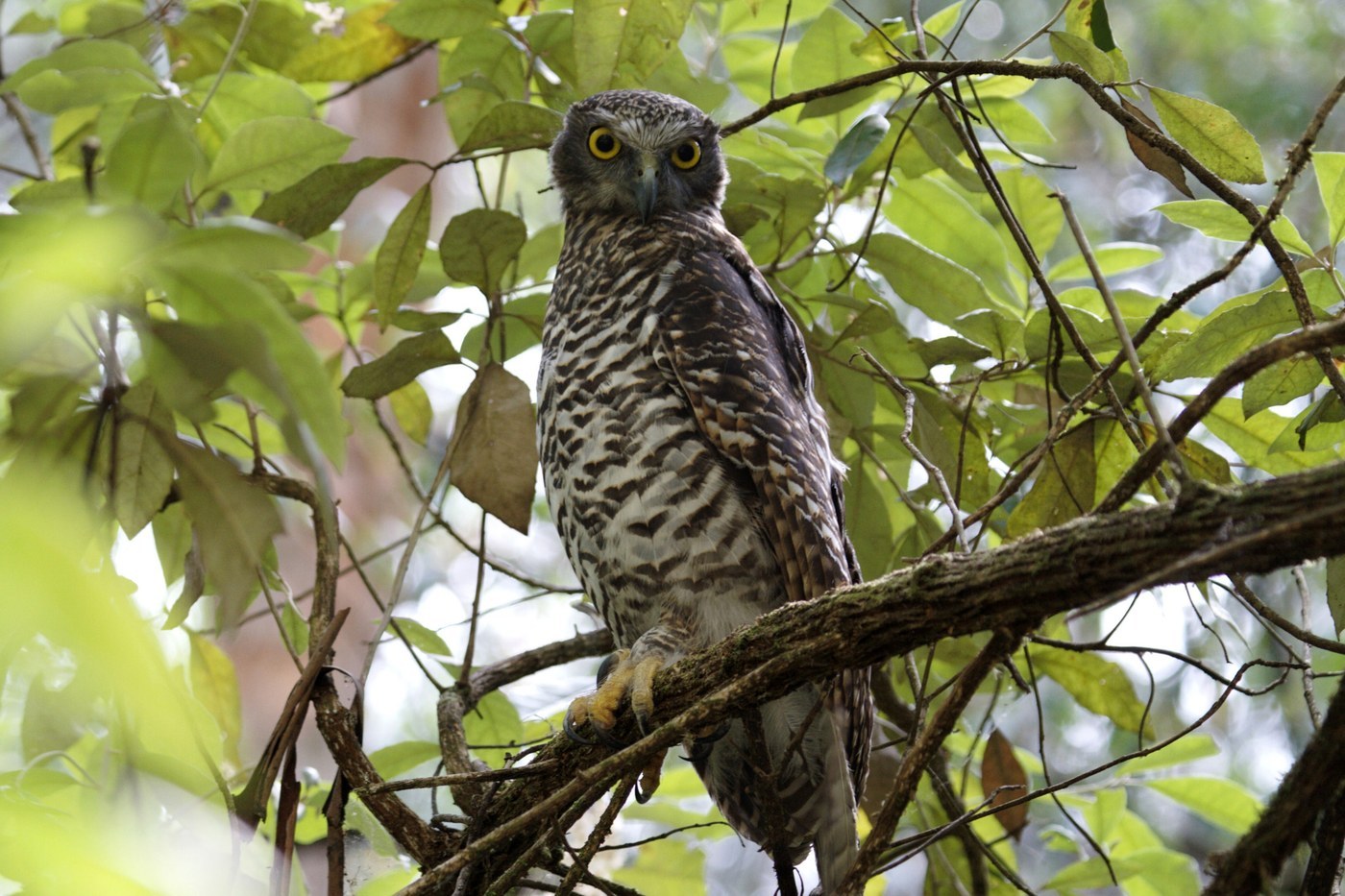
What Powerful Owl Feathers Look Like
Powerful Owl is Australia's largest owl, and its flight feathers reflect that scale, running very large at roughly 12-15 inches, fitting a formidable nocturnal predator capable of taking possums. Upperpart feathers are dark grayish-brown to blackish-brown with fine white spotting arranged in rows, giving a spotted rather than barred look on the back and wings — a key structural difference from many other large owls. Underpart feathers show bold, heavy dark brown V-shaped or chevron-shaped barring on a whitish to pale buff ground — thick, blunt chevrons rather than fine streaking, covering the breast and belly densely. Facial disc feathers are only weakly defined, without the sharply outlined heart-shaped or round disc seen in barn owls, since this species belongs to the hawk-owl group, which has plain, rounded heads without a strong facial ruff. Leg and foot feathering is dense down to the large, powerful talons.
Step-by-Step: Is This Feather From a Powerful Owl?
- Measure. Very large flight feathers (12 inches or more) point to one of the largest owls in the region — Powerful Owl is the largest owl in Australia.
- Check facial feathers. No sharply defined disc rim — a plain, rounded hawk-owl-type face, unlike barn owls.
- Check underparts. Bold, thick brown chevron or V-shaped barring on whitish ground, denser and heavier than most other owls in range.
- Check upperparts. Rows of small white spots on dark brown, a spotted rather than mottled or barred back pattern.
- Consider size and structure together with heavy feet and talon feathering if a foot is attached — unusually large and robust for a nocturnal raptor.
Similar Species & How to Tell Them Apart
Barking Owl is much smaller, with finer, more streak-like underpart markings rather than bold chevrons, and proportionally smaller flight feathers. Sooty Owl has a more sharply defined, rounder facial disc (a true barn-owl relative) and finer, more delicate spotting rather than bold chevron barring below. Rufous Owl shows warmer rufous-brown barring rather than the blackish-brown chevrons of Powerful Owl and is restricted to tropical northern Australia and New Guinea, versus Powerful Owl's eastern Australian range.
Where & When You'll Find Them
Powerful Owl is a resident of tall eucalypt forest and woodland along the eastern Australian seaboard, from Queensland through New South Wales and Victoria, nesting in large old-growth tree hollows and requiring extensive forest home ranges. Non-migratory, so feathers can be found year-round beneath regular roost trees, where the species tends to reuse the same daytime roost for extended periods, allowing pellets and molted feathers to accumulate below, and near nest hollows, with molt occurring gradually rather than in one intense synchronized period.
Frequently asked questions
What's the biggest single clue this is a Powerful Owl feather?
The sheer size - at 12 inches or more its flight feathers are far larger than nearly any other Australian owl, combined with bold chevron-shaped (not fine streak) barring below.
Does this owl have a heart-shaped facial disc like a Barn Owl?
No, it belongs to the hawk-owl group with a plain, rounded face and no sharply defined disc rim.
How do I tell it apart from Rufous Owl?
Powerful Owl's barring is blackish-brown, while Rufous Owl shows a warmer rufous-brown tone, and their ranges barely overlap since Rufous Owl is restricted to tropical far-north Australia and New Guinea.
Where should I look for feathers?
Beneath regularly used daytime roost trees in tall eucalypt forest along Australia's eastern seaboard, where this owl tends to reuse the same roost for long periods.