
How to Identify Princess Parrot Feathers
A guide to the pastel blue-crown, pink-throat, and long tapering tail that identify Princess Parrot feathers among Australian desert parrots.
Read the full Princess Parrot encyclopedia entry →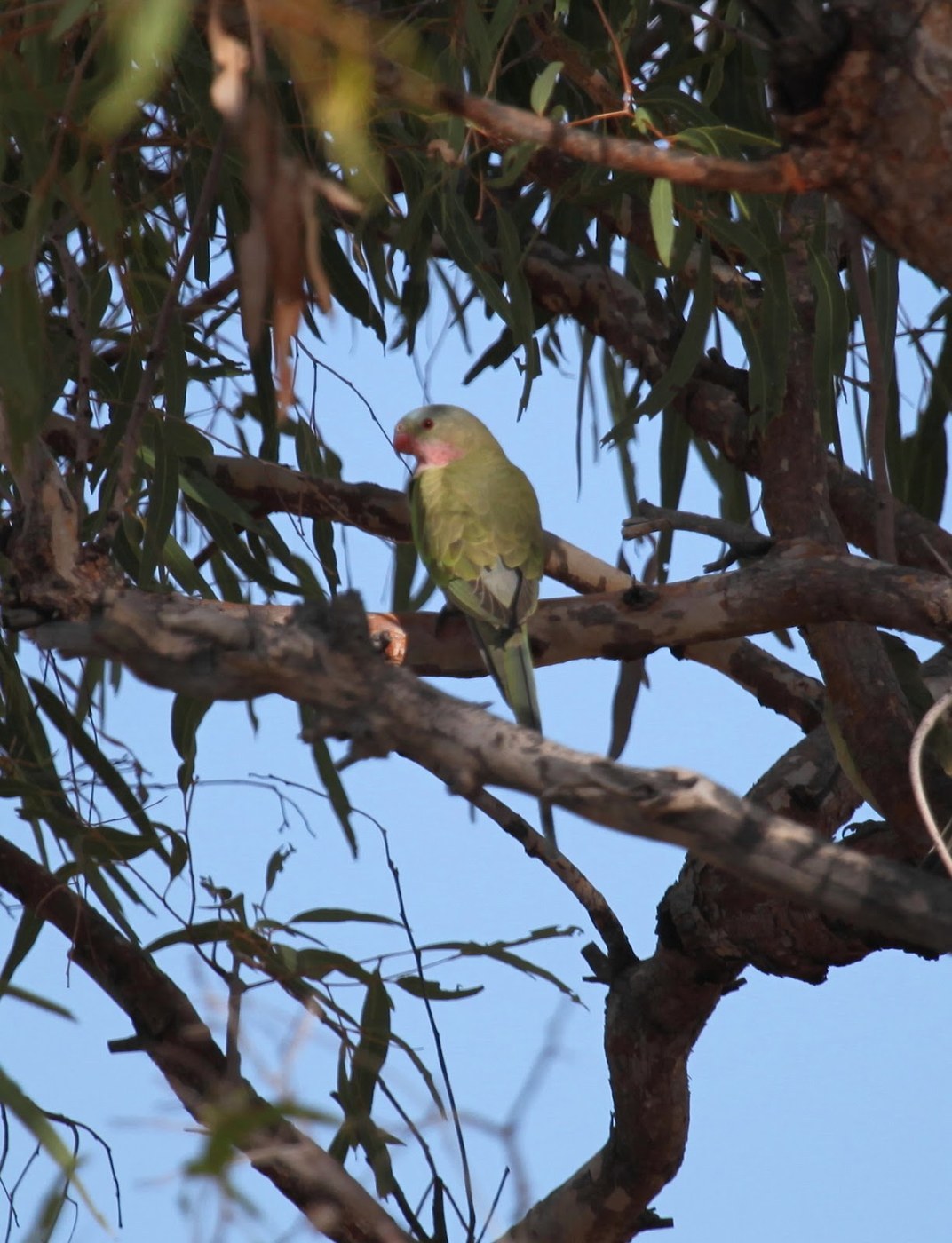
What Princess Parrot Feathers Look Like
Princess Parrot is a slender, long-tailed Australian desert parrot with an unusually elongated, graduated tail whose central feathers can approach 8 inches. Overall plumage is soft and pastel rather than boldly saturated: back and body feathers are olive-green, crown feathers are sky-blue, throat and upper breast feathers are soft rose-pink, and rump feathers are blue — a combination of pastel colors unique among Australian parrots. Wing feathers show a rose-pink to crimson patch on the shoulder or covert area in adults, contrasting with the otherwise soft green and blue tones. Central tail feathers are notably long, slender, and tapering, olive-green to bluish, ending in a fine point, a distinctively elongated, delicate tail feather shape compared with most other parrots' broader tail feathers.
Step-by-Step: Is This Feather From a Princess Parrot?
- Check the overall color palette. A combination of pastel olive-green, sky-blue crown, and soft rose-pink throat on the same bird is essentially unique — most other desert parrots don't combine these three pastel tones.
- Check tail feather shape. Unusually long, slender, and finely tapered or pointed, unlike the broader tail feathers of most parrots.
- Check for a rose-pink or crimson wing-shoulder patch.
- Measure central tail feather length, if present. Notably elongated relative to body size.
- Note the overall softness and pastel quality of the color, distinguishing it from bolder, more saturated Australian parrots.
Similar Species & How to Tell Them Apart
Regent Parrot shares an elongated shape and some yellow-green tones, but lacks the pink throat and blue crown combination, showing yellow rather than pastel pink and blue on the head and body. Superb Parrot is mostly bright green and yellow with a red frontal band restricted to males, without the sky-blue crown or rose-pink throat of Princess Parrot, and has a shorter tail. Bourke's Parrot is similarly soft pastel-toned (pink and blue), but its overall body color is grayish-brown rather than olive-green, and it's considerably smaller with a shorter, more typically parrot-shaped tail rather than the long tapering tail of Princess Parrot.
Where & When You'll Find Them
Princess Parrot is a nomadic species of arid interior Australia, favoring desert woodland dominated by desert oak, mulga, and spinifex country, tracking unpredictable rainfall and seeding events across its vast range. Because of this nomadism, feathers can turn up almost anywhere across the arid interior depending on where flocks have moved that season, with breeding and associated molt occurring opportunistically after good rains rather than on a fixed calendar, so there's no single reliable season, just a higher chance near desert oak woodland following wet periods.
Frequently asked questions
What's the standout color combination to look for?
Sky-blue crown, soft rose-pink throat, and pastel olive-green body together on one bird - a pastel palette unique among Australian parrots.
How does the tail feather shape help?
Princess Parrot's central tail feathers are unusually long, slender, and finely tapered to a point, unlike the broader tail feathers of most parrots.
Is this species easy to find because of a predictable range?
No, it's highly nomadic, tracking rainfall across Australia's arid interior, so there's no fixed location or season - just a general association with desert oak and mulga woodland after good rains.
How is this different from Bourke's Parrot, which is also pastel-colored?
Bourke's Parrot is grayish-brown overall (not olive-green) and much smaller with a shorter tail, unlike Princess Parrot's green body and long tapering tail.