
How to Identify Pyrrhuloxia Feathers
A field guide to the gray-and-red feathers of the desert Pyrrhuloxia (Desert Cardinal) and how to distinguish it from the true Northern Cardinal.
Read the full Pyrrhuloxia encyclopedia entry →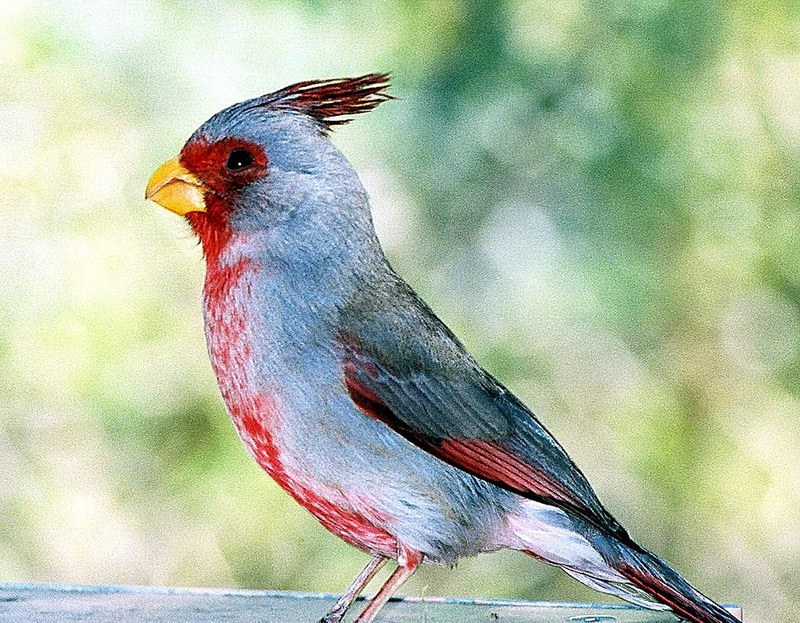
What Pyrrhuloxia's Feathers Look Like
Often called the "desert cardinal," Pyrrhuloxia shares its cousin's crest and general shape but is colored very differently:
- Body feathers (overall): predominantly ashy gray to gray-brown, quite unlike the near-total red of a male Northern Cardinal.
- Crest feathers: gray with a reddish tip or wash, especially visible on males, forming a distinctive two-tone crest feather if found intact.
- Face and throat feathers: males show a red mask around the face and a red bib down the center of the throat and breast, standing out sharply against the gray body.
- Wing and tail feathers: gray-brown with red edging on males, particularly noticeable on the primaries and the long tail feathers, giving a streaked red-on-gray look when the wing is spread.
- Female feathers: much more subdued — buffy-gray overall with only faint reddish tinges on the crest and wings, lacking the male's strong facial red mask.
- Size: similar to Northern Cardinal — primaries around 7–9 cm, tail feathers notably long (8–10 cm) and graduated.
Step-by-Step: Is This Feather From a Pyrrhuloxia?
- Check the base color first. A cardinal-shaped feather that is mostly gray rather than red immediately suggests Pyrrhuloxia over Northern Cardinal.
- Look for red confined to edges and patches. Red on Pyrrhuloxia feathers appears as a face mask, throat bib, and feather edging, not as an all-over wash the way it does on a male cardinal.
- Examine the crest feather shape. A gray feather with a reddish tip, rather than solid red, points to this species' crest.
- Check tail feather length and edging. Long, graduated gray tail feathers with red fringing fit adult male Pyrrhuloxia.
- Consider a plain grayish-buff feather. If there's little to no red at all, it likely came from a female or juvenile, which are much harder to distinguish from female cardinals by feather alone.
Similar Species & How to Tell Them Apart
- Northern Cardinal (male): Almost entirely red with only a black face mask — a world of difference from Pyrrhuloxia's gray-dominant plumage with limited red accents.
- Northern Cardinal (female): Warmer buffy-brown with reddish crest, wings, and tail edging, similar to female Pyrrhuloxia but often slightly warmer/browner rather than ashy-gray; range and habitat (desert scrub vs. more general woodland/edge) help separate them.
- Phainopepla: Male is glossy black, not gray, ruling this out quickly; female Phainopepla is gray but lacks any red tones entirely.
- Curve-billed Thrasher: Similar desert habitat but shows streaked brown plumage with no red at all and a much longer, more curved bill (not feather-relevant).
Where & When You'll Find Them
Pyrrhuloxia is a bird of arid Southwestern scrub, mesquite thickets, and desert washes, generally staying south of true Northern Cardinal's core range and favoring drier habitat, so a gray-and-red feather found in Sonoran or Chihuahuan desert scrub is a good contextual match. As a non-migratory resident, feathers can be found year-round, but the post-breeding molt in late summer is when the most feathers — including fresh red-edged wing and tail feathers — tend to turn up near desert brush and feeding areas.
Frequently asked questions
How is Pyrrhuloxia's red pattern different from a Northern Cardinal's?
Northern Cardinal males are almost entirely red with just a black mask, while Pyrrhuloxia males are mostly gray with red limited to the face, throat, crest tip, and feather edges — the amount of red is the key giveaway.
Can female Pyrrhuloxia and female Northern Cardinal feathers be told apart reliably?
It's difficult by color alone since both are buffy-brown with reddish accents; habitat and range (arid desert scrub versus broader woodland edge) are often more reliable clues than the feather itself.
Why does the crest feather have a red tip instead of being solid red?
This partial coloring reflects Pyrrhuloxia's overall pattern of restricting red pigment to feather tips and edges rather than the whole feather, distinguishing it from the fully red crest of a male cardinal.
Does Pyrrhuloxia molt on a different schedule than Northern Cardinal?
Both species follow a similar late-summer post-breeding molt pattern typical of many resident songbirds, so feather turnover timing is not a useful way to distinguish between them.