
How to Identify Red-legged Partridge Feathers
A guide to identifying Red-legged Partridge feathers by their black-bordered white throat, boldly barred black-white-chestnut flanks, and rufous outer tail feathers, distinguishing them from Chukar and Grey Partridge.
Read the full Red-legged Partridge encyclopedia entry →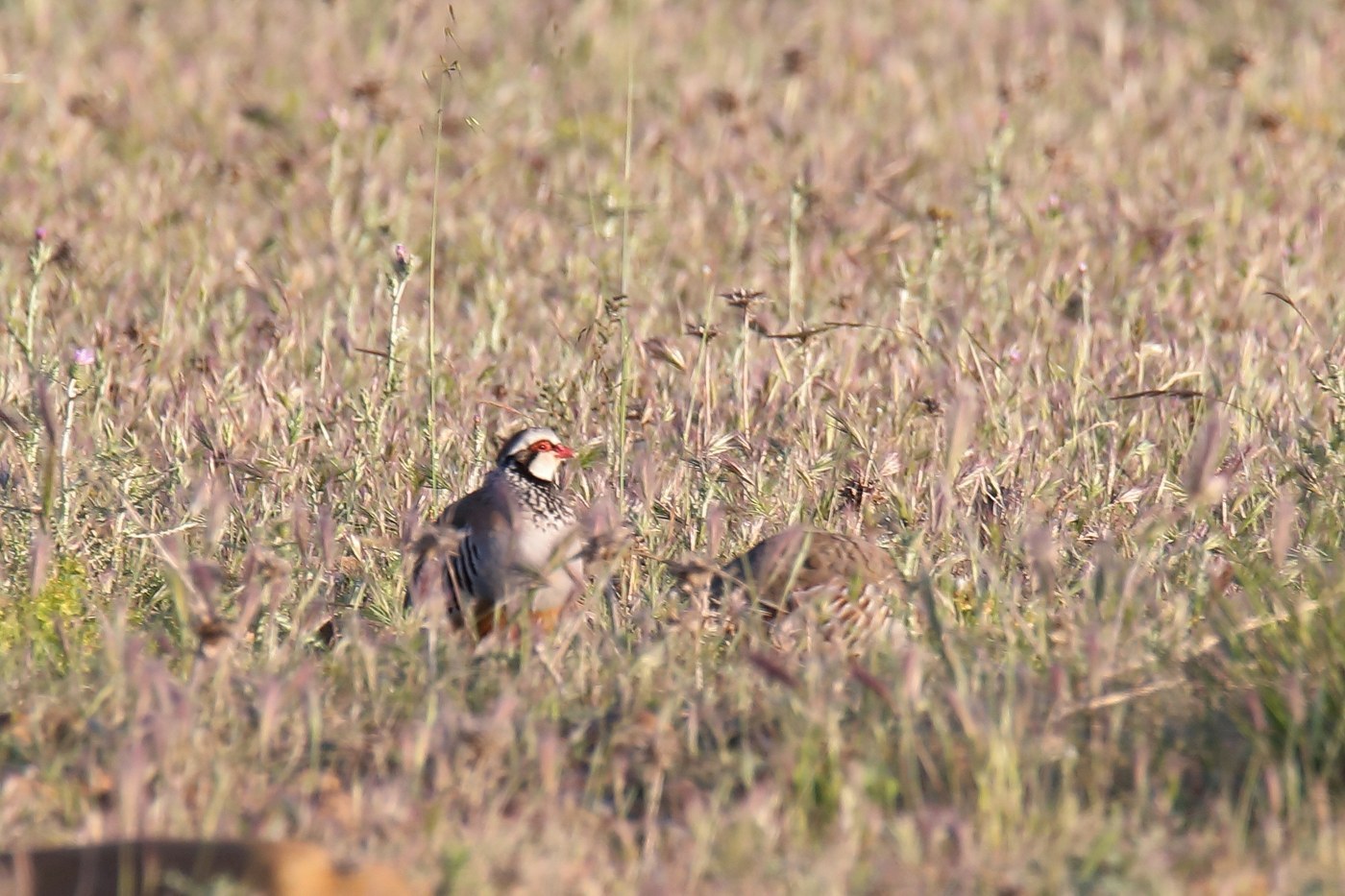
What Red-legged Partridge's Feathers Look Like
Red-legged Partridge is a distinctive game bird whose feathers combine a plain body tone with one of the boldest flank patterns of any partridge. Back and breast feathers are a soft gray-brown to bluish-gray, plain and unmarked, providing a neutral backdrop for the more elaborate facial and flank feathers. The throat is white, bordered by a black band that extends up around the face and down into a black-spotted "necklace" across the upper breast — so a white feather edged in black, or a black-spotted breast feather, both support this species.
The single most useful feathers are from the flanks: each feather shows bold transverse bars of black, white, and chestnut-orange, a striking, layered barred pattern unlike almost any other game bird in its range. The outer tail feathers are rufous-chestnut, contrasting with the grayer central tail feathers, and are often visible as a warm flash when the tail is fanned or the bird flushes. Bill and leg color, if attached, are a bright coral-red, matching the species' name.
Step-by-Step: Is This Feather From a Red-legged Partridge?
- Check flank feathers for black-white-chestnut barring. This bold, layered pattern is one of the clearest diagnostic features among partridges.
- Look for a black necklace pattern on breast feathers. Black spotting forming a band across the upper breast, bordering a white throat, supports this species.
- Examine outer tail feathers. A rufous-chestnut tone contrasting with grayer central tail feathers is characteristic.
- Assess back/breast feather tone. Plain gray-brown to bluish-gray, without pattern, is typical of the body feathers.
- Check for a coral-red bill or leg fragment. If skin is attached, bright red bare parts support this species specifically.
Similar Species & How to Tell Them Apart
- Chukar Partridge — has a similar barred flank pattern but shows a single bold black band running through the eye and down around the throat (not a spotted necklace), and slightly buffier overall tone; the two overlap in parts of introduced range, so careful comparison of the throat border style helps.
- Grey Partridge — lacks the bold black-white-chestnut flank barring entirely, showing instead a plain orange face patch and a chestnut horseshoe mark on the belly, with no facial black border.
- Rock Partridge — extremely similar in pattern to Red-legged Partridge; range is often the most reliable separator, since the two occupy largely separate parts of southern Europe with limited overlap.
Where & When You'll Find Them
Red-legged Partridges inhabit open farmland, dry scrub, vineyards, and rocky hillsides across the Iberian Peninsula, France, and introduced populations in Britain and elsewhere, favoring warm, dry, well-drained ground. Feathers are most often found near field margins, hedgerows, and dust-bathing sites, with the highest volume typically turning up during the late-summer and autumn post-breeding molt, when adults replace worn plumage, and around game-managed estates where the species is commonly released for shooting, which can add feathers outside its strictly wild range and season.
Frequently asked questions
What's the single best feather clue for Red-legged Partridge?
A flank feather showing bold transverse bars of black, white, and chestnut-orange — this layered barred pattern is one of the most distinctive features among partridges.
How do I tell this apart from Chukar Partridge?
Check the throat border pattern — Red-legged Partridge shows a black-spotted necklace across the upper breast, while Chukar Partridge has a single bold black band running through the eye and around the throat instead.
Does tail feather color help confirm this species?
Yes, the outer tail feathers are rufous-chestnut, contrasting with grayer central feathers, a useful supporting clue alongside the flank barring.
Why might I find these feathers outside the species' natural wild range?
Red-legged Partridges are commonly bred and released on game-managed estates for shooting, so feathers can turn up well beyond the bird's strictly wild native range.
When and where are these feathers most commonly found?
Near field margins, hedgerows, and dust-bathing sites in open farmland and dry scrub, especially during the late-summer to autumn post-breeding molt.