
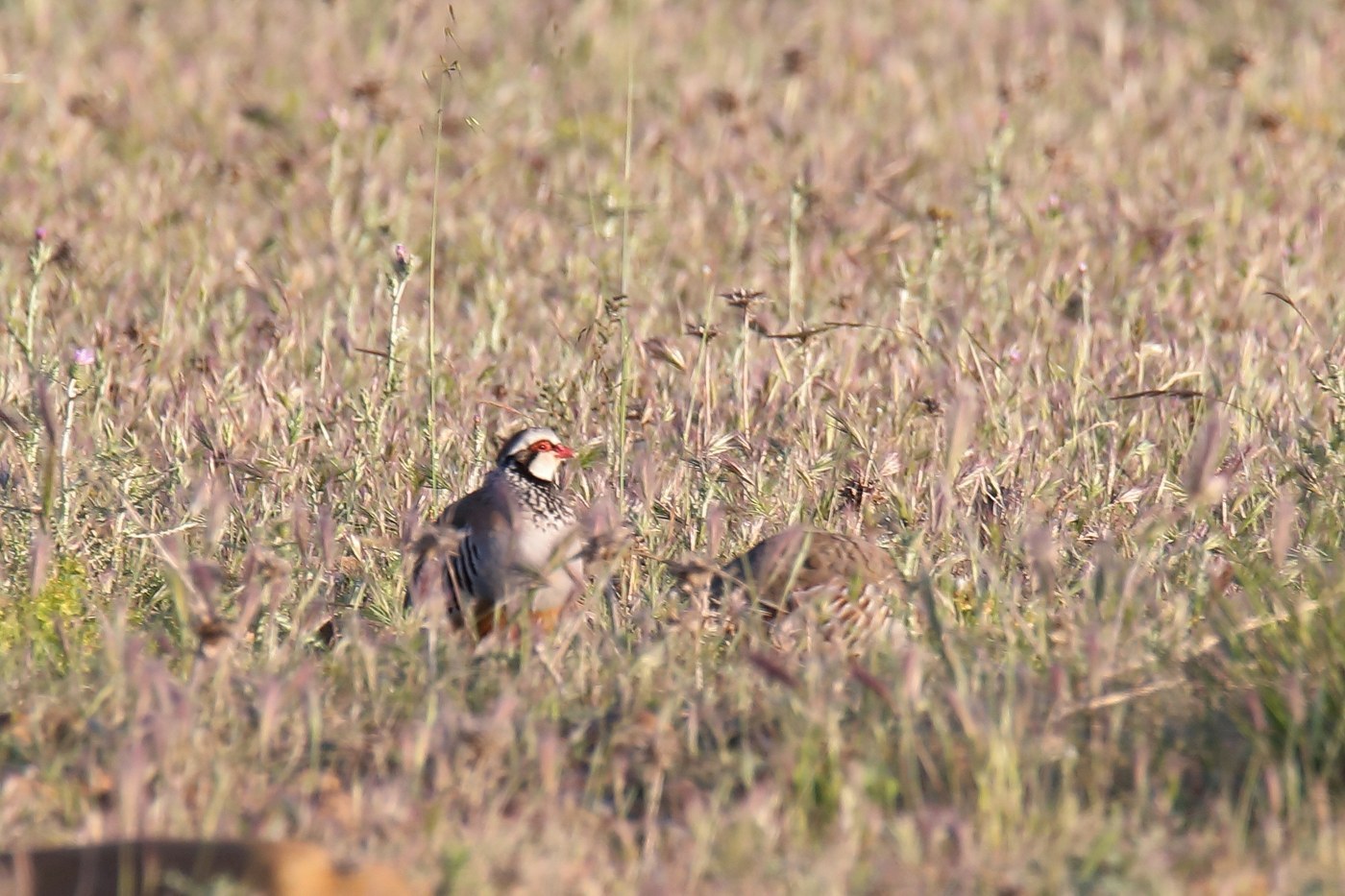
Red-legged Partridge
Alectoris rufa
A plump, ground-dwelling gamebird whose boldly barred flank feathers in black, white, and chestnut are unmistakable at close range.
- Feather type
- Flank, body, and flight feathers
- Colours
- Grey-brown back, black-and-white flank bars with chestnut bands, black-bordered face patch
- Bird size
- Medium gamebird, ~32-34 cm
Found a feather like this?
Identify any feather from a photo, free.
Overview
The Red-legged Partridge is native to southwestern Europe but has been widely introduced elsewhere, particularly Britain, for shooting purposes. It favors drier, more open ground than its native relative the Grey Partridge.
Identifying the Feather
The most distinctive Red-legged Partridge feathers come from the flanks: broad grey-buff feathers crossed with strong black and white bars edged in chestnut, forming a striking striped pattern found on few other European gamebirds. The back and body feathers are a more uniform grey-brown, and the face and throat are pale, bordered by a black line running through the eye and down around the throat like a necklace. Flight feathers are plain grey-brown, relatively short and rounded, suited to explosive rather than sustained flight.
Plumage & Molt
Sexes are similar in plumage, though males average slightly larger with more prominent leg spurs (a leg feature, not feather-related). Juveniles are duller and lack the bold flank barring, which develops with the first full molt. Adults molt fully after breeding.
Habitat & Range
This species favors dry, open farmland, stony or sandy ground, and Mediterranean-type scrub, tolerating drier conditions than the Grey Partridge. Native to southwestern Europe including Iberia and France, it has been introduced and naturalized in Britain and elsewhere, remaining resident year-round.
Behavior & Field Notes
Red-legged Partridges forage in coveys on the ground for seeds, leaves, and invertebrates, preferring to run from disturbance before flushing in a fast, low, whirring flight. Calls include a repeated, harsh "chuk-chuk-chukar" type call. Nests are shallow ground scrapes lined with vegetation, often concealed in field margins.
Frequently asked questions
What is the easiest way to identify a Red-legged Partridge feather?
Look for flank feathers with bold black, white, and chestnut barring, a pattern not shared by the plainer-flanked Grey Partridge.
Do Red-legged and Grey Partridge feathers overlap in range?
Yes, in parts of Britain and continental Europe both species can occur in similar farmland habitat, making the flank pattern especially useful for distinguishing them.
Are juvenile Red-legged Partridge feathers different from adults?
Yes, juveniles lack the bold flank barring seen in adults, developing it only after their first full molt.
What habitat is best for finding Red-legged Partridge feathers?
Dry, open farmland with stony or sandy soils, favored over the damper ground preferred by Grey Partridge.
Red-legged Partridge guides
In-depth guides for identifying and understanding Red-legged Partridge.
Other feathers you may enjoy

Ring-necked Pheasant
Body (contour), tail, and wing feathers

Bornean Peacock-pheasant
Contour and tail feathers with iridescent ocelli

Crested Argus
Extremely elongated, ocellated (eyespot-patterned) tail feathers among the longest of any bird; tall, erectile crest

Grey Partridge
Body and flank feathers

Willow Ptarmigan
Larger, stockier body feathers with warmer rufous tones in summer; tail feathers black year-round

Wild Turkey
Broad, iridescent body feathers and large flight and tail feathers

Bulwer's Pheasant
Contour feathers and elongated white tail feathers

White-tailed Ptarmigan
Small body feathers with a tail that stays pure white year-round, unlike other ptarmigan

Edwards's Pheasant
Contour and tail feathers

Sooty Grouse
Dense, plain contour feathers with a pale-tipped, fanned tail

Snow Partridge
Finely vermiculated barred contour feathers

Silver Pheasant
Finely vermiculated white upperpart feathers over glossy blue-black underparts