
How to Identify Rock Wren Feathers
How to recognize the finely speckled, buff-tailed feathers of the Rock Wren, a small songbird of dry rocky terrain in western North America.
Read the full Rock Wren encyclopedia entry →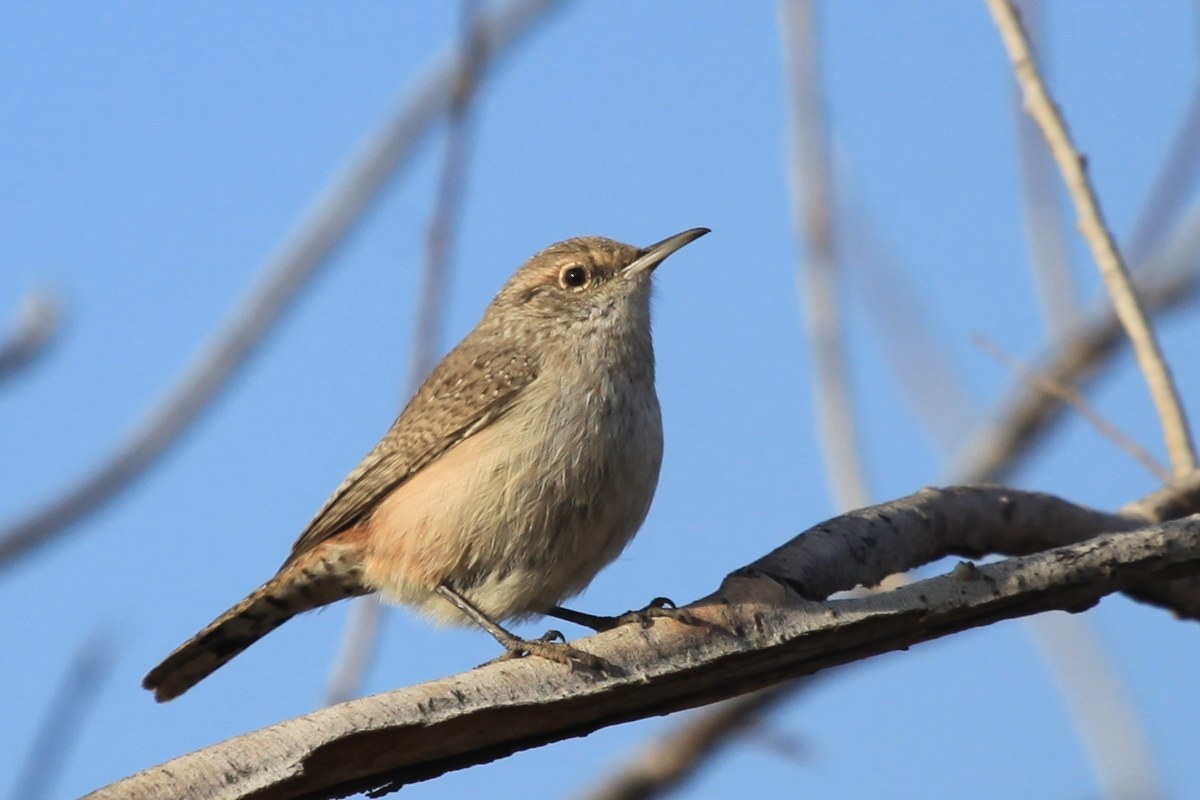
What Rock Wren Feathers Look Like
The Rock Wren (Salpinctes obsoletus) is a small, ground-loving songbird of arid, rocky terrain across the western U.S. and into Mexico, and its feathers show a subtle, finely detailed pattern suited to blending into stone and scree.
- Body feathers: pale grey-brown overall with fine dark speckling or vermiculation across the back and crown, giving a subtly "dusty" or finely peppered look rather than bold streaking.
- Underparts: paler buffy-white on the throat and breast, warming to a light cinnamon-buff wash on the belly and flanks.
- Tail feathers: a genuinely useful diagnostic feature — the outer tail feathers show a black subterminal band followed by a distinct pale cinnamon-buff tip, visible as a warm-toned band near the end of the tail when fanned.
- Wing feathers: brown with fine buff edging, unremarkable in isolation but consistent with the overall finely patterned look of the species.
- Bill note: not a feather trait, but a long, thin, slightly downcurved bill is characteristic if found with the feathers.
- Size: small songbird scale, similar to other wrens, with flight feathers typically under 6 cm — a compact, unassuming feather set overall.
Step-by-Step: Is This Feather From a Rock Wren?
- Check the tail feather tip. A black band followed by a pale cinnamon-buff tip on an outer tail feather is one of the most useful and specific clues for this species.
- Look for fine speckling rather than bold streaks. A subtly peppered, dusty grey-brown back feather (rather than sharply streaked) fits this species' understated camouflage pattern.
- Assess underparts tone. A warm buffy-cinnamon wash on the belly, paler on the throat, supports Rock Wren over plainer or greyer wren relatives.
- Consider size. A small, compact feather set consistent with other wrens narrows the search within the songbird family generally.
- Factor in habitat. Found on dry rocky slopes, canyon walls, talus fields, or arid scrubland in the western U.S. or Mexico, a finely speckled small feather with a buff-tipped tail strongly supports Rock Wren, a habitat specialist rarely found away from rocky terrain.
Similar Species & How to Tell Them Apart
- Canyon Wren: shares similar rocky habitat but shows a much richer rust-red body color and a bright white throat/breast patch, a clearly different overall tone from the Rock Wren's dusty grey-brown.
- Bewick's Wren: browner overall with a bold white eyebrow stripe and longer tail, found in brushier habitat rather than bare rock.
- House Wren: smaller, plainer brown overall without the fine speckling or the distinctive buff-tipped tail band, and typically found in more vegetated habitat.
- Rifleman (New Zealand, no range overlap): superficially similar in general small-bird scale but geographically impossible to confuse given no range overlap with the North American Rock Wren.
Where & When You'll Find Them
Rock Wrens inhabit dry, rocky terrain including canyons, talus slopes, arid hillsides, and even human-made rock piles across the western United States, parts of Canada, and south through Mexico into Central America, generally avoiding vegetated or forested habitat. Feathers are most likely found tucked among rock crevices and scree used for nesting and foraging, with molt following the breeding season in mid-to-late summer, and feather turnover generally concentrated wherever suitable rocky habitat exists year-round in the milder parts of the range, or seasonally in higher, colder areas the birds vacate for winter.
Frequently asked questions
What's the single most useful feather feature for this species?
The black band followed by a pale cinnamon-buff tip on the outer tail feathers is the most specific and reliable clue, since that exact tail pattern isn't shared by most similar-habitat songbirds.
How do I tell this apart from Canyon Wren?
Canyon Wren is noticeably more rust-red overall with a bright white throat patch, while Rock Wren is a duller, finely speckled grey-brown throughout, making overall color tone the quickest distinguishing feature.
Would I find this feather in a forest?
It's very unlikely — Rock Wrens are strongly tied to bare, dry rocky terrain like canyons and talus slopes, rarely venturing into forested or heavily vegetated habitat.
Are juvenile feathers noticeably different?
Juveniles look similar but slightly duller and less crisply marked than adults, so a washed-out version of the speckled pattern and buff tail tip can still indicate a young Rock Wren.